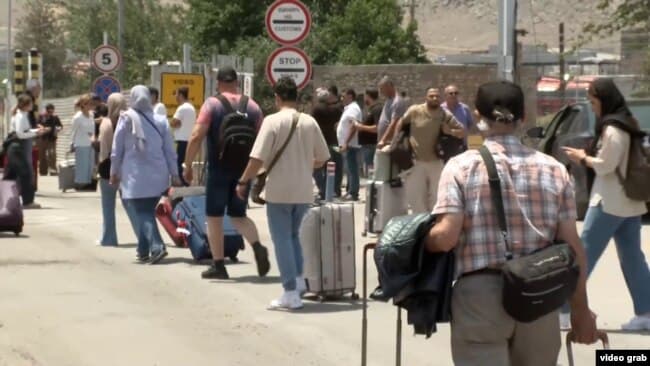
Tehran (AsiaNews) – War and an economic crisis linked to the conflict with the United States and Israel are driving a growing number of citizens of the Islamic Republic to cross the border into Armenia in search of work in the construction and transport sectors, as taxi drivers and home delivery staff. The neighbouring country is thus transforming from a long-favoured holiday destination for Iranians into an ideal destination for families seeking new sources of income and struggling to make ends meet. For some, reports Iran International (a London-based website close to the opposition), Yerevan is no longer a place to relax but a means of earning the money needed to cover daily expenses and send the remainder to their families back home.
From tourists to workers
For years, Armenia was very different destination for many visitors from the Islamic Republic. Travel agencies sold packages for the water festival, the wine festival and the numerous concerts. Images from Yerevan mainly depicted Iranians who had crossed the border to spend a few days enjoying music, celebrations and leisure.
These trips continue to this day, but as economic difficulties have worsened, the streets of the capital paint a different picture of the Iranian presence there.
Near Republic Square, in the centre of the capital, tourists stroll amongst the fountains and characteristic stone buildings. Amongst them, men of various ages from the Islamic Republic sit on benches chatting in Persian. Listening to their conversations, one realises that the topic is not where to eat or what to visit, but rather the search for a job: wages, employers, rents and who is taking on staff.
The reasons driving Iranians to cross the border are extremely varied. War and security concerns have led some to leave Iran – at least temporarily – but others are simply driven by the need to earn a living. High inflation, a decline in purchasing power, the devaluation of the rial and growing difficulty in meeting daily expenses have upended workers’ calculations.
Even occasional work in a neighbouring country can prove financially advantageous if the income is received in Armenian drams and converted into foreign currency before sending part of it back to Iran. For these workers, a modest wage by Armenian standards can go much further once they return home.
Reza, an Iranian man in his thirties, arrived in Armenia from Karaj two months ago. Some friends, who had already visited the country, had suggested he move to Yerevan for work. Although fears linked to the war influenced his decision to leave his homeland, it was economic pressure that became the main driving force behind his decision to stay.
“The economic situation was so dire,” he explains, “that I couldn’t even cover my own expenses, let alone help my father, who is retired. Now I work in construction here [in Yerevan]. At least I can convert my wages into foreign currency and send money to my family,” even though he works without a formal contract.
Low-skilled jobs
Job opportunities often lie in sectors that do not require fluency in Armenian or high qualifications, and Iranians are among the nationalities that submitted the highest number of applications for work-related residence permits in the first half of 2026. The construction industry represents one of the main opportunities, with tasks ranging from laying steel reinforcement and building blocks to electrical installations.
Others work as taxi drivers via ride-hailing platforms. Some work as couriers, delivering food and other goods by bicycle, electric scooter or even on foot. Still others have found employment at online casinos or in the entertainment and nightlife sector.
Armenia’s expanding construction sector has helped to generate demand for labour, as shown by official figures indicating that construction activity grew by 24.5 per cent in the first six months of 2026 compared with the same period the previous year.
However, the appeal of these jobs for Iranian workers lies not simply in the higher wages offered in Armenia, but also in the differing value of salaries and their purchasing power in the two countries. Due to the collapse of the Iranian rial, earnings that might seem modest in Yerevan take on a different value once converted and sent home.
Official statistics provide only a partial picture of the Iranian presence in Armenia, as not everyone who crosses the border and finds work is included in the figures relating to work permits. The number of Iranian tourists visiting Armenia rose from 176,453 in 2024 to 182,364 in 2025, an increase of around 3.3 per cent. In 2025, Iranians accounted for around 8.1 per cent of all foreign tourists in the country, making them the third-largest group after Russians and Georgians.
The Yerevan–Tehran Axis
However, being registered as a tourist does not necessarily mean that the visitor spends their entire stay engaged in tourism or on holiday. High living costs, a lack of knowledge of the Armenian language and banking restrictions are among the main challenges faced by Iranians newly arrived in Yerevan.
In the first half of 2026, a total of 8,181 foreign nationals were granted temporary residence in Armenia, according to figures from the Armenian Ministry of the Interior, with India and Russia remaining the largest groups. Of these temporary residence permits, 6,085 were issued for work-related reasons.
Against a backdrop of growing relations between the two neighbours, last week Iranian President Masoud Pezeshkian met with Armenian Prime Minister Nikol Pashinyan during a joint trip to Turkmenistan for the Commonwealth of Independent States (CIS) summit on the Caspian Sea.
The talks focused on bilateral relations, strengthening cooperation between Yerevan and Tehran, and support for investments and initiatives by companies from the Islamic Republic in Armenia. Furthermore, on 8 October, Armenian Foreign Minister Ararat Mirzoyan held a telephone conversation with his Iranian counterpart Abbas Araghchi to discuss (among other things) the latest regional developments. Finally, the two countries signed a memorandum of understanding (MoU) with the aim of expanding cooperation in the fields of sport and youth affairs.