Milan (AsiaNews) – As reported yesterday by AsiaNews, Chow Hang-tung and Lee Cheuk-yan have been found guilty of incitement to subversion. Albert Ho Chun-yan had pleaded guilty last February. They are three leading figures of the democratic opposition in Hong Kong. Their conviction, unfortunately, comes as no surprise, but it is no less painful and no less unacceptable.
It is, however, a scandalous verdict. It is indeed scandalous that what was, until six years ago, one of the freest, most pluralistic and vibrant cities in Asia – albeit not governed by a fully democratic system – is today a city where people are sentenced for their political activism, despite never having committed a single act of violence; indeed, they have explicitly drawn inspiration from the prophets of non-violence and freedom.
We are now awaiting news of the sentence they will receive, which could be up to ten years’ imprisonment: following the conviction, their access to visits and other privileges will be curtailed. These years will be even harsher than those already spent in prison.
The length of the sentence will therefore be crucial: will the judges continue down the path of relentless severity, or will they choose to send a message of leniency to the public? The decision will be handed down in a few weeks’ time. In the meantime, a hearing has already been scheduled at which ‘letters of mitigation’ in favour of the convicted men, written by representatives of civil society, may be submitted to the judges.
A legal monstrosity
The reasoning behind the guilty verdict is disturbing: calling for an end to the Communist Party’s rule. Reference is made to a constitutional amendment introduced in 2018 which declares the Communist Party’s essential role in the governance of the state. In other words, the Communist Party and the state are completely equated.
The convicted leaders had expressed their free opinions on the Chinese political system well before 2018. We are therefore faced with a situation of retroactive application of the law, something universally regarded as a legal monstrosity.
The reasoning further states that Western-style democracy should not be applied in China. As if democracy were (exclusively) a Western concept and were not also practised – successfully – in major Asian countries.
The imprisoned leaders are well-known figures in Hong Kong, key players in political, parliamentary and trade union life over the past few decades. They have always stood out for their generous activism and idealism, and have never been involved in any negative incidents.
Even the ruling’s reasoning acknowledges this: Chow, Lee and Ho have always acted peacefully and had no strategic plan to subvert the government. They have been convicted for their opinions, for holding political views that dissent from the regime.
They have been targeted for their role as leaders of the Hong Kong Alliance in Support of Patriotic Democratic Movements in China (known in Hong Kong simply as ‘the Alliance’).
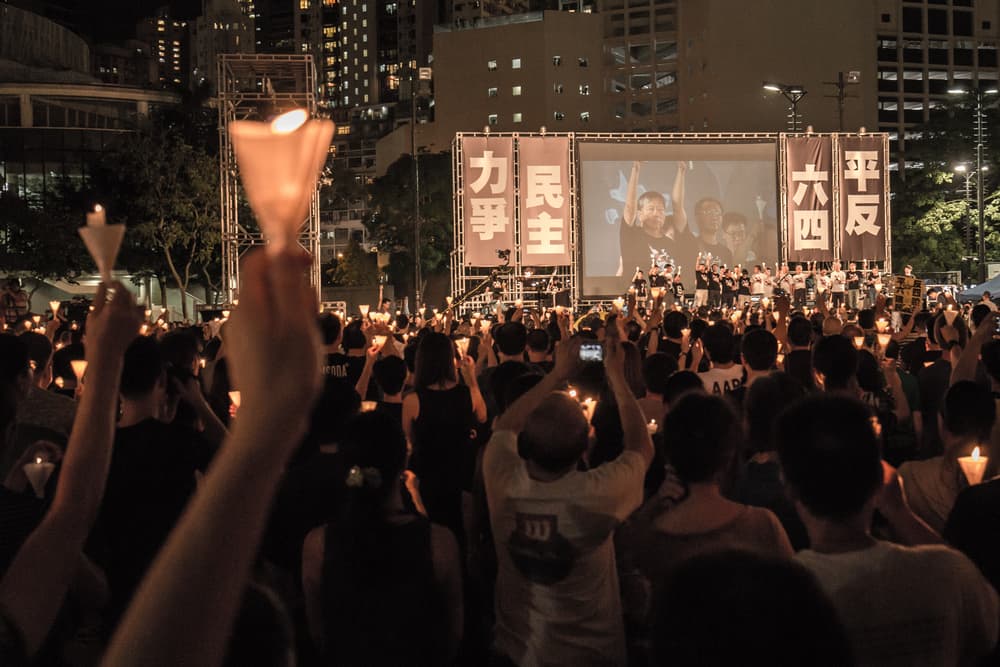
From 1990 to 2019, the Alliance legitimately commemorated, every year through massive vigils in Victoria Park, the killing of hundreds (perhaps thousands) of students and citizens in Beijing on 4 June 1989, universally known as the Tiananmen Square massacre.
Here, too, we see what appears to us to be a retroactive application of the law: until 2020, these vigils were perfectly legal. Since they were declared illegal in 2020, they have not been held.
The three judges who sentenced them were not chosen at random, as is the case with other offences. They form part of a special list of magistrates specifically selected by the Chief Executive (that is, Hong Kong’s ‘governor’, who is in fact appointed by Beijing) and tasked with adjudicating breaches of the National Security Law (which came into force on 1 July 2020).
In other words, they are politically appointed judges, in breach of the judiciary’s independence from politics, which was a cornerstone of Hong Kong’s judicial system.
All three activists had been pressured to plead guilty. This is a strategy employed by the political and judicial authorities to undermine the moral and ideological standing of democratic leaders in the eyes of the public: by pleading guilty, they acknowledge the legitimacy of the charges and admit to having committed offences.
Pleading guilty has its advantages: it paves the way for possible sentence reductions. Chow Hang-tung and Lee Cheuk-yan, however, refused to go along with this defence strategy, thereby asserting, in the eyes of the public, that they had done nothing illegal: it was the National Security Law that speciously introduced new, entirely political offences.
The situation is different for Alberto Ho: his precarious state of health meant that his family urged him to ‘plead guilty’, in the hope of a reduced sentence. In 2022, Ho had been released on bail precisely for health reasons, only to be returned to prison in 2023.
There are not many people, in Italy or around the world, who follow the political and judicial developments in Hong Kong with any real interest. There is also a widespread tendency, both in Hong Kong and internationally, to regard the cause of democracy and freedom as lost, and to leave the imprisoned leaders to their fate.
Most of the media did not report the news of the sentencing, and so many people no longer remember them. Others even find ways to highlight their (possible) mistakes and their political naivety – namely, believing that change was possible.
Hong Kong, it is often said, has turned a new page. The city’s economic future is secured by China’s massive presence, which is bringing new immigrants into the territory to offset the demographic losses caused by the self-imposed exile to Britain of some 300,000 residents.
Hordes of visitors from China are flocking to the city, sustaining the tourism industry which had suffered a downturn due to political instability and the Covid-19 pandemic.
We fail to understand how the price to be paid for Hong Kong’s integration with China – something no one disputes – can be the imprisonment of democratic leaders, the abolition of freedom, the eradication of a particularly vibrant and brilliant civil society, and the suppression of pluralism of ideas, parties and associations in the pursuit of the common good.
Many AsiaNews readers are familiar with the leaders who have now been found guilty. Our agency has never ceased to report on developments in their case and to keep the spotlight on them. We will not forget them.
Three prisoners of conscience
Finally, a few words on the three prisoners of conscience. The human rights and labour lawyer Chow Hang-tung (aged 41), in her self-defence during the trial and in a noble document written from prison in 2023, describes how the rhetoric of power manages to alter even the ordinary meaning of things and words. “Society and the law should encourage precisely what the court was called upon to prohibit and punish.”
In 2023, she wrote that even the word ‘peace’ takes on a sinister meaning in the regime’s rhetoric: “Peace consists in ensuring submission to the Party’s order by any means necessary, not in the rejection of war or hatred.”
Since 2024, a moving documentary film entitled She’s in Jail has been available in private circles, telling the story of the young lawyer: it portrays a highly motivated woman willing to pay the personal price for her loyalty to her ideals.
Over the past decade, the leader of the Hong Kong Alliance has been the trade unionist and Member of the Legislative Council Lee Cheuk-yan (69), the undisputed figurehead of the Victoria Park vigils.
He had been detained in Beijing in 1989, where he had travelled to convey the solidarity of the people of Hong Kong to the students at Tiananmen. On his return to Hong Kong, Lee dedicated his life to freedom, democracy and social justice.
A man of deep faith, he was brought up in the Anglican Church, and whilst in prison he was confirmed, thereby completing his conversion to Catholicism, the faith shared by his wife and daughter.
Lawyer Albert Ho (who turns 75 in December), former leader of the Democratic Party, is also a well-known figure within the Alliance. Having been an anti-colonial activist in his youth, he refused British citizenship, which had been offered to him as a means of escape from imminent arrest. Whilst in prison, he embraced the Catholic faith, thanks in part to the support of Cardinal Joseph Zen.