

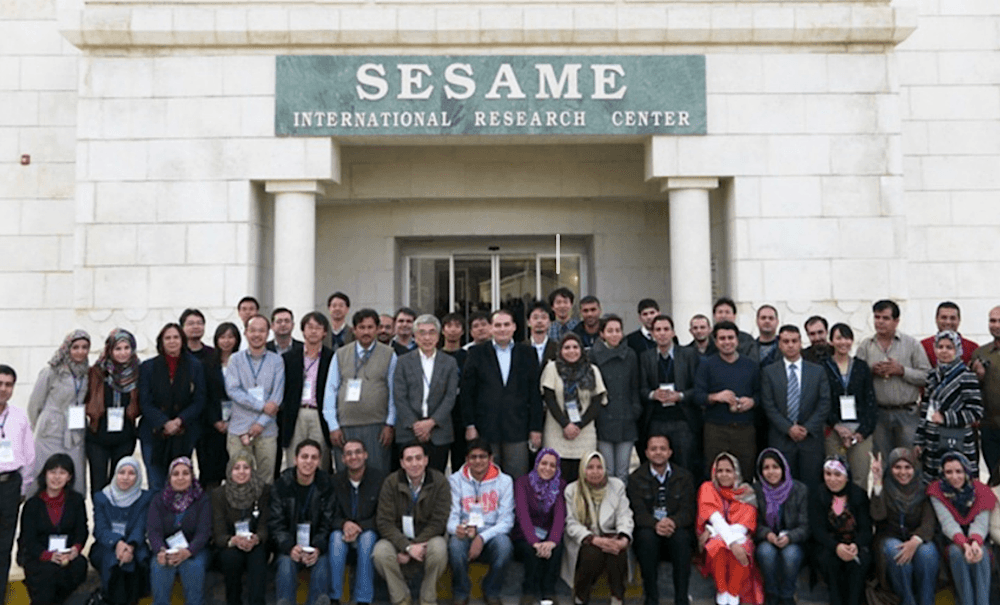
Milan (AsiaNews) –“Open Sesame.” The legendary phrase from the story of Ali Baba unlocks a secret cave filled with treasure. In Jordan, now back in the international spotlight amid escalating regional tensions and the recent Iranian attack on a U.S. base, the phrase has taken on a new meaning. It is the name of a scientific laboratory whose greatest treasure is not material wealth, but the pursuit of knowledge.
SESAME, an acronym for Synchrotron-light for Experimental Science and Applications in the Middle East, is the most important international centre for scientific research in the Middle East. It is located in Allan, in the Al-Balqa Governorate, within the municipality of Al-Salt, some 30 kilometres north-west of Amman.
Here, since 16 May 2017 (the inauguration took place in the presence of King Abdullah II), the region’s first synchrotron has been in operation: a huge machine that accelerates electrons and produces very intense light, used by scientists to study matter in its most profound aspects.
SESAME, in essence, is a sort of enormous microscope. Its light enables us to understand what matter is made of and how it is organised. Its applications range from chemistry to physics, from medicine to materials science, from energy to archaeology and the conservation of cultural heritage.
However, it is not merely a scientific project. From the very beginning, its history has been linked to a far more ambitious endeavour: to demonstrate that science can create opportunities for dialogue and peace even when politics fails to do so.
To grasp its significance, one need only look at the organisation’s membership. Member countries include Cyprus, Egypt, Iran, Israel, Jordan, Pakistan, Palestine and Turkey.
There is probably no other institution in the Middle East where representatives from countries that have strained diplomatic relations, or have been involved in conflicts, meet regularly to discuss research, investment and the future of the facility.
Despite the war ravaging the Middle East, SESAME has continued to operate. Researchers from Israel, Iran, Palestine, Turkey, Jordan and other member countries have continued to carry out experiments.
The project was conceived on the model of CERN in Geneva, the European research laboratory established in the aftermath of the Second World War. The idea was that large-scale international research could also become a forum for dialogue in the Middle East.
SESAME was launched in the late 1990s under the auspices of UNESCO. Jordan was chosen in 2000: the Allan site, near Al-Salt, was preferred to other candidates.
The Allan synchrotron has a history that is itself emblematic. In the wake of reunification, Germany donated part of the Bessy I synchrotron, which had been located in East Berlin, to the SESAME project.
Thus. a machine from a city that had been split in two by the Wall and the Cold War has helped to build a laboratory designed to bring together deeply divided countries. The prestigious scientific journal Nature, in recounting the project’s history, highlighted precisely this symbolic value.
The journey was not an easy one. It took SESAME almost twenty years to reach the point of opening. There were financial problems, technical difficulties and even the collapse of the building’s roof in 2013, caused by an exceptional snowfall (though not uncommon in the hills around Amman).
In January 2017, at long last, the first electron beam travelled through the storage ring.
In May of the same year, the laboratory was officially inaugurated. SESAME has been operational ever since. Its main ring, 133 metres long, accelerates the electrons to an energy of 2.5 billion electronvolts.
The light produced is directed towards various experimental stations, known as beamlines, where researchers can study the samples they have brought with them.
An archaeological artefact can therefore be analysed to determine which materials were used to make it. A new chemical compound can be studied to verify its properties.
A material intended for use in a battery can be examined to understand how to improve its performance. The same techniques can be used for research in the fields of energy, the environment and the life sciences.
Italy is directly involved in the project. Italian researchers have been collaborating with the laboratory for years, in particular through the INFN and Elettra Sincrotrone Trieste. Italy has contributed to the development of certain facilities and major research programmes.
Among these is BEATS, the beamline dedicated to X-ray radiography and tomography, developed in collaboration with a network of major European laboratories.
The relationship between Italy and SESAME has recently taken a further step forward. On 19 and 20 May, during the organisation’s Council meeting in Grenoble, the Italian government’s application to join the organisation as an associate member was approved. Italy, which until then had held observer status, thus became the second associate member after Germany.
This development comes at a particularly delicate time. SESAME is, in fact, situated in one of the most geopolitically unstable regions on the planet. The wars and crises of recent years have directly affected several of its member countries. Yet the laboratory has continued to operate.
This is precisely one of the aspects that has caught the attention of the international scientific community. Nature has also described SESAME as an example of science diplomacy: science as a tool for international relations.
Of course, an experiment does not end a war, and a scientific publication is no substitute for a political agreement. But it can achieve something simple yet fundamental: keeping a channel of communication open.
Scientists come to Allan with different questions; they belong to different universities and often come from countries at odds with one another. But when faced with the synchrotron, they must collaborate and use the same language: that of data, experiments and verification.
One final feature makes SESAME unique. The machine is powered almost entirely by solar energy. A large photovoltaic plant, built with European support, has made it possible to drastically reduce the cost of the electricity required to operate the synchrotron. This choice, driven in part by economic necessity, has become a key element in the laboratory’s sustainability.
The financial issue, however, remains one of the main challenges for the future. A facility of this kind requires highly specialised staff, ongoing maintenance and new instruments.
This is why SESAME is also looking beyond its eight members. The aim is to broaden the scientific community using the laboratory and transform it into a centre of excellence not only for the Middle East, but also for other regions that currently have few major scientific infrastructures.
Almost ten years after its inauguration, therefore, SESAME is no longer just a promise. It is a dream that continues to be a reality. In a region where many doors are still closed – not to say barred – the one thrown wide open by SESAME appears as a sign of hope for a better future.







.webp&w=3840&q=75)







