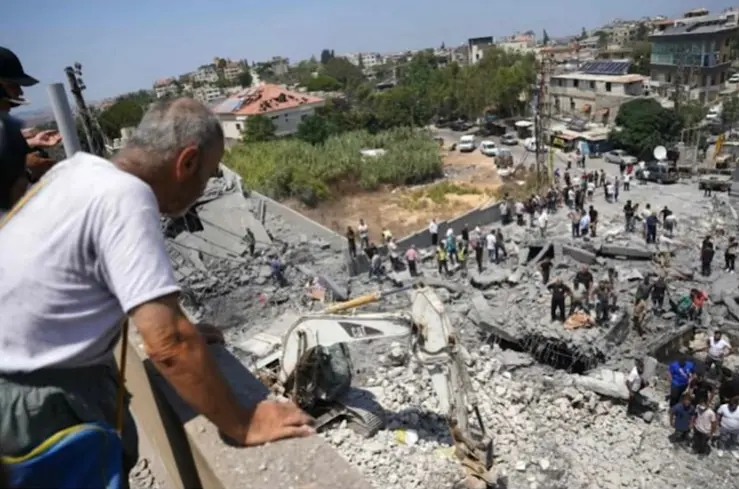
Beirut (AsiaNews) – Lebanon today marked the 6th anniversary of the catastrophic explosion in the port of Beirut of thousands of tonnes of ammonium nitrate, a fertiliser that can become highly unstable, stored unsafely since 2013 in warehouse N. 12.
Two marches and a rally at the site of the explosion are planned for the evening to coincide with the time the blast occurred (6:07 pm local time). The latter devastated a large section of the city, including the port's grain silos, killing more than 235 people, mostly Lebanese, wounding more than 6,000, with 77,000 apartments destroyed.
Six years later, the truth about one of the largest non-nuclear explosions in modern history continues to be suppressed, a tragedy produced primarily by a code of silence, a cover-up within the government of the time. Some elected and non-elected officials were aware of irregularities at the port, but kept silent because of complicity, negligence, or cowardice.
The words of the then-President, Michel Aoun, still resonate with the grieving residents of Beirut: "It was too late." The president admitted to having been alerted to the presence of the bags of ammonium nitrate several days before the tragedy, but did not consider it within his power to act.
The admissions by former Prime Minister Hassan Diab were no less disconcerting. He claimed to have been dissuaded from carrying out an inspection visit to the warehouse where the nitrate was stored, but did not name the person who made him give up on the idea…
Joseph Aoun demands indictment
On the eve of this painful anniversary, President Joseph Aoun called on the judiciary to "prove its independence and its capacity to deliver justice to the victims" by making public the indictment, a step he deems "a necessity that can no longer tolerate any further delay."
Six years after the disaster, the situation has begun to move forward and entered its final phase, thanks to President Joseph Aoun's arrival at the helm of the state in January 2025 and the evolution of the political context.
In late March, after completing his investigation, Judge Tarek Bitar submitted his findings to the Prosecutor General's Office at the Court of Cassation, so that the public prosecutor could lay out the indictment, a required step before the indictment is made public.
However, according to the families of the victims of the disaster, Judge Mohammad Saab, appointed by Attorney General Ramy Hage to review the voluminous case file, is taking too long to complete his task.
Conversely, legal sources cited in the press note that Mr Saab "is working day and night”, and could finish his work "in two to three months," according to Justice Minister Adel Nassar.
The father of one of the explosion's victims, Dr Nazih el-Adem, who lost his daughter Kristel in the blast, remains sceptical, though, “until proven otherwise”.
“The judiciary and the army are infiltrated," he said. "There is nothing left to hope for from that quarter. To the crime of silence (about the presence of ammonium nitrate at the port of Beirut) is added the actual crime of the explosion, as well as a third crime: impunity."
For Cécile Roukoz, who lost her brother Joseph, an employee of the CMA-CGM shipping company, in the explosion, “giving up is unthinkable.” “We have erased the word ‘hope’ from our vocabulary,” she stressed. “We are determined to act to obtain justice.”
This proactive stance is tempered by a young Beirut lawyer. “The case is politicised,” he noted, speaking on condition of anonymity. “I don’t think we can separate justice and politics in the current situation. A fair verdict would inevitably be a resounding defeat for one political camp. Someone will do everything they can to avoid that.”
It should be noted that the Beirut Bar Association has formed a group to oversee the legal proceedings related to this tragedy, particularly with the insurance companies, which are awaiting the verdict before compensating the victims.
The number two in the Amal movement implicated
Ali Hassan Khalil, number two in the Amal movement after Parliamentary Speaker Nabih Berri, was reportedly summoned by investigating judge Tarek Bitar, on suspicion of negligence and potential responsibility in the case, but refused to appear.
An arrest warrant in absentia has been issued against him, which the judicial police disregarded.
According to researcher Ramzi Kais (Human Rights Watch), former ministers Ali Hassan Khalil, Ghazi Zeaiter, and Youssef Fenianos, as well as former army Commander-in-Chief Jean Kahwaji, had been informed of the presence of the ammonium nitrate stockpile in a warehouse lacking ventilation.
The researcher stated that these officials did not take the necessary steps to secure the stockpile. “They anticipated the possibility of death and accepted that risk,” he summarised.
Tarek Bitar pursued his investigation despite the numerous obstacles that marked his work, such as legal complaints (abusive appeals and invocations of immunity) that long hampered his investigation, opposition by politicians adept at delaying tactics, and long confronted by a public prosecutor's office that, according to many observers, behaved as an adversary rather than a partner in the justice system.
The judge was also the target of intimidation, notably in September 2021, when a Hezbollah operative, Wafic Safa, threatened him directly at the Beirut Courthouse.
After more than five years of proceedings, he finally succeeded in concluding his investigation. He now hopes, through an indictment that he intends to be rigorous and substantiated, to pave the way for a trial.
This trial will be conducted by the Court of Justice, presided over by the First President of the Court of Cassation and President of the High Judicial Council, Souheil Abboud.
Regarding the identity of the actual recipient of the nitrate, Bashar al-Assad's Syria is singled out, as is Hezbollah, acting as an intermediary. The ousted dictator is accused of circumventing US sanctions imposed on his country and importing the nitrate to fill barrels which he then used to drop from planes on opposition populations.
Unanswered questions
Several unanswered questions remain in this case, which the indictment should clarify. For example, several violent deaths, never solved, are linked to it.
Joseph Skaff, a customs officer, was the first to report the presence of ammonium nitrate in the port in 2014. He died in 2017 under suspicious circumstances. His colleague Mounir Abou Rjeily was assassinated in late 2020, as was Joe Bejjani, an amateur photographer who reportedly took pictures of the storage site.
The latest case is that of analyst and historian Lokman Slim, an opponent of Hezbollah, who had dared to publicly implicate the Syrian regime and its ally Hezbollah in the explosion on an Arab television channel.
Other unanswered questions concern, in particular, the convoluted process and subterfuges that allowed a shipment of ammonium nitrate produced in Georgia, intended primarily for a mining explosives factory in Mozambique, to end up in Lebanon.
The ignition of the nitrate stockpile – triggered, according to some, by welding work that set off a stockpile of fireworks illegally stored nearby – also raises concerns. Accidental explosion is the accepted theory.
The possibility of an Israeli strike, which has been the subject of much speculation, has been definitively ruled out by an expert analysis conducted by France’s National Forensic Police, who collected and examined samples from the crater created by the explosion, confirming the absence of traces of military components or explosive residues linked to a missile.
Hezbollah weapons stockpile discovered in Beirut
A few days ago, the public instinctively linked the port explosion to the recent, fortuitous discovery in Beirut by the Lebanese army, between Wednesday night and Thursday morning, of a large weapons cache belonging to Hezbollah.
This incident comes as Lebanon faces increasing pressure from Israel and the United States to accelerate the disarmament of the Iranian-backed group, within the framework of ongoing direct negotiations between Beirut and Tel Aviv, with a new round of talks scheduled for 4-6 August in Rome.
This chance discovery at the home of a tyre repairman also comes three months after the cabinet’s decision to "extend state control" in the capital to "ensure a monopoly on weapons” in response to the Israeli massacre of 8 April.
According to a judicial source quoted by L’Orient-Le Jour, the weapons and ammunition were intended for "street battles” rather than an arsenal for a large-scale operation. Hezbollah flags were also seized, along with a map of the Ras el-Nabeh neighbourhood and walkie-talkies.
“Hezbollah’s caches are everywhere,” said the cashier at a delicatessen in Beirut. “They’ve been stockpiling weapons for years. Nobody dared ask them any questions.”
“Tarpaulin-covered semi-trailer lorries passed before our eyes, without anyone daring to ask what they were carrying. This country is riddled with hiding places, and we're not about to get rid of them anytime soon," she added in an exasperated tone that reflects the mindset of a large part of the population, still uncertain that Hezbollah's hegemony over the state is truly over.