Milan (AsiaNews) – There are journalists of whom nothing has simply been heard since. Others have been found in mass graves or identified through photographs of bodies released from Syrian prison archives. Still others have died under the bombs whilst documenting attacks on cities. For many, however, there is not even any certainty as to their fate. The fall of Bashar al-Assad’s regime on 8 December 2024 did not bring this chapter to a close. It opened a new chapter of questions, particularly for the families of those who were arrested, tortured and made to disappear.
On 2 November, the International Day to End Impunity for Crimes Against Journalists (established by the United Nations in 2013), the Syrian news agency SANA republished a report by the Syrian Network for Human Rights (SNHR), the independent organisation that has been documenting human rights violations in the country for years. The figures are staggering: 559 journalists and media workers killed by regime forces between March 2011 and 8 December 2024. Of these, 48 died under torture in detention centres. At least 1,612 were injured. The same organisation has recorded 1,358 cases of the arrest or abduction of media workers. And 392 people, who fell into the hands of Assad’s security apparatus, are still missing. Among them are eight women and four foreign journalists.
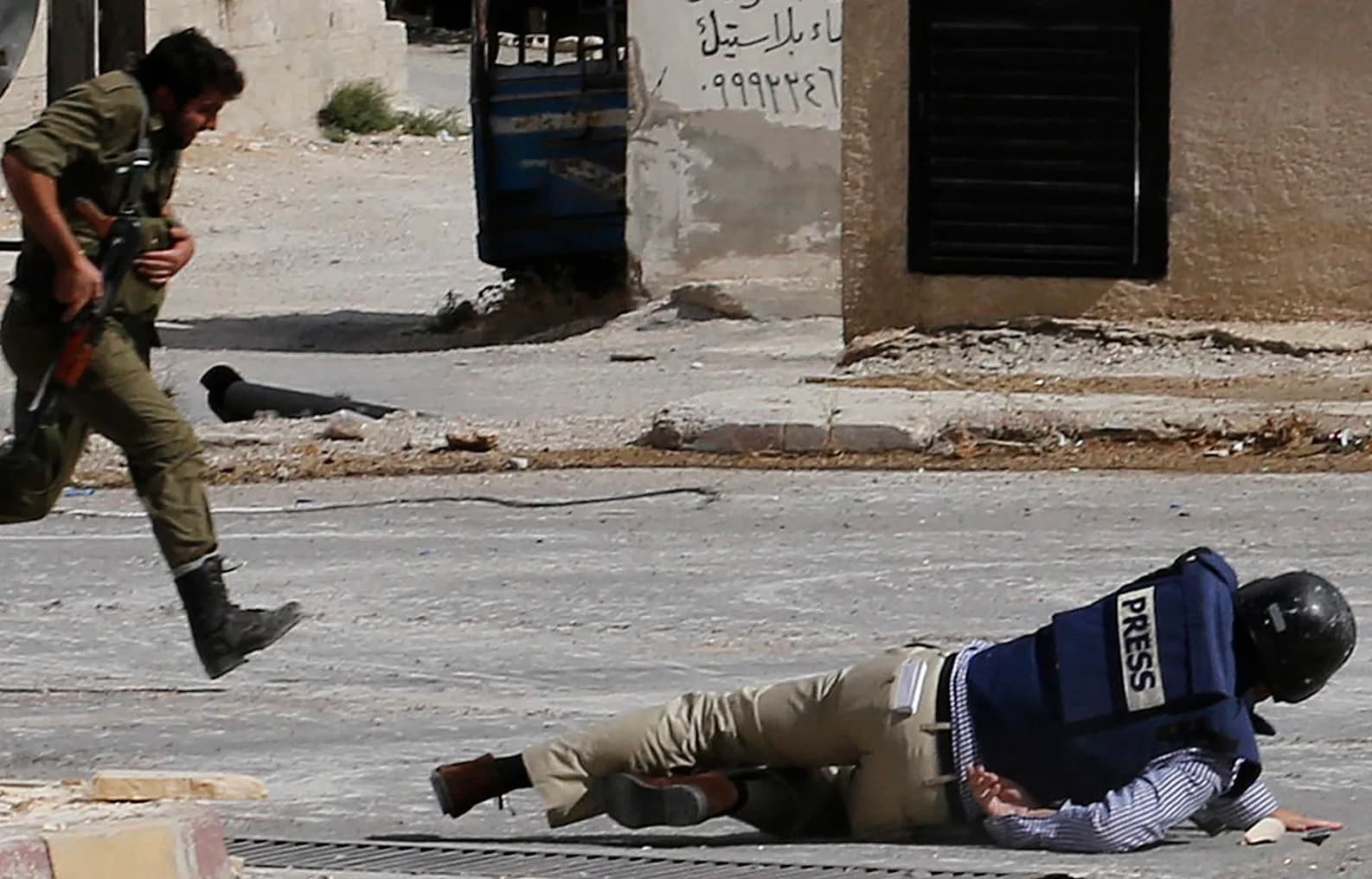
This toll tells the story of a war within a war: the one waged against those seeking to inform the public. The Assad regime’s repression was not limited to preventing the circulation of news or controlling newsrooms. It directly targeted individuals, turning journalistic work into an extremely high-risk activity. Documenting a demonstration, photographing a bombardment, or gathering testimonies about violence by government forces could mean being arrested, tortured or killed.
The figures provided by the Syrian Network for Human Rights warrant some clarification. International organisations adopt different criteria for recording such incidents and do not always use the same definition of a journalist. The SNHR, on the other hand, also includes media workers and individuals involved in reporting on the ground in its records.
Reporters sans frontières (RSF), for example, the international organisation for press freedom, has documented 183 killings of journalists attributed to the Assad regime and its allies during the war. The most recent victim, Anas Alkharboutly, a photojournalist with the German agency Dpa, was killed on 4 December 2024 whilst documenting events on the ground, just a few days before the regime’s collapse. The New York-based Committee to Protect Journalists (CPJ) also monitors violations against media professionals. According to figures cited by Freedom House in its 2025 report on Syria, the CPJ recorded 148 journalists and media workers killed in connection with their work between 2011 and 2024.
Ten were still missing as of December 2024. The figures provided by the various organisations appear to be inconsistent and not directly comparable: the professional categories considered and the criteria for establishing a link between a killing and journalistic activity vary. Nevertheless, the heavy toll paid by media professionals remains.
But it is the disappearances that form one of the most harrowing chapters of the Syrian conflict, particularly as regards journalists. Arbitrary arrests and secret detentions have been central tools of repression: many reporters have been taken away at checkpoints, from their homes or whilst at work. In numerous cases, families have never received any information about the place of detention or the condition of their loved ones.
An RSF investigation published in December 2025, one year after Assad’s fall, pieced together the stories of 45 media professionals who remain missing or are believed to be held hostage in Syria. At least 13 had been arrested by the regime, whilst others had been abducted by Islamic State or armed groups. At the time of Assad’s fall, only three detained journalists were released: Tal Mallouhi, Hanin Gebran and Abdelmajid al-Rahmoun. For at least 13 people, there is still no definite news, nor any proof of their death.
Among the cases of disappearance are those of Thabet al-Muhaisen and Quteiba al-Marei, two young reporters for the independent website Syria News, who were arrested on 1 August 2011 at a checkpoint near Damascus. The military had found images of the protest demonstrations on al-Marei’s mobile phone. There has been no news of the two since then. Years later, a former inmate of Sednaya (the maximum-security prison where the Assad regime held political opponents) reportedly said he had met a prisoner whom the guards called ‘Mr Journalist’: a clue, not a certainty. The case of Nizar Said, a contributor to the website al-Hal al-Souri (The Syrian Solution), is different. After receiving assurances regarding his safety, he left the Palestinian refugee camp of Yarmouk, but was arrested by regime forces. According to RSF, he died under torture on 17 July 2018.
Responsibility for the killings and disappearances of journalists, however, cannot be attributed exclusively to Bashar al-Assad’s regime. The Islamic State, Hayat Tahrir al-Sham and various armed opposition groups have also arrested, abducted and killed media workers. The SNHR attributes a total of 717 killings of journalists and media workers between 2011 and 2024 to the various parties to the conflict (of which 559 are attributed to the Assad regime)
The regime change that took place in December two years ago has made it possible to gain access to previously off-limits locations and to recover documents and testimonies useful for establishing responsibility. But documenting crimes does not yet mean obtaining justice. It is necessary to transform the archives of human rights organisations into evidence that can be used in legal proceedings, to reconstruct chains of command and to identify those who ordered or carried out arrests, torture and killings.
This is the new challenge that Syrian human rights organisations intend to take on. According to Fadel Abdul Ghany, director of the SNHR, the documentation work must now be turned into case files capable of supporting proceedings before Syrian and international courts. Every name left unanswered is a story to be reconstructed and a responsibility to be established. It is a debt of truth that the new Syria, if it wishes to embark on the path of national reconciliation, cannot afford to leave unresolved.