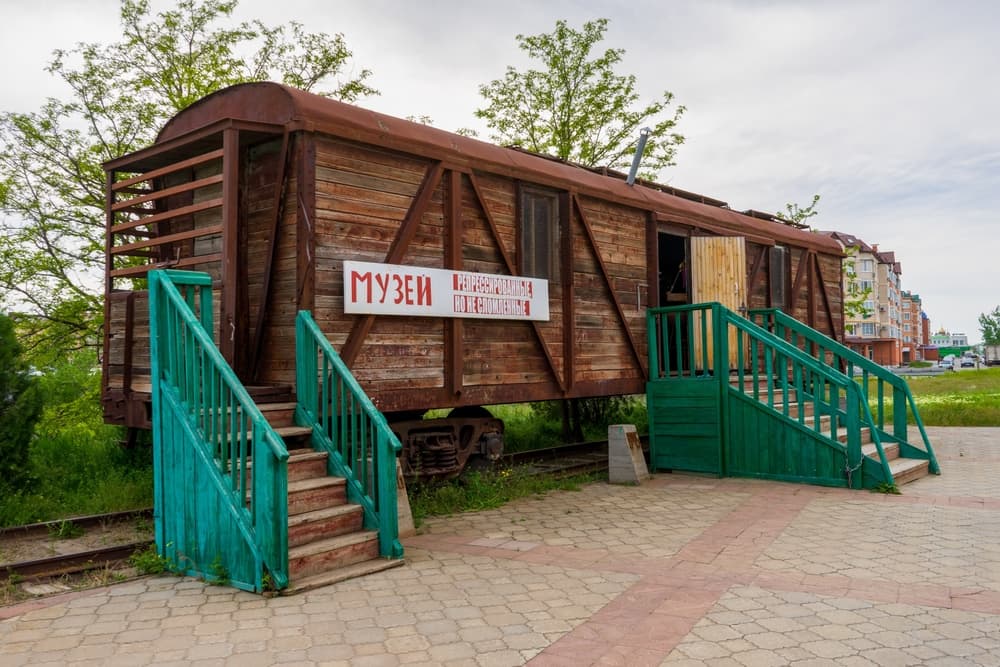
Moscow (AsiaNews) – The recent proposal, also discussed in the Moscow Duma, to resettle the inhabitants of the ‘new territories’ within the Russian heartland is evoking associations with the deportation of peoples during the Soviet era.
The artificial allocation, so to speak, of the workforce, the ‘construction projects of the century’, organised recruitment: all this is in the Russian-Soviet style, states Andrei Kolesnikov in Novaya Gazeta.
The Russian state has moved vast numbers of people according to its own needs, rather than out of arrogance, fantasy or notions of ‘security’, and naturally ‘bringing these fantasies to life required forced labour: railways cutting through the permafrost leading nowhere, a perpetually ‘unfinished’ style, a symbol of the state’s irrationality and pernicious arrogance”, comments Kolesnikov.
Even the idea of diverting the course of rivers – fortunately abandoned in the late 1980s – has suddenly resurfaced, and the desire to dictate people’s destinies manifests itself in the most unexpected circumstances: thus, the television presenter Sergei Solov’ev proposed relocating people from frontline regions under ‘normal’ conditions to the Russian hinterland, where ‘there is plenty of free, buildable land’ .
This idea brought to mind the plan to deport Soviet Jews, which emerged in the final months of Stalin’s regime.
There are no documents attesting to the preparation of such a plan, but the experience of deportation accumulated in the 1940s may have provided the impetus for such actions, and the anti-Semitic hysteria that broke out in the late 1940s and intensified in 1953 following the start of the ‘murderous doctors’ case, together with ‘popular’ demands fuelled by the authorities to resettle Jews in some location in the Far East, most likely prepared public opinion for a mass resettlement.
Feasibility studies have also been presented: resettlement today would need to be accompanied by the government’s purchase of new buildings to house citizens living in the ‘liberated’ territories of the Donbass—which are now unfit for habitation—and by the implementation of certain programmes such as ‘The Far Eastern Hectare’.
There is talk of 200,000–300,000 people who would be asked to leave their homes and set off with nothing but the clothes on their backs – presumably to cultivate this very ‘Far Eastern Hectare’, which, in terms of comfort, is a far cry from holiday resorts.
It is clear that Russian authorities throughout history have always been concerned with the development of underdeveloped lands; their colonisation in some places has remained incomplete, and human resources have always been needed to adapt these vast expanses to human life.
And it is all too easy to ‘imagine the movement of huge masses of people as if it were a video game’, suggests Kolesnikov, since in reality the military clashes themselves have become like video games for many, and the participants – whether they are armchair warriors or office workers – feel like players.
According to the Kremlin’s proposals for negotiations, a broad ‘buffer zone’ is to be established in Ukraine that will continue to expand, and a growing number of ‘historic lands’ will be transformed into resettlement zones in remote parts of Siberia and the Far East. The journalist concludes that “territories matter more than people, who can be ‘replaced’, just like the course of a river. All a person can do is flee from these grand schemes on their own little raft – provided they have one, of course”.