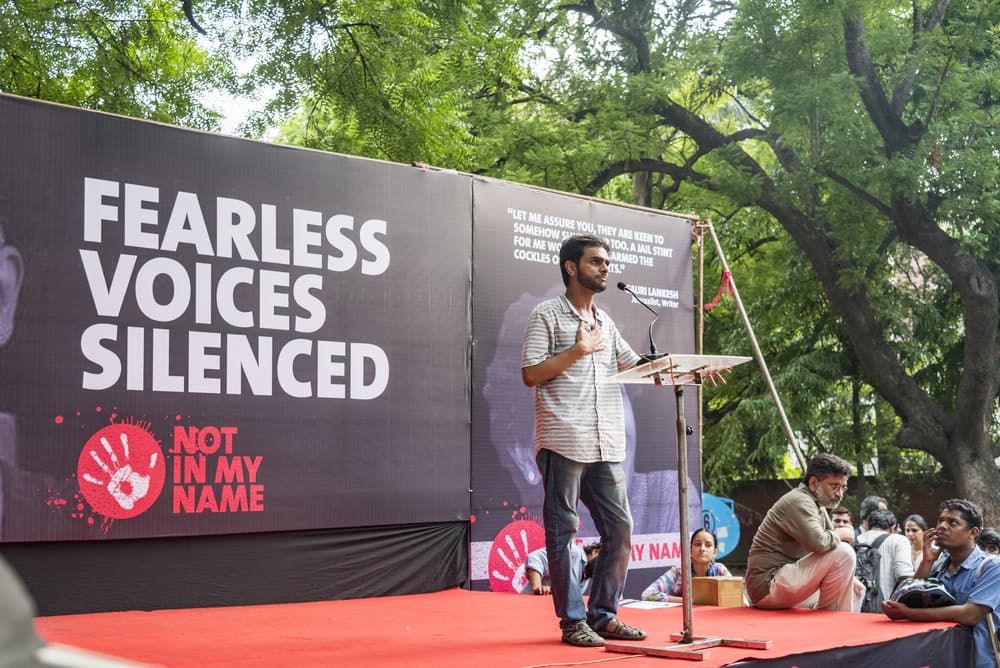
New Delhi (AsiaNews) – Six years after Umar Khalid’s arrest, several university campuses had organised screenings of “Prisoner No. 626710 is Present”, a 2024 documentary about the activist and his imprisonment. At two of the country’s leading universities – the International Institute of Information Technology (IIIT) in Hyderabad and the National Law School of India University (NLSIU) in Bangalore – the events were cancelled or postponed, sparking criticism and protests from students and filmmakers.
Directed by Lalit Vachani, the documentary traces the researcher and activist’s story through the voices of those close to him, reconstructing the events that led to his arrest in September 2020. Khalid, who holds a PhD from Jawaharlal Nehru University (JNU) in Delhi, is accused of playing a role in the alleged ‘wider conspiracy’ behind the sectarian violence that erupted in the north-east of the capital in February 2020, during the protests and clashes linked to the controversial Citizenship Amendment Act (CAA), the citizenship law passed in 2019. The CAA introduced a fast-track route to Indian citizenship for Hindus, Sikhs, Buddhists, Jains, Parsis and Christians from Afghanistan, Bangladesh and Pakistan, excluding Muslims from this specific mechanism of international protection. The unrest resulted in 53 deaths and hundreds of injuries, with the majority of victims being Muslim.
Khalid is charged under the Unlawful Activities (Prevention) Act (UAPA), India’s main anti-terrorism law, and other provisions of the Indian Penal Code. Khalid has been in prison since September 2020, whilst the trial for the alleged conspiracy has yet to begin. In January 2026, the Supreme Court denied bail to Khalid and Sharjeel Imam, whilst granting bail to other co-accused, including Gulfisha Fatima. On 21 September, the Delhi High Court adjourned the hearing of the bail applications filed by Khalid and Imam until 30 September.
The Central Board of Film Certification (CBFC), the Indian body responsible for approving films for public screening, objected to the screening of the documentary at IIIT in Hyderabad. In a post on X on 17 September, the Board argued that the public screening of an uncertified film would contravene the Cinematograph Act, unless a specific exemption had been obtained. IIIT-Hyderabad consequently cancelled the event, whilst clarifying that it had not been organised or authorised by the institute and that no event, whether public or private, relating to the film would be permitted on its premises.
The problem, however, is that the CBFC has not certified the documentary, leading students and filmmakers to criticise the decision and question its applicability to screenings organised within universities. For some Supreme Court lawyers, too, the question is whether the screening of the documentary on university premises can be considered public rather than private.
At the National Law School of India University in Bangalore, too, the screening – organised by the students’ Law and Society Committee to mark Political Prisoners’ Day – was first postponed and then cancelled. The event had been contested by the Akhil Bharatiya Vidyarthi Parishad (ABVP), a student organisation affiliated with the RSS, a far-right paramilitary group, which had accused the organisers of seeking to use the campus for political propaganda. The student committee had initially cited logistical and security reasons for the postponement, assuring that the event would eventually be rescheduled later in the term.
The debate on censorship and freedom of expression is nothing new in India, including within the film industry. Just a few days before the events were cancelled, on 16 September, the Ministry of Information and Broadcasting had issued new guidelines for the CBFC, in which ‘anti-national attitudes’ were classified as unacceptable.
Despite the ban on screenings on university campuses, the film remains available online and continues to circulate at private gatherings. According to some filmmakers, the suspension of these events – whilst not preventing people from watching the documentary – limits public debate on Khalid’s case and his prolonged detention without trial. In Mumbai too, a screening scheduled to take place in Versova was cancelled following police intervention. However, the film was subsequently shown at a private screening at a cultural centre in Kurla, attended by more than 20 people. The evening concluded with Gulfisha Fatima reading a selection of poems.