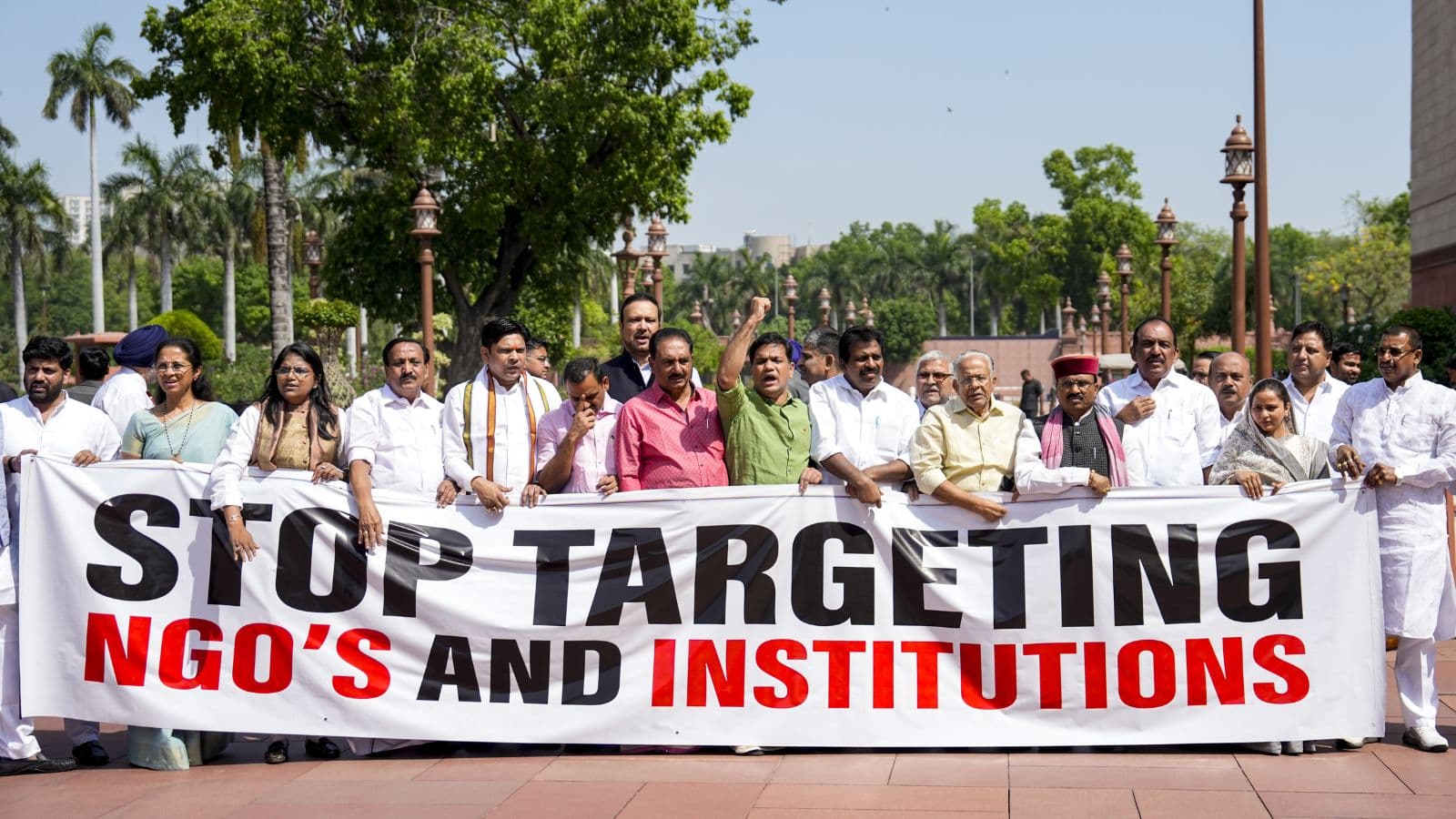
New Delhi (AsiaNews) – The bill amending Indian regulations on foreign funding to non-governmental organisations has been referred to a Joint Parliamentary Committee (JPC) for further consideration following strong criticism from opposition parties, civil society groups, and Christian organisations.
Home Affairs Minister Amit Shah introduced the draft legislation, called the Foreign Contribution (Regulation) Amendment Bill, in the Lok Sabha, the lower house of the Indian parliament, on 25 March.
The government claims that bill is meant to make the management of foreign contributions more transparent and controllable and fill some gaps in the existing Foreign Contribution (Regulation) Act (FCRA), which has regulated foreign funding for Indian organisations and associations since 2010.
The All India Christian Council welcomed the referral to a JPC. In a statement released on Tuesday, the association's president, Anglican Archbishop Joseph D'Souza, noted that, “the Government has accepted that a Bill of this reach should not have been carried through Parliament in the closing days of a session that has sat through daily adjournments.”
D'Souza later clarified, however, that the postponement does not address the objections raised by the Christian community, which continues to call for the bill's withdrawal.
The All India Christian Council has therefore announced that it will submit its observations to the committee, requesting that its work include direct consultation with schools, hospitals, and charities affected by the new legislation.
The most controversial part concerns the management of assets purchased or generated through foreign contributions when an organisation loses its FCRA certificate.
The bill provides for the creation of a "Designated Authority" responsible for assuming custody, administration, and, in certain circumstances, disposing of the NGO’s contributions and assets.
An NGO can become deregistered when its certificate is cancelled, when it voluntarily surrenders it, or when its registration expires and renewal is not obtained.
The government explained that the administration of assets financed by foreign contributions was already provided for in Section 15 of the FCRA of 2010. The 2026 provision, however, introduces a more detailed framework for the custody, management, and eventual final disposition of those assets.
It is precisely this change that most concerns Christian organisations. Archbishop D'Souza argues that an organisation could risk losing schools, hospitals, or reception facilities even if the failure to renew the certificate was due to an administrative issue.
“A delay on a government portal would become a transfer of property,” the archbishop warned.
The decision to refer the bill to the JPC comes just a few days after Cardinal Oswald Gracias, Archbishop Emeritus of Bombay, made a similar appeal directly to Home Affairs Minister Amit Shah.
In a letter dated 8 August, the cardinal asked the government not to rush the bill's approval and to subject both the bill and the new Foreign Contribution (Regulation) Amendment Rules to thorough parliamentary scrutiny.
In his letter, Gracias acknowledges the need for financial transparency, accountability, and protection of national security, but questions the scope of some of the new provisions, calling them draconian.
Cardinal Anthony Poola, Archbishop of Hyderabad and President of the Catholic Bishops' Conference (CBCI), also emphasises the Christian community's contribution to nation-building.
In his message on today's Independence Day, he notes that Christians have served India for generations through education, healthcare, social service, and humanitarian assistance, particularly among the poor and most vulnerable.
Hence, he renewed his appeal to the government to withdraw the proposed FCRA amendment bill, expressing concern that its provisions could seriously hinder charitable institutions from pursuing their humanitarian mission.
The FCRA is one of the tools through which the Indian government controls the entry of funds into the country from foreign entities, but the framework has become progressively restrictive in recent years.
The 2020 reform, for example, introduced the requirement that contributions must be received through a dedicated bank account at the State Bank of India in New Delhi, banning part of the funds from being entrusted to other associations, and reducing the limit on administrative expenses from 50 per cent to 20 per cent.
The government also introduced new rules this year, which came into effect on 22 June, linking FCRA registration to specific activities and the states or territories in which an NGO operates.
The new rules also require entities applying for renewal to demonstrate having received at least Rs 10 lakh (about US$ 10,500) in foreign contributions over the previous two years and introduce new reporting requirements, including more precise identification of foreign donors.
The bill and the new rules are therefore two separate measures. The 2026 rules are already in place, while the Foreign Contribution (Regulation) Act Bill has yet to be approved by parliament.
The government defends the new measure, arguing that its goal is to strengthen transparency. But for D'Souza, the Christian community's request is not to avoid scrutiny.
“No one in our community objects to transparency. No one objects to accountability,” he writes. However, he insists that, “a law genuinely concerned with transparency prescribes audits, penalties and the prosecution of the guilty. It does not transfer the title deeds of the innocent.”
(Nirmala Carvalho contributed to this article)