Phnom Penh (AsiaNews) – Thousands of Cambodians who fled their homes as the border conflict with Thailand came close to war are settling in for their second year in "temporary" accommodations in overcrowded and unhealthy camps.
Some may never go home – their houses and the farms that sustained them – lie behind barricades and trenches and occupied by heavily armed Thai Soldiers.
More than 20,000 remain displaced, according to the Cambodian government, including more than 6,000 children.
The humanitarian crisis is creating a new intergenerational trauma in a country still mentally and emotionally scarred by the Khmer Rouge genocide of the 1970s and the subsequent Vietnamese invasion, psychologists specialising in conflict told AsiaNews.
Like the trauma suffered by survivors of the Khmer Rouge, this one can be passed on to future generations by today's children, they say.
The refugees live in tiny, leaky tin huts or tents. Hygiene, sanitation, nutrition and a lack of clean water are major problems, aid workers say.
“These are not nice places," said one aid worker with a Western agency, asking not to be named for fear of publicity. “The government and NGOs are doing their best, but it is not easy – especially now with the rainy season."
Peace still faraway
Bopha Moly, a 42-year-old mother of three in a Rong Cham (Waiting Village), a camp almost 400 km northwest pf Phnom Penh, desperately wants to get home.
"It's OK now the children can go to school. But it's not home. I am afraid they will get sick here,” she said. “But I am afraid we may never go back.”
On the Thai side, most people who were displaced at the height of the tensions have returned home. Cambodia, much weaker militarily, has not occupied Thai land.
Despite international attempts to broker a solution, the two governments are no closer to a resolution, arguing over disputed century-old French maps. And the situation is being fuelled by social media – with unrestrained vitriol from ordinary people in both countries.
“They are bigger than us, but they will never beat us," 27-year-old software engineer Chroeck Chhunieng told AsiaNews in Phnom Penh. “They have bullied us throughout history. But we never give in.”
More than 100 people have been killed in the conflict. And about 1.1 million were displaced in both countries at the height of the tensions, around last December.
Another 900,000 Cambodian migrant workers were forced to flee Thailand, many of whom had gone into crippling debt to get work.
Full-scale clashes erupted on 24 July last year after a minor confrontation in May. The worst violence was in December.
Both sides have accused each other of violations of a December ceasefire.
The economic cost has been high.
The United Nations estimates lost Cambodia remittances alone will cost almost US$ 1 billion in 2025-26 – more than 1.8 per cent of GDP.
Art therapy brings some light amid the suffering
Amid the gloom, some groups are stepping up to make a big difference.
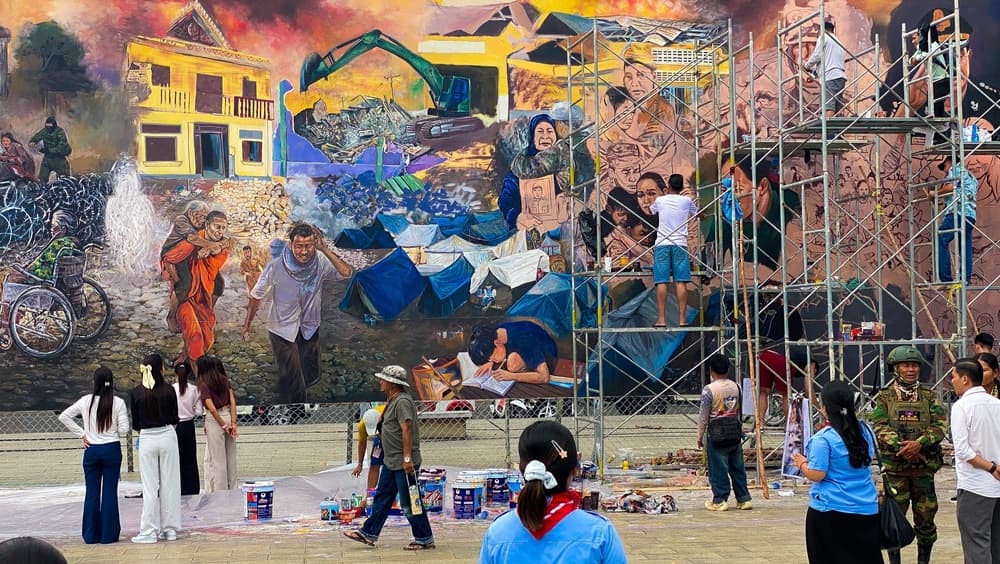
One is Phare Ponleu Selpak, “the brightness of the arts”, which has been helping thousands of kids as young as three adjust to their new lives and homes amid the latest war in a bid to ease their trauma.
Founded by a group of people born in the squalid Thai refugee camps of the wars of the 1970s and 1980s, it is using the harsh lessons they grew up with to bring hope and healing to a new generation of traumatised kids.
It's called art therapy. A fancy name for letting kids draw, paint, learn music, and play.
“We began in August last year as emergency relief for families fleeing border clashes, but the focus has shifted toward sustained, long-term support," Phare's communications manager, Ponlork Van, told AsiaNews.
“Phare has committed to keeping activity centres open as long as children remain in these camps,” he explained. “This year, our team continues to seek out new camps where help is still needed as families are relocated."
By late last year, Phare saw a tragically familiar pattern: small camps closing, merged into bigger, longer-term settlements.
"Without intervention, the traumas of forced displacement can set in permanently," Van said.
Long-term displacement steals a normal childhood.
“Prolonged stress can replace a sense of normalcy with a permanent state of fear and survival," Van says. “Continuous exposure to conflict and displacement can lead to long-term mental health disorders.”
Phare was founded by people who grew up in what was once Southeast Asia's biggest refugee camp, and one of the biggest in the world at the time: Site 2, near Aranyaprathet in Thailand.
Cait McMahon, an Australian psychologist with decades of experience working with war trauma victims throughout Southeast Asia, says art and music are ideal healing tools for kids.
“Children don't need to use words at all, or be verbal, in arts therapy," she told AsiaNews. “It is no pressure, and it builds a connection with other kids.”
This “can help kids learn to regulate their emotions through play and feel more confident in themselves and their bodies. These are really important things for traumatised children.
“Trauma takes away a sense of power and control from you. This sort of therapy can help you reinstate that.”