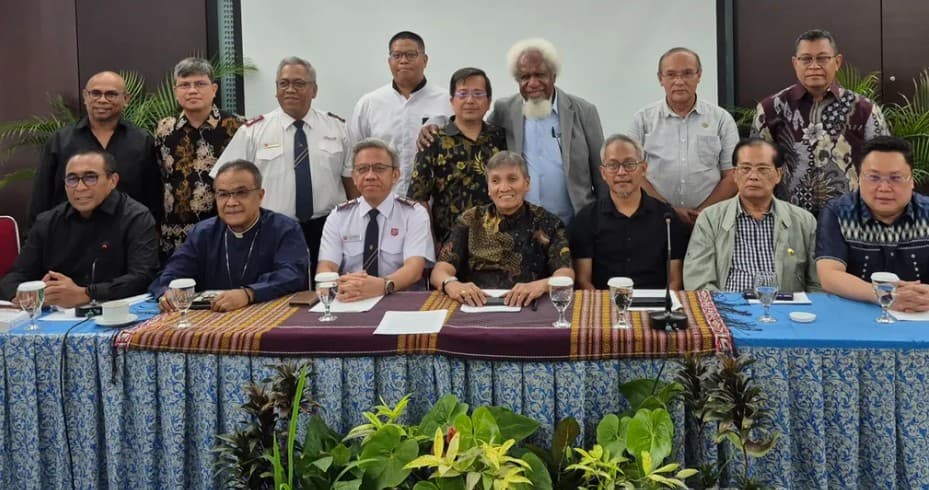
Jakarta (AsiaNews) – Eight leading Christian church organisations in Indonesia have called on the government in Jakarta to end the protracted humanitarian crisis in the Papua region, prioritising dialogue, justice and respect for human dignity rather than an expansion of the military presence.
The appeal was set out in a joint statement released yesterday under the title: “Ending the humanitarian crisis in Papua: defend human dignity, dialogue and justice, not militarisation”.
The statement was signed by the Indonesian Bishops’ Conference (KWI), the Communion of Churches in Indonesia (PGI), the Fellowship of Pentecostal Churches in Indonesia (PGPI), the Fellowship of Indonesian Evangelical Churches and Institutions (PGLII), the Indonesian Baptist Fellowship (PBI), the Salvation Army Indonesia, the Seventh-day Adventist Church in Indonesia, and the Orthodox Church of Indonesia.
In presenting the text, the president of the PGI, Rev. Jacklevyn Fritz Manuputty, stated that the repeated acts of violence in Intan Jaya and other conflict-affected areas demonstrate that the humanitarian crisis in Papua is no longer an isolated incident, but a structural problem that continues without a dignified solution. “We call on all armed parties, both state security forces and non-state armed groups, to cease all forms of violence and to prioritise the safety of civilians above all other interests,” he said.
The humanitarian crisis is worsening
Church leaders have expressed deep concern over the armed conflict in Papua, which has been ongoing for decades and continues to claim victims amongst indigenous Papuans, non-Papuan civilians, security force personnel and others caught up in the violence. “The humanitarian crisis in Papua is no longer an occasional problem, but a structural crisis that continues to recur without a dignified solution,” the statement reads.
The churches noted that women, children, indigenous communities, healthcare workers, teachers, farmers and internally displaced persons remain the most vulnerable to the consequences of the conflict, and that many displaced families still lack adequate access to food, healthcare, education, protection and pastoral care.
One of the incidents highlighted was the death of Mrs Markina Sondegau, a pregnant woman struck by a bullet during an exchange of gunfire in the Sugapa district, in the Intan Jaya regency, on 2 July. Previously, Okto Tigau, a local farmer, had been found dead after allegedly being attacked during a military operation aimed at searching for members of the Free Papua Movement (OPM).
According to the National Human Rights Commission, 59 people were killed in the armed conflict across Papua in the first six months of 2026.
Of these, 43 were civilians, whilst eight were members of the Indonesian security forces (TNI-Polri) and a further eight belonged to the West Papua National Liberation Army – Free Papua Movement (TPNPB-OPM).
The Commission’s chair, Anis Hidayah, stated that the deaths of Okto Tigau and Markina Sondegau constitute human rights violations relating to the right to life, the right not to be subjected to torture or cruel treatment, the right to a fair trial and the right to personal safety. She urged President Prabowo Subianto to review security policies and military operations in Papua and to ensure transparent investigations into alleged human rights violations.
According to the PGI, the conflict has forced some 107,000 people to flee their homes, whilst Human Rights Monitor estimates the figure at 124,931. The National Human Rights Commission reported that around 3,000 residents were displaced in Intan Jaya alone between May and July 2026.
From a militarised approach to dialogue
Church leaders urged the government to conduct a comprehensive review of its security policy in Papua, arguing that a predominantly militarised approach has failed to bring about a just and lasting peace. On the contrary, the continued deployment of non-organic military units, the construction of new defence facilities and the intensification of security operations have contributed to the displacement of the population, trauma, fear and a persistent cycle of violence.
“The well-being of the population should not be measured by the growing presence of security forces, but by improvements in education, healthcare, the protection of indigenous peoples’ rights, respect for customary lands, equal economic opportunities and the ability of civilians to live without fear,” the statement said.
The Churches reiterated their long-standing call for an inclusive and sincere dialogue involving all stakeholders to address the long-standing conflict in Papua. They stated that dialogue should not be seen as a sign of state weakness, but as an expression of democratic maturity and a means of rebuilding trust, acknowledging suffering and seeking peaceful solutions that respect the dignity of every person.
The statement also called on President Prabowo Subianto to place the protection of human life at the heart of all government policies concerning Papua.
Humanitarian protection
The church leaders also urged the government to give greater priority to the needs of internally displaced persons, particularly women, children, people with disabilities and the elderly, who have been severely affected by the conflict. They call for assurances that they will be able to carry out their humanitarian and pastoral ministries freely and without stigmatisation.
According to the statement, the humanitarian work carried out by the Churches should not be regarded as support for any political or separatist group, but rather as part of a shared commitment to restoring human dignity and trust and promoting a just and lasting peace.
The statement concludes with a call to churches throughout Indonesia to continue praying for Papua, whilst at the same time strengthening humanitarian assistance through pastoral care, trauma healing, peace education, reconciliation initiatives, health services and community building.
Rev. Manuputty also stated that church leaders have repeatedly sent letters requesting a dialogue with President Prabowo, but have so far received no reply. “We will not stop making our voices heard and we hope that we will eventually be given the opportunity to engage in an open dialogue,” he said.
Responding to the appeal, the Minister for Human Rights, Natalius Pigai, said he supported efforts to achieve lasting peace in Papua and hoped that the armed conflict would not claim any further victims. He also suggested that requests for dialogue be submitted via the State Secretariat.