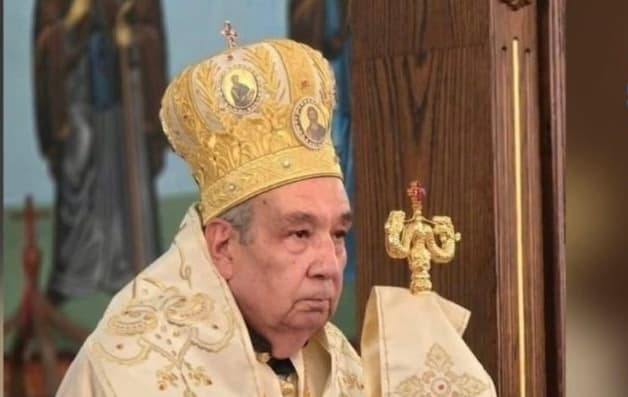
Damascus (AsiaNews) – The warnings issued by Syrian Christians in recent weeks regarding an “uncertain future” – not least that of the Archbishop of Homs, Monsignor Jacques Mourad, who spoke to AsiaNews just a few days ago of a situation of “increasing Islamisation” and “discriminated against” faithful – have been disturbingly confirmed in the last few hours: local witnesses report that the Greek-Melkite Catholic Archbishop Mar Youhanna Abdo Arbash was attacked by armed men who humiliated him, handcuffed him and slapped him in the face whilst he was inside the archdiocesan curia in Homs, in western Syria. His office was ransacked and even his bishop’s cross was stolen, fuelling the concerns and fears of those who see the safety – and indeed the very presence – of Christians in the Arab country as being in extreme danger. Christian sources, interviewed by AsiaNews, speak of an “outrageous attack on the dignity of the community”.
Christian leaders and experts emphasise the gravity of the attack, stressing that it should not be dismissed as a mere criminal act or attempted theft, as it entails a far more serious form of religiously motivated violence of an Islamist extremist nature. Among the first to condemn the assault were the patriarchs and heads of the Churches in Syria, who have in the last few hours issued a joint statement, copied to AsiaNews, in which they reiterate their “deep concern” over the ongoing attacks, kidnappings and intimidation.
Concerned patriarchs
In the statement signed by Greek Orthodox Patriarch John X, Syriac Orthodox Patriarch Mor Ignatius Aphrem II and Greek Melkite Catholic Patriarch Youssef I Absi, the heads of the Churches in Syria note that “this wave of attacks continues unabated”. “These attacks,” the Christian leaders warn, “are not, and have never been, isolated incidents. What has happened, and continues to happen, in many places – including, most recently, Al-Suqaylabiyah – in the form of systematic assaults and kidnappings carried out to demand exorbitant ransoms, constitutes a violation of the most basic human rights.” The reference to Al-Suqaylabiyah concerns the abduction in October of a local Christian – the goldsmith Maher Sankari – and the demand for an exorbitant ransom accompanied by a video showing him being tortured, which the family is in no position to pay.
“In light of the failure of the relevant authorities,” the Christian leaders continue, “to provide security and protection in response to what has happened and continues to happen, these attacks have intensified again in recent days, culminating in the archbishop being targeted.” “The recurrence of these incidents, without any response or tangible results from the authorities, confronts us – and the public – with a serious question regarding the future of Christians in this country,” write the three patriarchs. “We condemn, in the strongest possible terms, what has happened and continues to unfold. Once again, we raise our voices to demand an end to these attacks, and we call on the relevant authorities to fulfil their duties, to conduct the necessary investigations and to inform us of their findings. Christians,” the statement concludes, “must not be treated as easy targets for attacks or as scapegoats. They will continue to maintain the closest possible relations with their Muslim brothers and sisters, on the basis of full and equal citizenship.”
ACS: “Ensure safety”
Among those expressing concern and condemning the attack is the Christian NGO Aid to the Church in Need (ACS), which recalls that during the attack on 14 November, the assailants also “took several personal items, including an image of the Virgin Mary”. ACS spoke with the archbishop, who confirmed that he was “fine” and that “investigations are ongoing”, adding that he was “confident that further details of the incident will emerge in the coming days”. For the time being, he preferred not to go into detail, pending clarification of the circumstances of the attack.
In a statement, ACS Executive President Regina Lynch said: “We have been deeply shocked by the news of the attack on Archbishop Arbach, a courageous shepherd who has stood by his people through so many years of war and suffering. We thank God that he is well and assure him of our prayers and solidarity. Our thoughts also go out to all those who continue to live in fear and insecurity in Syria. We sincerely hope,” she added, “that the country will finally find the peace and stability its people so desperately need.” For years, the prelate has been drawing the international community’s attention to the suffering of the population and the difficulties faced by Christian communities, collaborating on projects and initiatives in the fields of education and healthcare, as well as the reconstruction of homes and church buildings. “As ACS,” concluded Regina Lynch, “we wish to reaffirm our solidarity with Monsignor Arbach and with all those suffering from the consequences of the violence in Syria. We join the appeal made by the leaders of the country’s Churches for the safety of all citizens to be guaranteed and for progress to be made towards a lasting peace.”
Unresolved tensions
Sectarian tensions, attacks against minorities (from the massacre of Alawites in March 2025 to raids against Christians, including the suicide attack on the Church of Mar Elias in Damascus) and widespread violence mark the arduous path towards the rebirth of the “new” Syria. For almost two years, power has been in the hands of Ahmed al-Sharaa and the militias of Hayat Tahrir al-Sham (Committee for the Liberation of the Levant, HTS), which, in the space of a few weeks between late November and December 2024, toppled Bashar al-Assad’s decade-long regime. The former dictator fled into exile in Moscow, whilst the country began a slow and arduous journey back into the international political, diplomatic and economic arena.
However, the lifting of Western sanctions and the overtures from the White House and Donald Trump towards the interim president (who has never renounced radical Islamism) have not been enough to guarantee stability and security within the country’s borders. From the Alawites to the Kurds, via Christians and Druze, the lines of conflict are numerous and unresolved, whilst gangs linked to the ruling militias commit abuses and crimes, often with complete impunity.