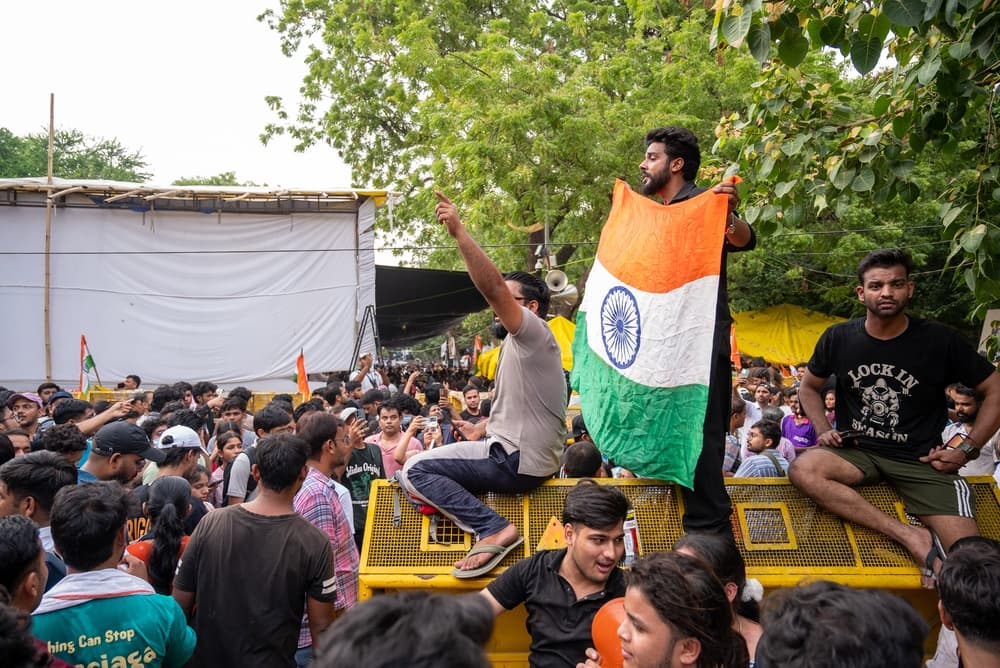
“On the afternoon of 25 July, the Education Minister Dharmendra Pradhan finally submitted his resignation,” said Father Cedric Prakash, SJ, a well-known human rights activist, reacting to the youth protests that have been shaking the capital New Delhi and the rest of India for days.
This “was a key demand of the Cockroach Janata Party and for thousands of other agitating students and youth all over the country. There were massive celebrations all over,” he said. “It is common knowledge that he amassed huge amounts of money as Education minister.” His “resignation [. . .] is just the beginning, the tip of the iceberg!”
Pralhad Joshi will now take over the Education portfolio from Dharmendra Pradhan, while retaining his post as minister of Consumer Affairs, Food and Public Distribution. The seasoned lawmaker from the Dharwad, Karnataka, previously served as minister of Parliamentary Affairs, of Coal, and of Mines. After his appointment, he publicly stated that he intended to approach the role with humility and a sense of duty, thanking Prime Minister Narendra Modi for his confidence in him.
Young Indians against the divisions stoked by the BJP
The success achieved by the Cockroach Janta Party (CJP), a movement that began online as political satire and quickly became a catalyst for widespread discontent among India's younger generations, was possible because young people overcame the divisions that the government led by the Bharatiya Janata Party (BJP) and Prime Minister Narendra Modi had stoked over the past decade.
“The youth protesting in Jantar Mantar and elsewhere were loud and clear. They would never allow xenophobia, exclusivism, sectarianism or any form of bigotry to permeate their ideals, their dreams, their hopes for a better future,” Father Prakash explained.
“They visibly and vocally demonstrated in no uncertain ways that they were first and foremost citizens of the country, students and youth. They were with one heart and one mind, transcending the confines of every religion. They belonged to every stratum of society.
“No one could divide them and pit them against each other. Not the fascist, fundamentalist agenda of the regime. They were determined not to fall prey to insidious designs. With the Constitution in hand, they chanted in unison, " We are one, we shall overcome!”
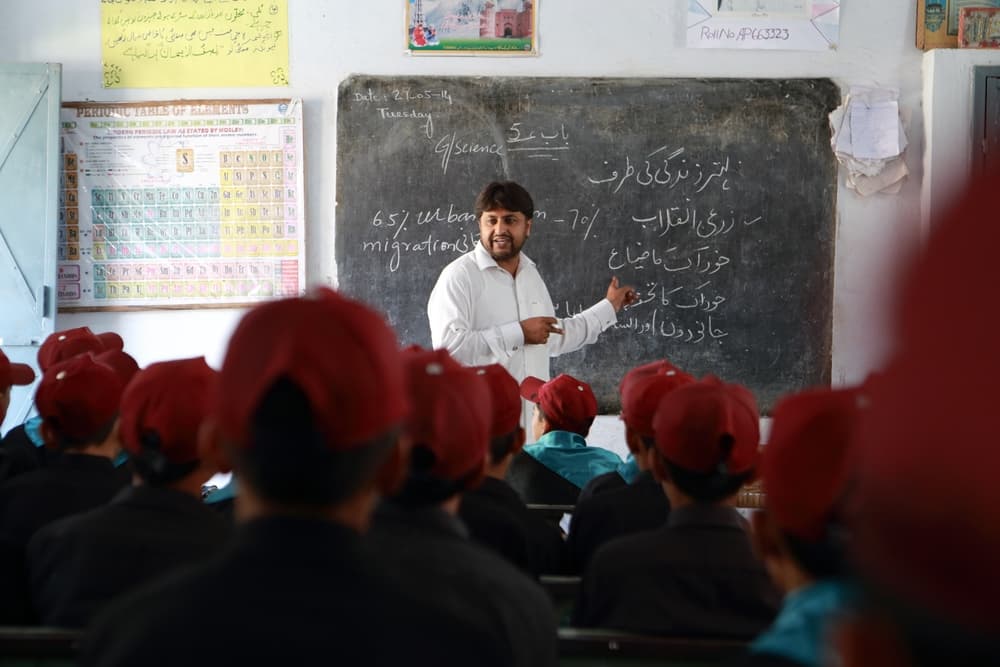
“Thousands of students, youth and others have come out on the streets all over the country: in perhaps every big city and small town, in district headquarters and even in villages. This was not a paid mob mobilisation – as this current government does so often!
“It was a spontaneous uprising, giving voice to their angst, their sense of outrage at what is happening to them, to the whole educational system, to the fact that 21 students had committed suicide because of the NEET paper leakage.
“It reminded one of the ‘Arab Spring’, of what happened not too long ago in neighbouring Nepal and Sri Lanka, and they have come out in large numbers everywhere in protest. Besides, in several countries across the world there have been protests in solidarity with what is happening in India.”
Investigations into police brutality
Today, the Supreme Court of India ordered the immediate release of minors detained by the police, along with all those without criminal records.
The bench, composed of Chief Justice Surya Kant and Justices Joymalya Bagchi and V. Mohana, is examining a series of appeals alleging excessive police force against protesters who marched to Parliament on 20 July, out of anger over serious irregularities in the administration of university entrance exams.
Several protesters were injured by police charges, tear gas, and live ammunition used to disperse the crowd.
Against civilians, security forces also used pellet-firing guns, weapons that can fire multiple metal or plastic pellets in a single burst, and are the source of great controversy in India, particularly due to the risk of serious and permanent injury, including loss of eyesight.
Police in New Delhi categorically denied using these weapons during the protests, despite images and accounts from doctors and protesters suggesting otherwise.
Eventually, thanks to an internal probe by the Central Reserve Police Force (CRPF), the paramilitary force that controls the Rapid Action Force (RAF), it was determined that one officer fired at least seven shots from his pellet gun, five of which hit peaceful protesters.
A 19-year-old university student is among the most seriously injured, undergoing surgery to remove metal fragments from an eye, while a journalist from Outlook magazine was shot while covering the protests.
The relevant authorities have not yet released any definitive forensic reports on these cases, but the CRPF's internal report has effectively refuted the initial official police versions, further fuelling calls – already under consideration by the Supreme Court – for an independent and transparent investigation into all incidents of violence linked to the protests.
“The fact that hundreds of thousands, from all walks of life, began this historic march was a breakthrough in the recent annals of the country,” the clergyman said. Security forces “spared no efforts to stop the march.” As a result, “Many had to be hospitalised. This ensured a groundswell of protests all over the country.”
Against corrupt politics
Young people are particularly concerned about corruption. CJP leaders announced the suspension of the protests, saying that the government had met the movement's main demands, including dropping complaints against protesters and compensation for the families of young people who took their own lives under the pressure of exams and the subsequent news of the scandal.
Spokesperson Saurav Das emphasised, however, that young people will monitor the government's next moves and that the movement will continue to demand the implementation of a five-point document on education reforms, with a new meeting between the parties expected within four weeks.
The harshest criticism of Joshi's appointment came from opposition parties, who focused on some controversial aspects of his past tenure in government, particularly the privatisation policies in the mining sector implemented when he was Coal Minister, which were criticised by unions and environmental groups.
“The youth are not going to take things lying down anymore. Not only corruption in education, but which has permeated every stratum of society. Beginning right at the top. There is a lack of accountability and transparency.
“Much has to be addressed, like demonetisation, electoral bonds, the PM Cares fund, and now the E20 (The E20 Janata Party is on the rise).
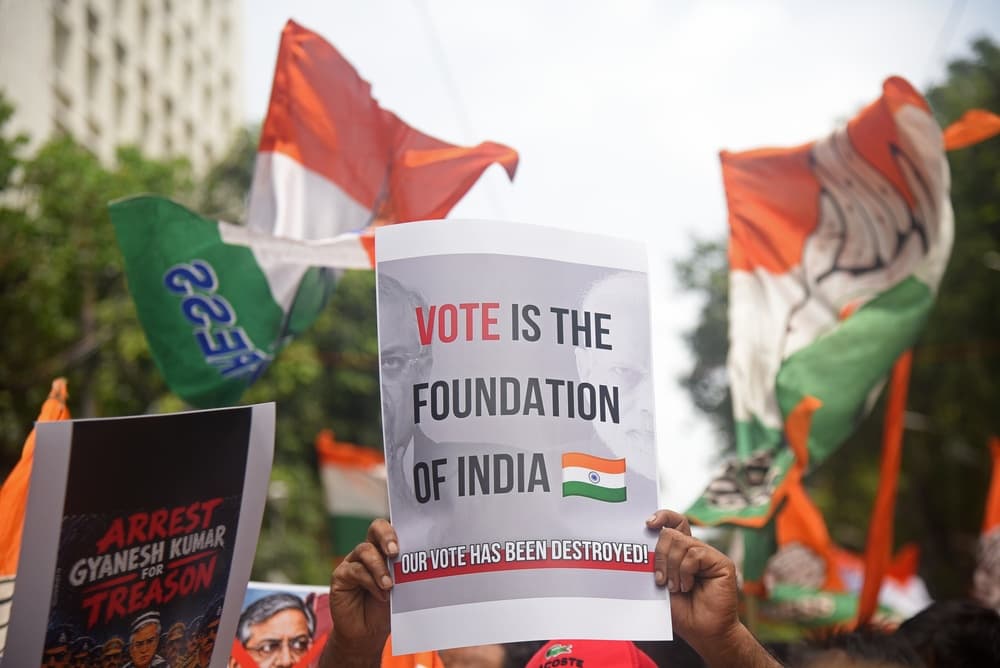
“More questions will be asked. Where did the RSS and BJP get the enormous amounts of money to put up palatial buildings everywhere? What about the crony capitalist friends who profiteer at the cost of the poor and by looting the country? What about electoral malpractices: the manipulation of the EVMs and the meticulous disenfranchisement, through SIR, of thousands of legitimate citizens everywhere.”
The cleric here is referring to some of the most controversial issues in Indian politics in recent years, such as:
- demonetisation, the Modi government's 2016 decision to remove 86 per cent of cash from circulation, causing serious economic hardship without fully achieving its stated objectives of combating tax evasion;
- electoral bonds, an anonymous financing tool for political parties declared unconstitutional by the Indian Supreme Court in 2024 after investigations revealed large corporate donations to the ruling party;
- the PM Cares fund, established in 2020 to raise donations for the COVID-19 emergency but criticised for its lack of transparency in fund management, since it was exempt from the public oversight requirements applied to the existing state fund for national emergencies; and
- E20, a new satirical acronym – modelled after CJP itself – that emerged online in recent days against the requirement to use gasoline blended with 20 per cent ethanol to reduce imports.
Regarding "electoral malpractice”, Father Prakash is referring to two issues raised by the Indian opposition, namely doubts about the security of the electronic voting machines (EVMs) used in India instead of paper ballots; and, the Special Intensive Revision (SIR) of voter rolls by the Election Commission in some states, which resulted in the exclusion of hundreds of thousands of citizens from voting, particularly among the poorest and most marginalised segments of the population, due to the bureaucratic complexity required to confirm their registration.
Now for Father Prakash, “The Revolution has begun indeed. And there is no looking back!”