








“An Indian missionary among the forgotten people of Kherson”
From Ukraine, Sister Ligy Payyappilly, a nun from Kerala, shares her account of a journey to the areas closest to the front line of the war with Russia. “We have been alongside people for whom the war is not just news but a daily struggle for survival. The challenge is to give children living here a chance.”
Mumbai (AsiaNews) – The war in Ukraine has seen a new and extremely serious escalation in recent weeks. We are publishing a new account sent to India by Sister Ligy Payyappilly, originally from Kerala, who carries out her apostolate in Western Ukraine as a member of the Sisters of St Joseph of St Mark, a congregation founded in France in 1845 by Fr Pierre Paul Blanck. Sister Ligy recounts what she saw during a journey to the ‘zero positions’, the areas closest to the front line. Below we publish extensive extracts from the text released by the Sisters of St Joseph of St Mark.
There are journeys after which a person can no longer look at the world in the same way. Such was the journey undertaken by Sister Ligy and Sister Laura through central, eastern and southern Ukraine – Kyiv, Kharkiv, Sumy, Dnipro, Zaporizhzhia and Kherson. They did not go as detached observers, but as witnesses: to see, to listen and to stand alongside people for whom the war has long since ceased to be mere news and has become a daily struggle for survival.
The sisters were in what are known as ‘zero positions’ – places as close as possible to the front line, where the distance between life and death is measured not in kilometres but in seconds. There are no breaks between one air-raid alert and the next: bombardments struck every hour, and every hour became an ordeal – not only physical, but also spiritual. Living at this pace, where danger leaves no room for rest even at night, is an experience that cannot be fully conveyed in words to those who have not lived through it.
Kherson: a city on the brink of the abyss
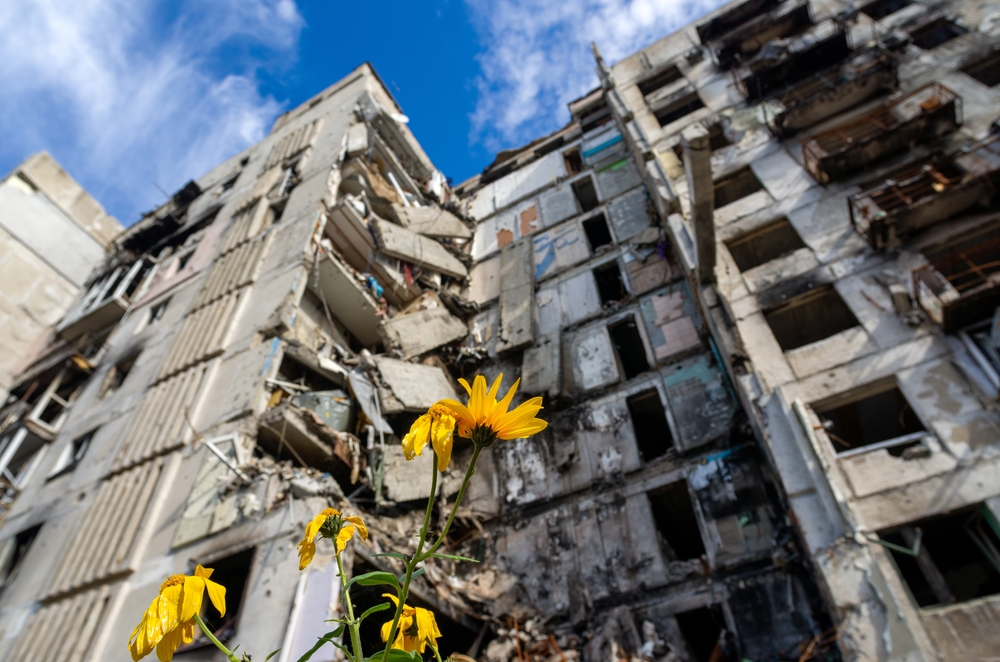
The impression left by Kherson was particularly harrowing. Almost every building in the city has been destroyed: the war has left its mark on every street. Part of the city is still under occupation, and even the liberated part has found no peace: there is no water. The cause is a tragedy that has shocked the whole world: the destruction of the dam on the Dnipro, following which many people died and their bodies still lie in the water. For this reason, the city’s water supply system is no longer usable: it has become a source not of life, but of danger.
This is one of the most painful paradoxes of war: liberation does not always mean a return to normal life. People regain their freedom of movement, but lose the most essential things – clean water, a safe home, the certainty that tomorrow will be like today.
The situation in the occupied part of the city is a wound in its own right, an even deeper one. Those who have remained there are experiencing something that, in the 21st century, seems impossible: the occupying authorities do not allow humanitarian aid to reach the population, and Russia itself provides no aid whatsoever. To survive, people are eating rats, pigeons and crows. For five years they have had neither electricity nor water: conditions that we take for granted as essential have become an unattainable luxury there.
Survivors of captivity
The nuns spoke with women and men who had survived captivity. Conversations of this kind require particular sensitivity and patience: the trauma of captivity lingers for a long time in the body and in the memory, and every account takes an immense toll on those who recount it. The very fact that these people have found the courage to speak is, in itself, an act of extraordinary courage.
One of the men the nun spoke to told a story that reveals another dimension of this war: the use of humiliation as a means of exerting pressure. He recounted how Russian soldiers stopped the bus he was travelling on and forced all the passengers to speak exclusively in Russian. They then forced them to strip completely naked in the middle of the road. This was not merely an act of cruelty: it bears witness to how the occupation seeks to break a person not only physically, but also inwardly, by depriving them of the most fundamental things – the right to their own language, to their own body and to their own dignity.
Among the stories that left the deepest mark on the nun is that of a fifty-six-year-old woman who now looks decades older. The discrepancy between her outward appearance and her biological age is a silent testament to what the war has done to her. She sustained a very serious injury caused by a missile explosion and, holding her abdominal organs in her own hands, made her way to a doctor on her own. It is difficult to find the right words to describe such an experience. It is a story not only of physical suffering, but also of a will so strong that it keeps the body moving even when movement seems impossible.
Giving children the chance to study again
Among the people the nuns met was a family with two children aged eleven and thirteen, both seriously injured. Where they currently live, it is impossible to attend school: there is neither safety nor suitable conditions. Upon hearing this story, we decided to offer these children an opportunity and invited the family to move in with us. This decision is not merely an act of mercy. It is a recognition that a child’s education and future should not depend on where the front line happens to be at that moment.
One of the most significant details of this journey is a warning that the nun received and experienced first-hand: in the city, one must walk with extreme caution, because landmines are hidden everywhere. Stated matter-of-factly, this sentence actually describes a completely transformed reality: a space that was once a normal city made up of pavements, courtyards and parks now demands constant vigilance. Even a simple walk becomes a decision that requires constant risk assessment.
What to do with what has been seen
Returning home did not bring this story to a close; on the contrary, it became its continuation. Having seen with her own eyes how people live practically on the front line, Sister Ligy – together with all her fellow sisters who had stood in for her at home, who had prayed and awaited their return – realised that simply recounting what she had seen was not enough.
So a decision was taken: to direct all our efforts towards helping the families who are still living practically on the front line and have no chance of moving to a safer place. These are people who, for various reasons, cannot leave: some have nowhere to go, others lack the means to leave, whilst others are simply so exhausted that they no longer have the strength to face yet another move into the unknown.
We recognise that we, too, sometimes live under bombardment and that this leaves its scars. But it is impossible to compare our experience with what is happening on the front line, in devastated Kherson or in the places from which people are emerging after captivity. The difference is too great for our ordeals to be considered equivalent.
That is precisely why it is our duty not to remain silent about what we have seen, but to take action: to seek donors, to build homes, to offer families a real chance to move to a place where hourly bombardments are not part of daily life. Every house built is not just a roof over one’s head. It is the chance for a child to return to school, for parents to stop counting the minutes between air-raid sirens, and for a family to start living again rather than merely surviving.

.png)
07/02/2019 17:28










