








Japan, NGOs against xenophobia in election campaign
Human rights and religious organisations denounce the increase in xenophobic rhetoric ahead of the 8 February vote. In a joint statement, they call on parties, candidates and the media to condemn hate speech. Criticism of the government's policies Takaichi: ‘We want a society where the human dignity of all is guaranteed’.
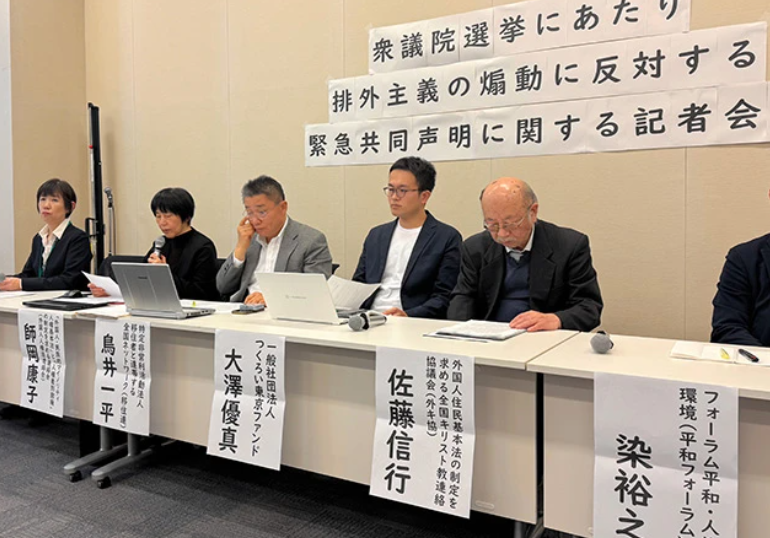
Tokyo (AsiaNews/Agencies) - ‘Hate speech is not acceptable in election campaigns.’ This is the strong message from a group of human rights and religious organisations in a joint statement ‘against incitement to xenophobia’. Japan is grappling with its shortest post-war election campaign, following the dissolution of the lower house ahead of the 8 February 2026 elections, confirmed by Prime Minister Sanae Takaichi, who aims to strengthen support for the ruling coalition between the Liberal Democratic Party (LDP) and Nippon Ishin.
The statement - signed, among others, by Christian NGOs such as Gaikikyō, which is committed to protecting the rights of foreign residents in Japan - is addressed to political parties and potential candidates. It denounces the increase in ‘manifestations of hatred against the Kurdish people and Kurdish children’ living in the country. It also condemns widespread stereotypes such as “foreigners receive preferential treatment” and “commit more crimes” as false. Meanwhile, the false belief in a “silent invasion” is widespread, fuelled over the years by political campaigns on social media, such as the “Japanese First” campaign by the anti-immigration Sanseito party.
Among the signatories is the NGO Solidarity Network with Migrants Japan (SMJ), founded in 1997, which last year brought together 274 organisations in a statement against anti-foreigner messages in the campaign for the Upper House elections in July 2025. In the current electoral context, the measures taken by the government towards non-Japanese citizens are also denounced. “The latter do not have the right to vote, and becoming a public official or receiving social benefits is not recognised as a legal right,” the statement says. Thus, xenophobic agitation is described as “extremely dangerous”.
In the text, the group reports on the tense climate that accompanied the Upper House elections six months ago, with a veritable ‘race to incite xenophobia’, confirmed by the rise of the far-right Sanseito party. Nor is any leniency shown towards the decisions of the Takaichi administration. It is pursuing ‘restrictive measures’, including ‘stricter controls on residence permits’ and the exclusion of foreign nationals ‘from the free education system’. Furthermore, since May 2025, the “Zero Illegal Immigration Plan for the Safety and Protection of the Japanese People” has been “aggressively” enforced, with deportations doubling compared to 2024.
The organisations reiterate that the belief that foreigners have access to preferential treatment - in areas such as healthcare, pensions and scholarships - is “unfounded and false”. What is being denounced is “legal discrimination”. For example, Japanese citizens receive a fine of “up to 50,000 yen” for failing to report a change of address, while foreigners receive a fine of “up to 200,000 yen”. All of this is incompatible with the United Nations International Convention on the Elimination of All Forms of Racial Discrimination (ICERD), to which Japan is a signatory.
“Since October last year (Takaichi has been leading the country since 21 October 2025, ed.), demonstrations and street protests against foreigners and Muslims have increased, and hate speech online has multiplied,” the signatories of the joint statement note. Meanwhile, everyday discrimination has also worsened, as ‘some people are denied access to housing or parking spaces, their credit card contracts are not renewed, and their classmates tell them that “Japanese people have priority”,’ they say.
Ahead of 8 February 2026, the NGOs are calling for: candidates to refrain from ‘prejudice against foreigners’; condemnation by the government and local administrations of “hate speech”; verification by the media of campaign issues, accompanied by condemnation of “rumours and hate speech, rather than treating them as legitimate opinions”.
‘We fear that these elections will see a further incitement to xenophobia, spreading fear among people of foreign origin and leading to violent attacks aimed at silencing voices that oppose discrimination,’ the signatories conclude. ‘We want to create a society where there is no discrimination based on nationality or ethnicity, where the human dignity of all is guaranteed, where we can have hope for the future and live in peace.’

.png)
07/02/2019 17:28
12/02/2016 15:14
11/08/2017 20:05










