








Leo XIV hopeful that sport can truly be ‘life in abundance’
In a letter released on the opening day of the Winter Olympics, the pontiff, a sports enthusiast, offers his thoughts on the value of sports, citing the prolonged rally of tennis as an example of the ability to improve oneself through such activities. At the same time, he warns against undue competition that sidelines the culture of encounter, as well as doping and the use of technology that focuses solely on improving performance while losing sight of the individual.
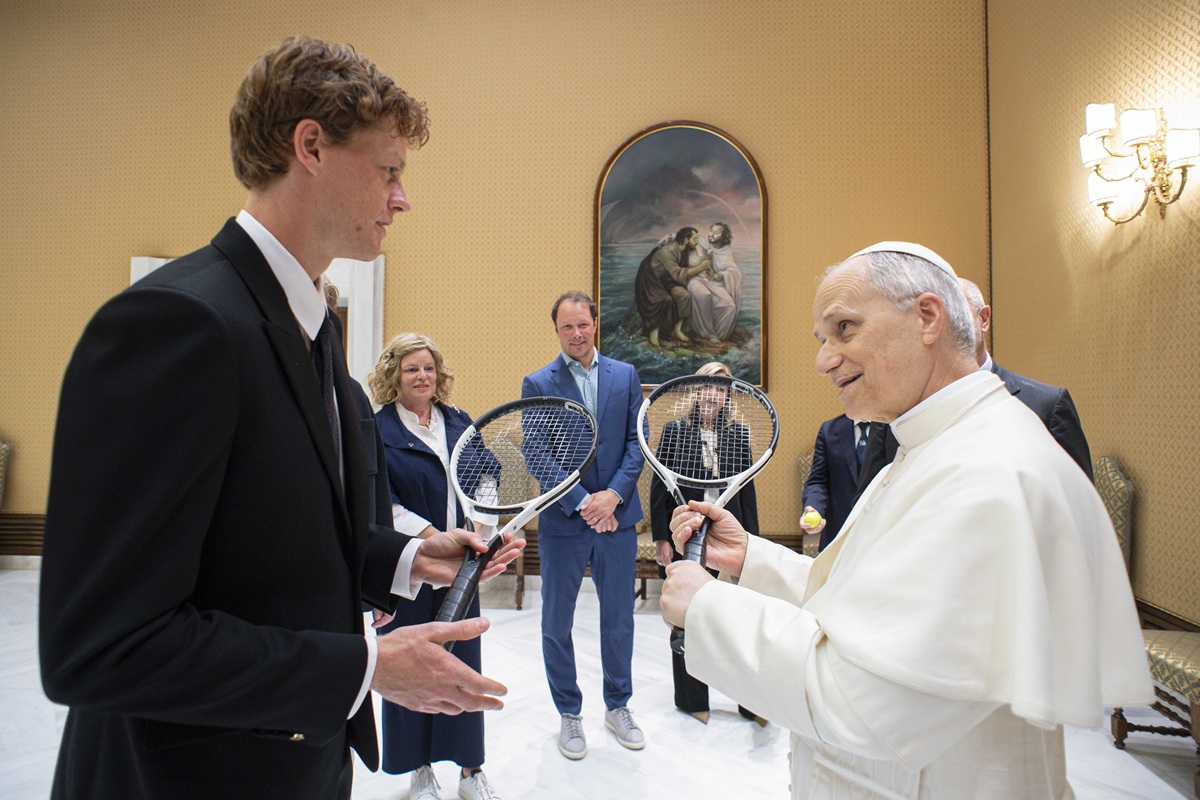
Vatican City (AsiaNews) – Pope Leo XIV released a long letter titled "Life in Abundance”, centred on the "value of sport”, on the first day of the Milano Cortina 2026 Winter Olympics, which opened today in Italy.
In it, the pontiff stresses that the games should not be just a grand event featuring competitions, live TV coverage, and medals, but should also stimulate a broader reflection on the truest values of sport, such as asking oneself how to defend the games in a context where too many economic interests fuel wrong visions such as the pursuit of victory at all costs, even through doping.
The pope’s letter draws its title from a verse in the Gospel of John, “I came that they may have life, and have it abundantly” (Jn 10:10), and reflects his own love for and involvement in sports.
In it, Leo renews his call for an Olympic truce, urging everyone to grasp its deeper meaning. In fact, in ancient Greece, “The institution of the Truce stems from the conviction that participation in public games (agones) constitutes an individual and collective path toward virtue and excellence (aretē). When we engage in sport with this spirit and under these conditions, it promotes the growth of fraternal solidarity and the common good.”
Conversely, “war results from a radicalization of conflict and a refusal to cooperate with each other. Thus, the adversary is considered a mortal enemy, to be isolated and, if possible, eliminated.”
The letter, however, goes far beyond the Olympic event, offering a comprehensive reflection on sport in all its forms, including the way the Church has looked upon the formative value of sporting experiences since its origins.
This means turning to Saint Paul, who was well acquainted with the sporting traditions of the Greeks and cites them in his Letters, and Saint Bernard of Clairvaux, who reinterpreted knightly tournaments from a Christian perspective, as well as the great philosopher Saint Thomas Aquinas, who also reflected on the ethical significance of play.
Leo also cites the most recent pages of the magisterium from Saint Pius X to the two Jubilees of Sport celebrated by Saint John Paul II, and invites us to consider the significance of sport in other religious traditions and experiences since this they can be a stimulating ground for dialogue. Indeed, “there is much to be learned from the sporting traditions of indigenous cultures, African and Asian countries, the Americas and other regions of the world.”
Reflecting on the contribution of sport to personal development, the pontiff singles out tennis, a sport he loves to play. He is particularly enthused by the experience of “prolonged rally” between two players, because “this is one of the most enjoyable parts of a match,” when “each player pushes the other to the limit of his or her skill level. The experience is exhilarating, and the two players challenge each other to improve; this is as true for two ten-year-olds as it is for two professional champions.”
More generally, in playing sports, people tend to “focus their attention completely on what they are doing,” reducing “the tendency towards egocentricity.”
This very idea of stepping outside oneself to enter, through playing, into an intrinsically relational dimension is one of the central messages on sport proposed in Leo XIV's letter. It is the heart of the "tremendous educational opportunity” that the practice of any discipline offers, an aspect that becomes even more evident in team sports.
“It is not always easy to recognize one’s own abilities or understand how they can be useful to the team,” the pope notes. “Moreover, working together with peers sometimes involves dealing with conflicts and managing frustrations and failures. They even have to learn to forgive. In this way, fundamental personal, Christian and civic virtues take shape.”
This great potential also requires us to reflect on the risks that jeopardise the values of sport. Here too, Leo XIV's letter addresses a series of extremely timely issues in the world of sport.
The first one is the rise in some countries of the "pay-to-play" principle, which ends up excluding "children from poorer families and communities”. In other places, religious mistrust and fears prevent girls and women from participating in sports. Because of this, we must work "to make sport accessible to everyone.”
The pope goes on to warn against reducing sports to mere business.
“It is clear that money is necessary to support the sporting activities”, he writes, but when the profit-maximising mindset invades sport “attention is obsessively focused on results and the monetary rewards that winning can bring. In many cases, even at the amateur level, commercial demands and values have come to overshadow the human values of sport that ought to be safeguarded.”
For Leo, healthy competition cannot be separated from the culture of encounter.
“Winning is not simply outdoing others, but recognizing the value of the journey, of discipline and of shared commitment. Losing, in turn, does not entail personal failure, but can become a lesson in truth and humility. Sport thus teaches us a deeper understanding of life, in which success is never definitive and failure is never the last word.”
In the letter, the pope also addresses the issue of the “quasi-religious dimension” that sport takes on in the lives of many people today.
“Stadiums are perceived as secular cathedrals, matches as collective liturgies and athletes as saviors. This sacralization reveals an authentic need for meaning and communion, but risks stripping both sport and the spiritual dimension of their essence. When sport claims to replace religion, it loses its character as a game that benefits our lives, becoming instead aggrandized, all-encompassing and absolute.”
This applies to the sacred but also to other distorted perspectives that exploit sport.
“When sport succumbs to the mentality of power, propaganda or national supremacy, its universal vocation is betrayed.” Instead, “Major sporting events are meant to be places of encounter and mutual admiration, not stages for the affirmation of political or ideological interests.”
Dangers associated with new technological frontiers are also changing the way we experience sports today. In this context, the use of artificial intelligence focused solely on improving performance risks “introducing an artificial separation between body and mind, transforming the athlete into an optimized, controlled product, enhanced beyond natural limits.”
Indeed, there is a danger of turning sport into "a laboratory for disembodied experimentation," losing the idea of an activity for "people of all ages, social conditions and abilities, thereby serving as an instrument for promoting integration and dignity."
The same argument applies to the growing assimilation of sport to the logic of video games, with the "reduction of experience to scores, levels and replicable performances”.
“The game, which always involves risk, unpredictability and presence, is replaced by a simulation that promises total control and instant gratification. Recovering the authentic value of sport therefore means restoring its incarnational, educational and relational dimension, so that it can continue to be a school of humanity and not simply a device for consumers.”
For all these reasons, the letter “Life in Abundance” renews the Church’s commitment at all levels to the pastoral care of sport.
For the pope, “sport is an activity that forms imaginations, shapes lifestyles and educates young generations.” Hence, “it is necessary for particular Churches to recognize sport as an opportunity for discernment and accompaniment and to offer human and spiritual guidance.”
“The Church,” Leo writes, “is called to be close to the world of sport when it is played professionally, as an elite competition, or as an opportunity for success or media exposure, but also through a particular concern for grassroots sport, which often has a scarcity of resources but is rich in relationships.”
Ultimately, she can “offer accompaniment, discernment and hope. In this way, sport can truly become a school of life, where all can learn that abundance does not come from victory at any cost, but from sharing, from respecting others and from the joy of walking together.”

.png)
15/02/2025 15:32
09/10/2025 18:42










