








Seoul one year after the attempted coup. Lee: 3 December Sovereignty Day
Twelve months after the dramatic night when his predecessor Yoon tried to impose martial law, the current president praises the resilience of South Korean democracy and nominates the Korean people for the Nobel Peace Prize. Twenty-five members of parliament from the then ruling party also issued a public apology. Meanwhile, the trials continue: 14 years sought for corruption for the former first lady.
Seoul (AsiaNews) – In a speech to the nation on the first anniversary of his predecessor Yoon Suk Yeol's failed attempt to impose martial law, South Korean President Lee Jae Myung declared his intention to designate 3 December as ‘National Sovereignty Day’, arguing that what happened a year ago ‘demonstrated South Korea's democratic resilience to the world’.
Lee also said that, having ‘defeated an unjust power’ by peaceful means, the South Korean people fully deserved the Nobel Peace Prize. ‘It was the first time since the beginning of the 21st century that a coup d'état had occurred in a democracy like South Korea,’ Lee added.
At the same time, in an unprecedented move in world history, the coup was peacefully and splendidly prevented by unarmed citizens. The government, born out of the “light revolution”, will designate 3 December as National Sovereignty Day to honour the great courage and actions of the South Korean people."
On 3 December 2024 - faced with political deadlock created by tensions in the opposition-controlled parliament - then-President Yoon Suk Yeol declared martial law, invoking emergency powers to establish military control and citing what he described as ‘government dysfunction’ and the need to eliminate pro-North Korean forces and defend the constitutional order.
The decree was overturned by the National Assembly in less than three hours, and Yoon formally revoked it later that day. He was then impeached, leading to new presidential elections won by Lee in July.
Former President Yoon remains in prison, and his trial for insurrection is expected to conclude in the coming weeks. Meanwhile, just today, the prosecution sought a 15-year prison sentence for his wife, Kim Keon Hee, who is accused of corruption for a series of gifts she accepted during her husband's term in office. The legal aftermath of the events of a year ago shows how deep the polarisation in the country remains.
‘Severe punishment for those involved in the coup is only the beginning,’ Lee said in his speech, defending the investigations. "To build a nation where no one can ever dream of a coup again and where no one can threaten the light of popular sovereignty, “righteous unity” is essential. Together with the great people of South Korea, who lit the torch of democracy,‘ he concluded, ’we will ensure that the revolution of light is fully accomplished."
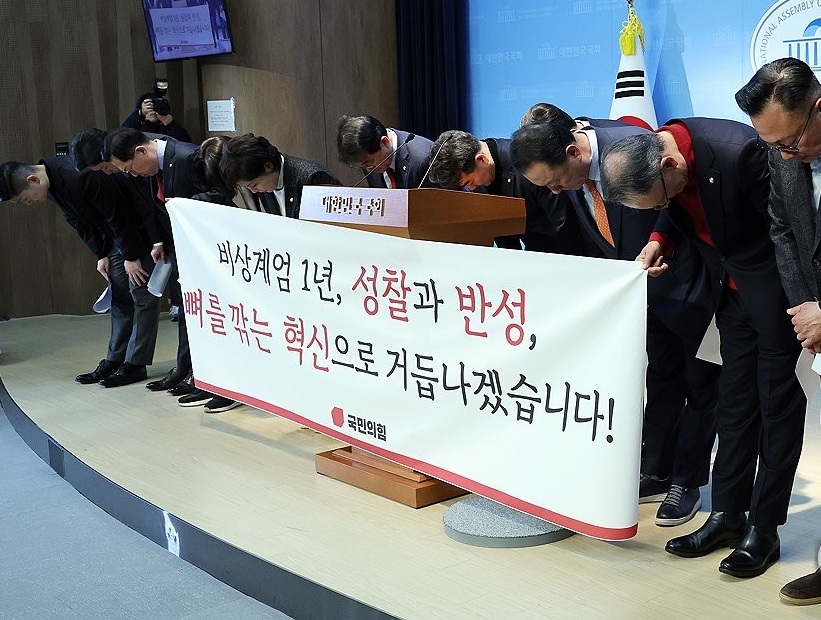
Meanwhile, today, 25 MPs from the People Power Party - the political force that supported Yoon, now in opposition - apologised to the nation for the failed attempt to impose martial law, promising to sever ties with the former president.
They called last year's action ‘unconstitutional and anti-democratic,’ saying it crushed the liberal democracy that South Koreans had built ‘with their blood and sweat.’ “We deeply apologise to the public, as members of the then ruling party, for failing to stop martial law in advance and for causing great pain and confusion,” they said, bowing their heads in apology.
Separately, PPP leader Jang Dong-hyuk posted a message on Facebook, saying he felt a ‘deep responsibility’ as party leader for the martial law crisis and Yoon's subsequent impeachment, which led to a ‘series of political tragedies’ and caused deep disappointment and confusion among the public.
Only 18 of the PPP's then 108 MPs on 3 December 2024 participated in the parliamentary vote to revoke Yoon's decree, which passed unanimously the following morning with 190 MPs present out of the 300 members of the Assembly.

.png)
12/02/2016 15:14
11/04/2024 16:59
20/01/2025 18:38










