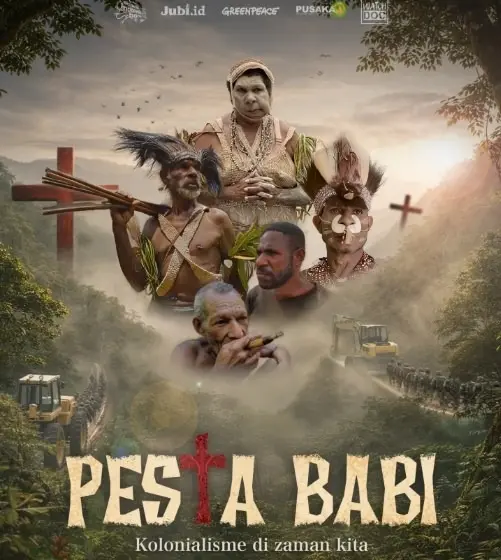
Jakarta (AsiaNews) - “Pesta Babi: Kolonialisme di Zaman Kita” (“The Pig Feast: Colonialism in Our Time”) is a documentary on the rapid deforestation in South Papua caused by the expansion of large-scale agribusiness, including sugarcane plantations for bioethanol production.
The documentary, the work of two young filmmakers – Cypri Paju Dale and Dandhy Laksono – is becoming a source of embarrassment for the Indonesian government of President Prabowo Subianto, as it exposes the reality faced by Papuan indigenous communities struggling to protect their ancestral lands from massive projects promoted under slogans such as “food security” and “energy transition”, amidst militarisation and a long history of exploitation.
The film shows how these projects are encroaching on 2.5 million hectares of forest on which indigenous Papuan communities depend for their daily lives. It also highlights the role of the military in supporting and protecting these projects.
Through the testimonies of indigenous Papuans, the documentary reveals how many have rejected this type of development on their customary lands and wish to continue living with intact forests, clean rivers and traditional food sources.
For this reason, the film has sparked controversy in public debate as it is considered provocative and seen as discrediting the Indonesian government under President Prabowo, particularly regarding the National Strategic Project (PSN) known as the ‘Food Estate’ programme in Papua.
Unmasking the reality behind the slogans
The conversion of Papuan forests into industrial plantations is one of the largest deforestation projects in modern world history. As their customary lands fall within the concessions granted to companies, local communities have erected large crosses and traditional barricades as symbols of resistance. Across South Papua, it is said that at least 1,800 crosses have been erected to block companies and military forces, both physically and spiritually.
The documentary Pesta Babi tells this story and chronicles the Papuans’ struggle to defend their ancestral lands amidst accusations of separatism and the shadow of 60 years of Indonesian military operations linked to their exploitation.
“There is an ongoing practice of territorial control that the filmmakers describe as the new face of colonialism in the modern era,” writes human rights activist Sandyawan in a discussion group for former seminary students.
The film runs for 95 minutes and is based on events that took place in the most heavily damaged forest areas near Merauke, Boven Digoel and Mappi. Its main focus is on the lives and traditions of the indigenous Papuans, including the Marind, Awyu, Yei and Muyu sub-ethnic communities, who, according to the film, have lost thousands of hectares of land and living space due to the expansion of sugarcane plantations, oil palm plantations and food estate projects.
The documentary shows how customary forests have been massively deforested to make way for large-scale bioethanol production and food security projects. Meanwhile, local communities feel driven from their lands.
The title Pig Feast derives from a Muyu cultural tradition called Awon Atatbon, an important customary ritual involving pigs as fundamental social and cultural symbols. The tradition depends on the survival of Papua’s forests and natural environment. It is a metaphor for how the destruction of forests also threatens the cultural identity of indigenous communities.
Screenings and debates forcibly broken up
Discussions about the documentary have continued in university cafés and corridors, but intimidation is also on the rise. Several public screenings and debates have been forcibly broken up. Last week, at Mataram University in Lombok, West Nusa Tenggara, the disruption is said to have been carried out by the university authorities themselves. For many Indonesians, this is the result of government orders or pressure.
A similar incident is also said to have occurred in Yogyakarta, where, according to a Jesuit priest, a public screening of Pesta Babi was cancelled following pressure from the authorities. A screening and discussion event in Fort Oranje, in the North Moluccas, on Friday evening was also reportedly broken up by local security forces.
For environmentalists and those concerned about the survival of Papua’s indigenous communities, the film is now much more than a simple cinematic work on environmental destruction in Papua. It is seen as a satire, a symbol and a mirror for those who do not want to face reality.
“Art is a mirror. When that mirror reflects the ugly face of power, it is not the mirror that gets angry, but those who fear being seen,” wrote one commentator on social media.
“The logic behind these acts of prohibition is difficult to understand. The ban on social analysis and critical studies through cinema by intellectuals and academics seems to confirm Louis Althusser’s argument that educational institutions have the potential to position themselves as state ideological apparatuses operating in favour of those in power,” interfaith activist Indro Suprobo told AsiaNews.