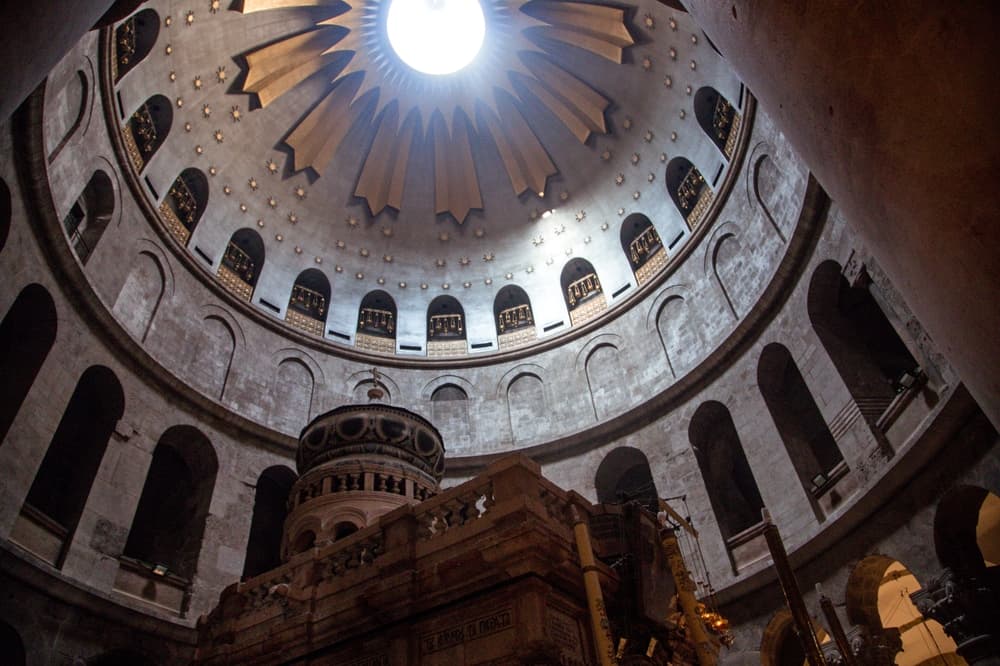
Milan (AsiaNews) – The Latin Patriarchate of Jerusalem and the Custody of the Holy Land issued a new joint statement today, which fortunately puts an end to the crisis that began yesterday morning when Cardinal Pierbattista Pizzaballa and Franciscan Custos Francesco Ielpo were not allowed to enter the Basilica of the Holy Sepulchre in Jerusalem for the celebration of Palm Sunday Mass.
“In agreement with the Israel Police, access for representatives of the Churches has been secured in order to conduct the liturgies and ceremonies and to preserve the ancient Easter traditions at the Church of the Holy Sepulchre,” the statement reads.
“Naturally, and considering the current state of war, the existing restrictions on public gatherings remain in force for the time being. Accordingly, the Churches will ensure that the liturgies and prayers are broadcast live to the faithful in the Holy Land and throughout the world,” it adds.
The liturgy was supposed to be held yesterday without the presence of the faithful but livestreamed; however, Israeli police prevented it, citing current regulations prohibiting gatherings, including those for religious liturgies, due to the dangers associated with missile launches from Iran.
After the news made headlines around the world yesterday, sparking critical reactions even from political leaders who are very close to Prime Minister Benyamin Netanyahu – such as US Ambassador to Israel Mike Huckabee and Hungarian Prime Minister Victor Orban, to name just two – the Israeli leader announced late yesterday evening in a post on X that he had instructed that Patriarch Pizzaballa be granted "full and immediate access" to the church.
The most logical solution, therefore, prevailed, upholding both security and the right to pray. This is why yesterday's events deserve some thought, because – notwithstanding the current situation – what is at stake is the way in which the religious relevance of Jerusalem is addressed for its various communities.
In their statements yesterday, Israeli authorities justified the ban by citing decisions taken solely to protect the safety of the two clerics, who, by celebrating at the Holy Sepulchre, would have exposed themselves to risks in the event of an Iranian missile attack.
This explanation does not hold up. Anyone who knows anything about Jerusalem knows that both the Latin Patriarchate, where Cardinal Pizzaballa lives, and the Monastery of Saint Saviour, where the Custos of the Holy Land, Brother Ielpo, has his seat, are located in the Christian Quarter of the Old City.
This means they are just over 100 metres as the crow flies from the basilica, in areas where debris from an intercepted missile could equally fall, as was the case in recent days. Both are historic buildings with the same characteristics as the Basilica of the Holy Sepulchre.
It is unclear what would be the "greater risk" if the two had been allowed to individually access the basilica of which they are the highest representatives in the Latin Church, to hold at least one celebration on behalf of the entire Catholic community of the Holy Land on an important feast day.
For this reason, it is much more likely that the real reason for the denial, which came after an express request, was different: The authorities did not want to allow any liturgy, regardless of its form, to avoid setting precedents that would also create complications with other religious communities.
Essentially, it was a matter of asserting that, in an objectively difficult situation, it is ultimately the Israeli government that decides what can and cannot take place in the shrines of the various denominations.
This is the crux of the matter that caused the scandal in Jerusalem on Palm Sunday. It is no coincidence that the protest issued yesterday by the Patriarchate and the Custody cited the rules of the status quo, that is, the customary norms that have safeguarded the rights of all religious denominations in Jerusalem since Ottoman times.
These are not ancient privileges, but a way for Muslims, Christians of all denominations, and Jews to live side by side, a system that the city's troubled history has shaped through many arduous days, just like yesterday.
The system has weathered storms no less severe than the current war in the Middle East. And it must be safeguarded not as a partisan demand, for there is no path to peace in Jerusalem that does not take into account respect for everyone's religious identities.
Failure to understand that for Latin-rite Catholics, it is essential to be able to celebrate, at least symbolically, the liturgies of Holy Week inside the Basilica of the Holy Sepulchre, means failing to recognise the ABC of Jerusalem's plural identity.
The same will apply next week for the Orthodox, just as it does in the coming hours for Passover, and just as it did a few days ago for Muslims during Ramadan.
Insisting on a presence at the Holy Sepulchre in a manner that does not imply any disobedience to the regulations on public gatherings (in fact, Palm Sunday procession had already been cancelled) was not a show of strength, not even a gesture of heroism. It was simply a way to remind ourselves that Jerusalem, even during a war, remains a place impossible to coerce because of purely political and military considerations.
Conscious of this and despite living in the same city now coping with Iranian missile alerts, many Israeli Jews yesterday said that the application of the rules was too rigid.
For this reason, we should ask ourselves whether the lack of understanding of the importance of Holy Week on the part of those who decided to deny it really came out of nowhere. Whether it was not the product of the steady growth in the Netanyahu era of a certain way of looking at the "one and indivisible capital”, with a form of nationalism that has favoured everything related to its Jewish history at the expense of the other (undeniable) faces of the Holy City.
Is it just a coincidence that this is happening when the Interior Ministry, responsible for the police in Jerusalem, is firmly in the hands of the same circles that nurture extremists who, in the alleys of the Old City, spit on the ground when they meet a Christian cleric.
Let's not forget what is happening in Taybeh, the only Christian town in the West Bank, which has been targeted by settler raids.
There is, however, another factor worth highlighting. Netanyahu's green light, late yesterday evening, came after many governments around the world had taken a stand. It is a testament to how the Holy Places of Jerusalem have a meaning that is, by their very nature, universal. This is precisely why the Holy See has consistently called for an internationally guaranteed status for the Holy City.
Yesterday demonstrated what this means in concrete terms. At its root is not a notion of political interference, but the need for the meaning each religious community attributes to Jerusalem be respected by whoever rules the city. It would also be good for those who care about Israel's future to remember this.
Finally, the question is: With all the violence of war, was it really that important to further inflame passions with a controversy over a religious celebration? The question is poorly asked because it is rooted in bias, i.e. the idea that Jerusalem is something else.
The Holy Places are evocative monuments, visited by throngs of tourists and devout pilgrims in times of peace, where picturesque rituals can be observed with aesthetic satisfaction; at the same time, the right to pray expresses a world other than the harsh reality of those who live every day in this land.
No city in the world bears witness like Jerusalem to the living presence of religious communities. Like it or not, they are the heart that makes this city unique.
For the Christians of the Holy Land, refusing to live this war-torn Easter away from the Holy Sepulchre means affirming a very specific idea.
The cross and the empty tomb that we have venerated for centuries inside that basilica are the path to truly facing reality, moving beyond the ideologies steeped in hatred and violence that are reducing the Middle East to rubble.
They are the path to reconciliation, respecting all believers living in this Holy Land, so as to face the challenge of peace together, even with tools like the status quo of Jerusalem, which, despite all its limitations and fragilities, has for centuries embodied the idea that it is possible to live together. Even in the midst of conflict.









.webp&w=3840&q=75)