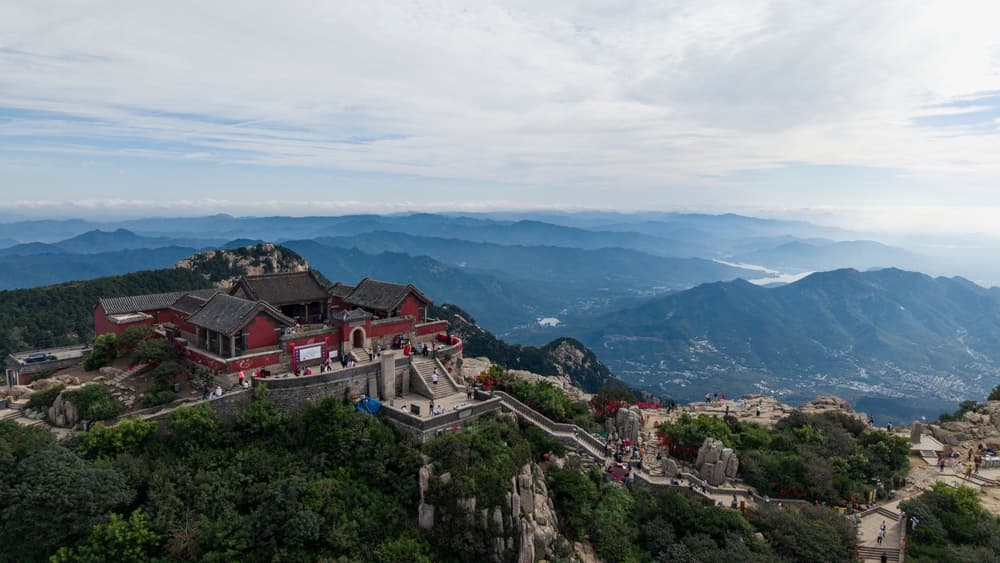
Beijing (AsiaNews/Agencies) – A vast enclosure around Mount Tai, one of China's most famous mountains and a UNESCO World Heritage site, is sparking heated debate among the Chinese.
According to several local media, a barrier consisting of mesh topped with roller-style bladed barbed wire spanning about 135 kilometres along the border between the cities of Jinan and Tai'an, Shandong Province.
The project, with an estimated cost of 25.19 million yuan (US$ 3.7 million), has virtually sealed off most of the areas not open to tourism.
Authorities maintain that the fencing was built primarily to prevent forest fires and stop people from accessing unauthorised trails, “wild hiking”, which has reportedly caused accidents in recent years, and increased the risk of starting fires.
However, the official claims have not convinced a significant portion of the public. Many people, hikers, and environmentalists believe that a barrier of this type, normally used for prisons, military borders, and high-security areas, represents an excessive measure that is disproportionate to the stated objectives.
According to witness stories reported by Chinese media, the new infrastructure significantly alters the natural landscape of Mount Tai, one of China's five sacred mountains, a place of spirituality and an important symbol of the country's culture for over 3,000 years.
Many residents also complain that the fence impedes traditional access to the mountain for locals, limiting activities practised for generations.
Another criticism concerns the environmental impact. Experts and residents fear that a continuous barrier of this size could hinder the movement of wildlife, fragment natural habitats, and compromise the ecological balance of the area.
Some observers also question whether such an invasive project could negatively impact the image of the site, recognised by UNESCO as a World Heritage Site.
The authorities' communication team further fuelled the controversy. Journalists who sought clarification from the Mount Tai Scenic Area Management Committee report being sent on a wild goose chase between various offices, without receiving a straight answer.
Available public documents show that the project is part of a broader programme to boost security in the tourist area.
One of the tenders published at the end of 2025 allocated over 4.16 million yuan for a specific lot dedicated to fence construction.
In recent years, the park has also promoted the construction of a "fire safety corridor" around Mount Tai, comprising dozens of kilometres of similar structures.
For the authorities, since 2022 such fencing has been part of an integrated fire prevention system based on technological surveillance, patrols, and physical barriers, with the aim of reducing both environmental risks and accidents caused by access to wild areas.
Despite these explanations, discontent continues to grow on Chinese social media, where numerous photographs and videos of the fence have been circulating with many accusing the local government of choosing the simplest and most drastic solution, rather than investing in more balanced land management.
Among the most common comments are doubts about the barrier's actual effectiveness, even from an operational standpoint. Some question, for example, how rescuers can respond quickly in the event of a fire if large areas of the mountain are closed off by metal fences.
Others suspect that the real purpose of the fence is to limit free access to alternative routes, discouraging those seeking to avoid entrance fees to official tourist areas.