Beijing (AsiaNews/Agencies) – After the impasse was overcome last Thursday with the ordination of the bishop of Zhengzhou in the province of Henan, this morning a new episcopal ordination took place in the People's Republic of China, also with Vatican approval.
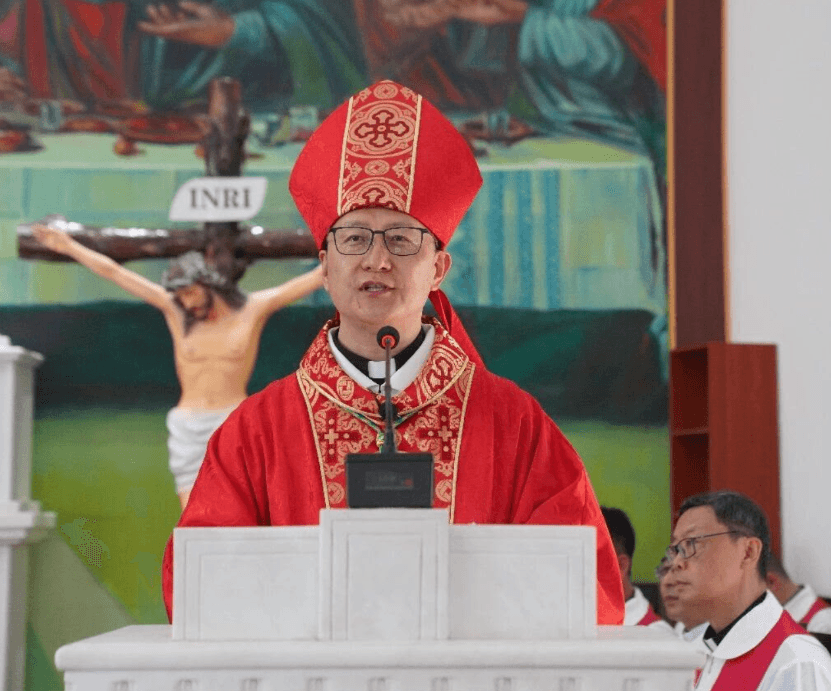
Fr Anthony Sun Wenjun, a 53-year-old priest, was consecrated bishop of Weifang, his native city, in the province of Shandong. He becomes the pastor of what until yesterday, according to the canonical map of the Church in China, was the Apostolic Prefecture of Yiduxian, which Pope Francis replaced with the Diocese of Weifang, with diocesan borders based on existing urban divisions.
Entrusted to the French Friars Minor in 1931, the Apostolic Prefecture of Yiduxian became vacant with the death in 2008 of Bishop Joseph Sun Zhibin, one of five bishops of Shandong ordained by Beijing without papal consent (therefore illegitimately) on 24 April 1988, but who eventually asked for and obtained permission to return to communion with Rome.
The consecration ceremony of Bishop Anthony Sun Wenjun took place this morning in the church of Qingzhou, which was also the seat of the Apostolic Prefecture of Yiduxian.
Bishop John Fang Xingyao of Linyi, honorary president of the Catholic Patriotic Association, led the service. The co-consecrators were Bishop Joseph Yang Yongqiang of Zhoucun, and Archbishop Joseph Zhang Xianwang of Jinang.
In announcing the ceremony, the Vatican Press Office noted that the appointment was made on 20 April 2023, as part of the Provisional Agreement on episcopal appointments, i.e. between the break made by Beijing with the transfer to Shanghai of Bishop Shen Bin (4 April) and Pope Francis’s subsequent approval (announced only on 15 July).
As usual, the website chinacatholic.cn, faithful to the principle of the "autonomy" of the Church in China, only mentions the election on 26 August 2022.
Today's is the first formal creation of a diocese by the Holy See in China since Mao's communist revolution. In fact, it is simply a geographical rearrangement of China’s dioceses by Chinese authorities in Beijing.
In 1949 the Catholic Church in China had 147 ecclesiastical entities divided as follows: 20 archdioceses, 96 dioceses (including Macau, Hong Kong, Baotou, and Bameng), 29 apostolic prefectures and two ecclesiastical administrations (Harbin and Hulubei'er).
According to Chinese authorities, there are 104 dioceses in China (excluding Macau and Hong Kong), redesigned following the boundaries of the civil administration.
The establishment of a diocese in Weifang is therefore an adaptation to this new geography, decided by the authorities and adopted over the years by the Church bodies controlled by the Party.
Even the elevation from apostolic prefecture to diocese is linked to the current structure of the "official" Church in China with no distinctions of rank: all are dioceses, without metropolises (including Beijing), or apostolic prefectures.
In its statement, the Vatican explains that "the territory of the Diocese of Weifang conforms to that of the main city of Weifang, with a total population of 9,386,705 inhabitants, 6,000 of whom are Catholics, served by ten priests and six religious Sisters.”
Back in 2021, when Francis Cui Qingqi was appointed "bishop of Hankou/Wuhan", the Holy See changed the name of the episcopal see; according to the Church geography of 70 years ago, it was an archiepiscopal see linked only to Hankou, one of the three cities that greater Wuhan municipality has incorporated.