

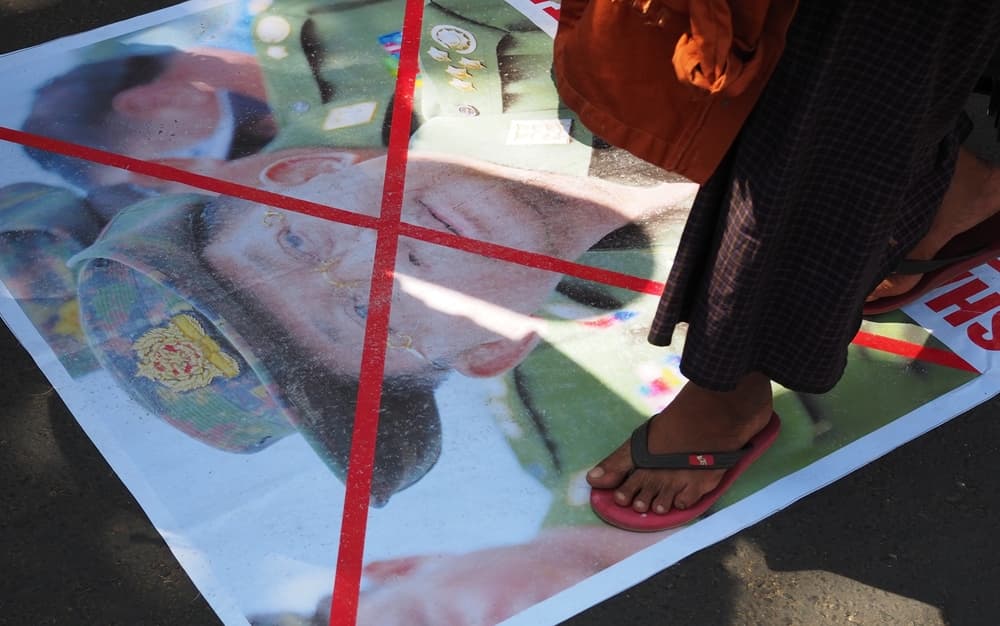
Yangon (AsiaNews) – In the capital Naypyidaw, Myanmar’s military junta has completed the formal transition to a formally civilian government under General Min Aung Hlaing, appointed president on 3 April. Meanwhile, elsewhere in the country, forces resisting this regime are trying to reorganise to propose a democratic and federal union.
This morning, Myanmar’s parliament – which is dominated by the pro-military USDP party that won in the sham elections held in December and January – approved a list of 30 ministers with most positions filled by former military officers or figures from the previous administration.
General Tun Aung, former head of the Air Force, takes over the Ministry of Defence, while former ambassador to China Tin Maung Swe moves to the Ministry of Foreign Affairs. Beijing has expressed its support for the new president, emphasising continuity in bilateral relations.
The transition was a formality designed to legitimise military rule dressed up in civilian clothes after Min Aung Hlaing resigned as Commander-in-Chief of Defence Services on 30 March, a move required to comply with the 2008 Constitution, drafted by the military, which bans serving members from assuming the presidency.
Command of the Armed Forces of Myanmar (Tatmadaw) passed to General Ye Win Oo, a key figure in military intelligence, whose rapid rise highlights his close personal ties to Min Aung Hlaing.
In his first speech, Ye Win Oo reaffirmed his commitment to the doctrine promoted by the current president ("Study, Train, Comply"), in full operational continuity.
General Kyaw Swar Lin was appointed deputy commander-in-chief of the Defence Services, replacing Soe Win, who many analysts believe is a potential rival to Min Aung Hlaing.
The current reorganisation consolidates the government’s control over the armed forces, minimising the risk of internal dissent.
But while the regime rebuilds its institutional façade, an alternative political project is taking shape in other parts of the country.
In remote regions and disputed territories, pro-democracy groups and the armed forces of ethnic minorities fighting the regime are consolidating an unprecedented political and military alliance with the aim of creating a federal union.
On that same 30 March, the National Unity Government (NUG) in exile, composed of former lawmakers from Aung San Suu Kyi's National League for Democracy (who was arrested during the 2021 coup and has been held incommunicado ever since), announced the creation of the Steering Council for the Emergence of a Federal Democratic Union (SCEF), a body that will transform the resistance from an informal military alliance into an institutionalised political structure.
The new council brings together key opposition actors: the NUG; the Committee Representing Pyidaungsu Hluttaw (CRPH), expression of the last democratically elected parliament in 2020; and the armed branches of the main ethnic minorities, including the Kachin Independence Organisation, the Karen National Union, the Karenni National Progressive Party, and the Chin National Front.
The project aims to highlight existing federal entities and ethnic organisations, in agreement with the people, and recognising the central role of women.
KNU leader Padoh Saw Kwe Htoo Win stressed this last point, noting how female participation is essential to the success of a future federal union.
The SCEF has set six key objectives: removing the dictatorship, ensuring civilian control over the armed forces, abolishing the 2008 constitution, drafting a new democratic federal charter, building the state on new foundations, and implementing comprehensive transitional justice processes.
According to the Special Advisory Council for Myanmar, which brings together expert observers, this is a “timely and significant development” that deserves the recognition and support of the international community, which should go hand in hand with cutting off relations with the military regime in Naypyidaw.
In effect, the NUG has adopted a pragmatic approach, leaving ethnic forces in charge of operations in their respective territories, particularly in Kachin, Karen, and Kayah States, where ethnic groups often cooperate with the People's Defence Forces (PDF).
Photo: Carsten Yangon / Shutterstock.com














