








At Rome’s Sapienza University, Leo XIV urged students to ‘study, cultivate, safeguard justice’
The pope visited Europe's largest university. He told students: "We are a desire, not an algorithm.” He told professors that “Teaching is a form of charity just like rescuing a migrant at sea.” He lamented “A world unfortunately distorted by wars”, and said not to call “‘defence’ rearmament, defence that increases tensions”. He slammed the “inhuman evolution of the relationship between war and new technologies”. Knowledge should help “discerning who one is.”
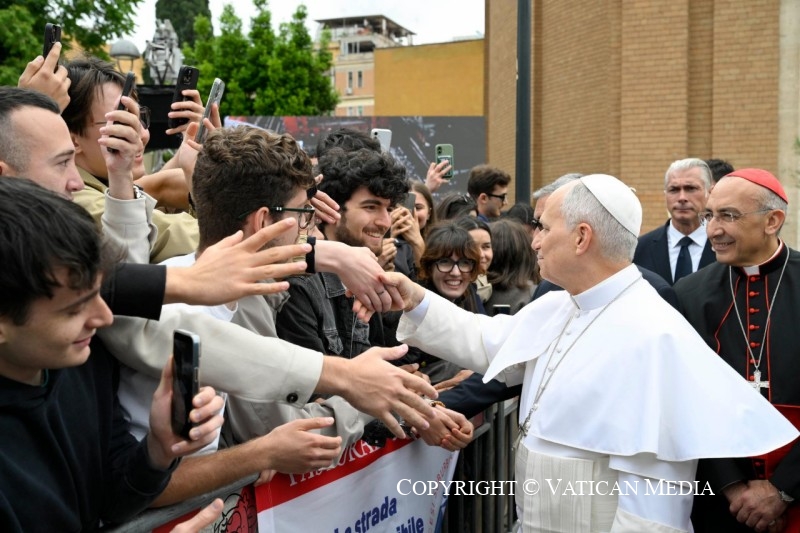
Rome (AsiaNews) – This morning, Pope Leo XIV visited Rome’s Sapienza University, which was founded by Boniface VIII in 1303, and is the largest in Europe in terms of students.
Before the current pontiff, Paul VI visited it in 1964. Benedict XVI was supposed to visit it in 2008, but cancelled following opposition from a group of physics professors, in a much-discussed case.
For the pope, the young people who walk across the imposing university campus every day carry with them a “restlessness” that gives rise to "conflicting feelings", that is hope in a future "yet to be written," fuelled by "youth” with a malaise caused by a "distorted system that reduces people to numbers."
Leo XIV spoke to the entire academic body, initially off the cuff, in the Chapel of Divine Wisdom, a place of faith and spirituality, located among the various faculties.
“Whoever studies, whoever seeks the truth, ultimately seeks God, will encounter God, will find God,” he said upon arrival.
In the university’s main auditorium (Aula Magna), he spoke to administrators and faculty, as well as students, to whom he devoted his deepest thoughts, noting that “many young people are struggling” due to the “blackmail of expectations,” the pressure to perform, and exasperated “competitiveness,” which fuel “spirals of anxiety”.
Such restlessness raises a question: “Who are you?” “We are our bonds, our language, our culture.” “We are a desire, not an algorithm!” he told the students.
At 10:17 am, Leo XIV stepped out of the car that had taken him from the Vatican to the university, where he was greeted by Rector Antonella Polimeni, the first woman to lead the Roman university, appointed in 2020, and the chaplain, Father Gabriele Vecchione.
After praying in the Chapel, he was taken to the rectorate. The press, including AsiaNews, and the academic community greeted the pope in the streets of the university campus; while they waited, people studied, read, and highlighted notes, as if this were only a temporary break from their university duties.
On the stage of the Aula Magna, Pope Leo XIV read his keynote address. Beginning with a reflection on youth distress, he addressed a question to the adults: "What kind of world are we leaving behind?" The answer was brief: "A world unfortunately disfigured by wars and by words of war,” which leads to the “pollution of reason."
This “simplification" must be countered with "care for complexity and the wise exercise of memory." Beginning with the "tragedy" of the 20th century, the pope cited the cry of his predecessors: "Never again war!" He puts his hope in a "spiritual alliance" with young people's "sense of justice," with their "vocation not to confine themselves within ideologies and national borders."
Leo went on to speak about the "huge" global military spending, "particularly in Europe," over the past year. "Let us not call ‘defence’ a rearmament that increases tensions and insecurity, impoverishes investment in education and health, denies trust in diplomacy, and enriches elites.”
He called for "monitoring the development and application of artificial intelligence in the military and civilian spheres," because the latter can worsen “the tragedy of conflicts”. In Ukraine, Gaza, Palestine, Lebanon, and Iran, there is an “inhuman evolution of the relationship between war and new technologies in a spiral of annihilation.”
The pontiff had already mentioned Gaza at the start of his speech, citing an agreement between the Diocese of Rome and Sapienza University to open a university humanitarian corridor from the Palestinian enclave. Rector Polimeni also spoke of the first students arriving in Rome from Gaza. Both speakers were greeted with prolonged applause.
On rearmament, the pope added: “Study, research, and investments must go in the opposite direction: they must be a radical ‘yes’ to life! Yes to innocent life, yes to young life, yes to the life of peoples who cry out for peace and justice.” More applause followed from the audience.
“Today, the implosion of a possessive and consumerist paradigm clears the ground for the new that is already sprouting forth: study, cultivate, safeguard justice! Together with me and so many brothers and sisters, be artisans of true peace: a disarmed and disarming peace, humble and persevering, working for harmony among peoples and the care of the Earth,” Leo said.
“Teaching is a form of charity,” he added, turning to the professors, “just as rescuing a migrant at sea, a poor person on the street, or a despairing conscience.” Inviting them to "cultivate fruitful contact with the minds and hearts of young people,” he noted that, “This is a demanding responsibility, certainly, but an exciting one."
Leo also urged them to often ask themselves: "Do I trust them?" this “is about always loving human life, valuing its possibilities, so as to speak to the hearts of young people." Indeed, “Knowledge, in fact, is not only useful for achieving professional goals, but also for discerning who one is."
Finally, Leo XIV spoke of the environment as a place for “shared commitment," citing Pope Francis's 2015 encyclical Laudato si', which refers to a “very strong scientific consensus”, about the “troubling” nature of global warming.
"More than a decade has passed since then, and despite good intentions and some efforts in that direction, the situation does not seem to have improved," he said. Against this background, “I especially encourage you, dear young people, not to give in to resignation, but instead to transform your anxiety into prophecy.”

.png)
16/01/2008
12/01/2006










