








At ninth party congress in Pyongyang sees Kim reshuffle its leadership, boosting his power
More than half of the members of North Korea’s main decision-making body has been replaced. Kim Jong-un's loyalists remain central, but some nuclear programme veterans have been removed. The strongman celebrates his “great successes” in the military and economic areas despite sanctions and isolation, reinforced by the axis with Russia. The approach to South Korea remains uncertain.
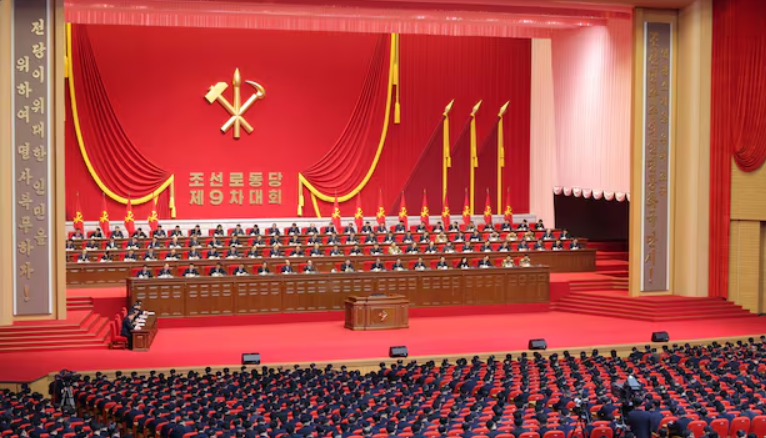
Pyongyang (AsiaNews) – North Korea’s leading decision-making body has been significantly renewed, with a reshuffle of its top members and possible adjustments in the regime’s stance towards South Korea.
At the ninth party congress, which opened yesterday, the praesidium, the party's main executive body, still has 39 members, like five years ago, but 23 were replaced, according to a report by the state-run Korean Central News Agency (KCNA).
With this reorganisation, Kim Jong-un removed several members of the old guard linked to the development of North Korea's nuclear programme from the ruling elite.
Prominent among them is Kim Yong-chol, former intelligence chief, considered one of the main architects of the hard line towards Seoul and Washington, whose influence had gradually diminished after the failure of the 2019 Hanoi summit between Kim Jong-un and US President Donald Trump.
Also leaving the praesidium are Pak Pong-Ju, a veteran economic reformer and former premier, O Su-yong, the party’s economic overseer, and Choe Hwi, a key figure in propaganda and sports diplomacy.
Kim Jong-un's closest aides, however, are firmly in place.
Jo Yong-won, secretary for organisational affairs and de facto second-in-command, has retained his position, as did Ri Il-hwan, head of propaganda and information.
Seated on the platform, Kim Yo-jong, the leader's sister, was reappointed. His daughter, Kim Ju Ae, whose possible presence had been the subject of much speculation, was a no-show.
Pak Jong-chon, vice chairman of the Central Military Commission and one of the main architects of the country's missile modernisation programme, was present.
In recent years, North Korea has developed more advanced solid-fuel intercontinental ballistic missiles, expanded its tactical options, and demonstrated progress in its naval programme, including the near completion of the hull of a nuclear-powered submarine.
These technological advances may have been facilitated by cooperation with Russia, to which Pyongyang has supplied troops and war materiel for the war in Ukraine.
A new 600 mm multiple rocket launcher, described by state media as super-precise, was also showcased yesterday. North Korea is reportedly investing in drones, artillery, and air defences.
Bolstered by these technological advances, Kim, in his opening speech to 5,000 delegates, celebrated the "great successes" achieved despite “harsh blockade and sanctions” and “successive natural calamities and the global public health crisis”, noting that in 2021, the country “could hardly maintain our own existence.”
Despite being one of the poorest countries in Asia (per capita GDP was estimated at US$ 640 in 2023 according to the United Nations), the North Korean economy has seen a recovery in recent years. The South Korean central bank has estimated growth of 3.1 per cent in 2023 and 3.7 per cent in 2024.
Experts attribute this improvement to arms exports to Russia and online cryptocurrency thefts, which are estimated to have generated approximately US$ 2 billion in 2025 alone.
The party congress also focused on the so-called 20x10 regional policy, a plan to develop 20 provincial areas each year over a ten-year period, with the goal of making rural areas more self-sufficient and reducing dependence on food rations distributed by the central government.
South Korean observers believe the leadership shakeup should be seen as a consolidation of Kim Jong-un's personal power, while North Korea's stance towards the South remains unclear.
The rise of Foreign Minister Choe Son-hui, a key figure in boosting ties with Russia, could signal a possible recalibration of Pyongyang’s diplomatic approach, after it abandoned reunification and redefined inter-Korean relations as between “two hostile states” at the end of 2023.

.png)
12/02/2016 15:14
26/08/2020 16:52










