








At the general audience, Leo XIV urged those in power to ‘avert a new arms race’
The pontiff called on the faithful to pray for "our brothers and sisters in Ukraine,” suffering from the cold and bombings. He expressed gratitude to dioceses in Poland and elsewhere for their assistance to the population. On the soon-to-expire New START treaty between Moscow and Washington, the pontiff urged action to “Ensure its concrete and effective follow-up.” Today’s catechesis was centred on “the Word of God in human words”.
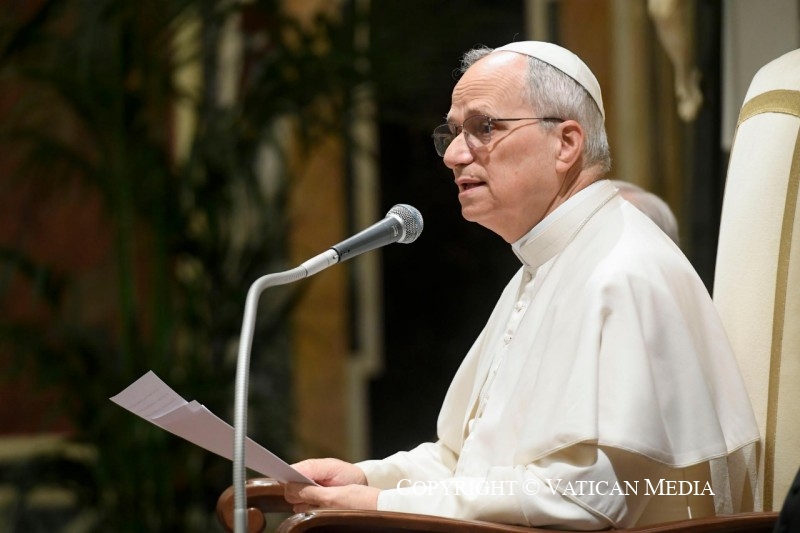
Vatican City (AsiaNews) – At the end of today's general audience, Wednesday 4 February 2026, held in the Paul VI Hall, Vatican, Leo XIV urged “everyone to support with prayer our brothers and sisters in Ukraine, who are being severely tested by the consequences of the bombings which have resumed, also striking energy infrastructure.”
In this regard, the pontiff expressed his gratitude for the initiatives of the dioceses in Poland and other countries, “which are working to help the people endure this time of extreme cold.”
The US-born pontiff also noted that tomorrow, 5 February 2026, the New Strategic Arms Reduction Treaty (START) on strategic armaments, signed by Moscow and Washington in April 2010 in Prague, is set to expire. This “represented a significant step in containing the proliferation of nuclear weapons,” he said. For this reason, he encourages “every constructive effort in favour of disarmament and mutual trust”.
Addressing those who have the power and responsibility, he urged them not to abandon “this instrument [. . .] without seeking to ensure its concrete and effective follow-up. The current situation requires that everything possible be done to avert a new arms race that would further threaten peace among nations”.
In fact, “It is more urgent than ever to substitute the logic of fear and distrust with a shared ethos capable of guiding choices towards the common good and to make peace a treasure to be cherished by all.”
At the start of the general audience, Leo continued his series of catechises on The Documents of the Vatican Council II, focusing today’s reflection, titled “The Sacred Scripture: the Word of God in human words”, once again on the Dogmatic Constitution Dei Verbum.
The document says that Scripture is “a privileged space for encounter where God continues to speak to the men and women of every time”. In it, “the words of God,” Dei Verbum emphasises, “have been made like human discourse”.
Since “making oneself understood to others is a first act of love,” God too “chooses to speak using human languages,” through “various authors, inspired by the Holy Spirit”. Thus, “not only in its content, but also in its language, the Scripture reveals God’s merciful condescension towards men, and his desire to be close to them,” Leo said.
Dei Verbum emphasises God’s authorship, as well as that of the hagiographers, the “true authors”, who should not to be seen as simple amanuenses for “God never mortifies human beings and their potential!”
“Scripture is the word of God in human words”. If we neglect the two dimensions of Scripture - human and divine – we risk “leading to fundamentalist or spiritualist readings of the Scripture, which betray its meaning.”
“This principle also applies to the proclamation of the Word of God: if it loses touch with reality, with human hopes and sufferings, if an incomprehensible language is used, uncommunicative or anachronistic, it is ineffective,” the pontiff explained. “In every age, the Church is called to re-propose the Word of God in a language capable of being embodied in history and reaching hearts.”
Loe quoted Pope Francis, who wrote: “Whenever we make the effort to return to the source and to recover the original freshness of the Gospel, new avenues arise, [. . .] for today’s world.”
Thus, the “Scripture is intended to speak to today's believers, to touch their present lives with their problems, to enlighten the steps to be taken and the decisions to be made,” serving “to nurture the life and charity of believers”.
In this regard, the pontiff also quoted Saint Augustine who wrote: “Whoever … thinks that he understands the Holy Scriptures … but puts such an interpretation upon them as does not tend to build up this twofold love of God and our neighbour, does not yet understand them as he ought”.

.png)
12/05/2025 20:14
14/06/2021 17:43










