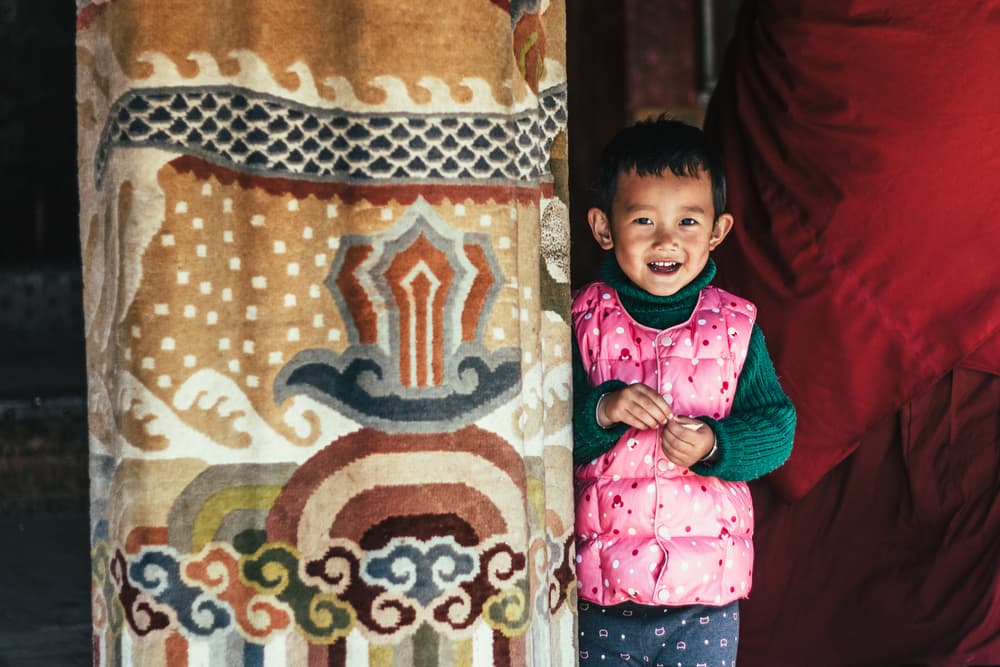
Milan (AsiaNews/Agencies) – Human Rights Watch (HRW) released a new report today titled Start with the Youngest Children: China Uses Preschools to 'Integrate' Tibetans. In it, the rights watchdog group notes that Beijing’s policy of erasing the local identity through forced assimilation and ideological indoctrination is now affecting even the youngest children in the Tibet Autonomous Region.
The study highlights how Tibetans are now forced to speak the “national Chinese language” from preschool onward in lieu of Tibetan. In some places, parents are pressured to provide videos proving that the same is happening at home.
The HRW study is based on an analysis of Chinese laws and policy documents, as well as interviews with seven Tibetans and scholars with recent and firsthand knowledge of living conditions in Tibetan areas.
In a 72-page analysis, the report documents how, starting with a specific 2021 directive from the Chinese Ministry of Education, the Children’s Speech Harmonization Plan, Tibetan language instruction is now severely restricted at a critical stage in language acquisition and identity formation, thus accelerating the erasure of the local language and culture.
“The Chinese government, by targeting kindergarteners, is accelerating its campaign to deprive Tibetan children of their mother tongue and their culture and identity,” said Maya Wang, deputy Asia director at Human Rights Watch. “This policy is not about education quality, but about forcibly assimilating Tibetans at an early age into a Han-centric national identity.”
Human Rights Watch found that many Tibetan children leave kindergarten unable or unwilling to speak Tibetan, even with family members. Parents reported that, within weeks or months of starting kindergarten, children switch almost entirely to Chinese.
The 2021 Harmonization Plan was the culmination of decades-long policy changes that reduced mother-tongue education for minority communities.
Since the 1984 Regional National Autonomy Law, China has moved through five phases toward compulsory Chinese education at progressively younger ages.
While this process had already been completed in primary and secondary schools, kindergartens remained the last setting where Tibetan could still be used as the primary language of instruction.
In 2021, the Ministry of Education ordered all kindergartens in minority areas to use the “national common language”, i.e. Standard Chinese, for all teaching and care activities.
Official references to "bilingual education" have disappeared from policy documents. A series of rulings, education laws, and government policies have also eliminated the remaining legal and political space for minority language education, while integrating political and cultural indoctrination throughout the school system, including preschool.
This culminated in the 2026 Law on Promoting Ethnic Unity and Progress, which imposes legal sanctions on anyone deemed to “obstruct” the learning and use of Chinese.
Although preschool is not mandatory on paper in China, HRW found that in Tibetan areas it has become mandatory in practice: primary schools in urban areas increasingly require proof of kindergarten attendance for enrolment, leaving parents with little choice but to send their children to Chinese-language preschools.
The authorities also require teachers to encourage or pressure parents and children to speak Chinese at home and to submit videos demonstrating this.
Government-appointed examiners have tested preschoolers' Mandarin skills through interviews and observation, despite regulations prohibiting exams and other academic pressure in kindergartens.
The language policy is also accompanied by intensified political and cultural indoctrination. Preschool programmes in Tibetan areas increasingly emphasise "patriotic education”, i.e. loyalty to the Chinese Communist Party, and identification as members of the “Chinese nation”.
Children are taught to celebrate Han festivals, recite Chinese classics, sing patriotic songs, and participate in activities that glorify the military and revolutionary history. Tibetan Buddhism and local cultural practices are absent from the curriculum.
For HRW, the accelerating language loss among increasingly younger Tibetans has profound cultural consequences. These include weakening communication between children and elders, disrupted family dynamics, reduced transmission of religious and cultural knowledge, and a growing perception among children that the Tibetan language and identity are inferior.
“This is not only about not teaching the Tibetan language,” said a Tibetan source interviewed by Human Rights Watch. “It is carefully done to manage the way children think and believe,” the source noted.
“The problem is that the kindergarten platform is designed in favor of the Han Chinese nationality – the way you talk, the topic, how to recognize objects, any knowledge that is introduced.”
In fact, “Not even a whiff of the Tibetan way of thinking is there. The result is that when the children come out of kindergarten at age 6, even if both parents are Tibetan, the children think that they are Chinese. … In a decade or two, maybe the culture will die, and be only in a museum.”