








Beirut challenges Tehran by expelling its ambassador, but deepens the rift with the country’s Shias
Expert wars of a "depressing and grim" situation in the country. Hezbollah’s accusations of treason, along with its open challenge to the government, threaten to further inflame the domestic situation. The arrival of US Marines in the region fuels fears of escalation. Meanwhile, Israel continues to advance across the border in the south.
Beirut (AsiaNews) – “It’s depressing and grim,” said Scarlett Haddad as she describes the internal “rot” in Lebanon, particularly following Foreign Minister Youssef (Joe) Rajji’s statement that Iran’s ambassador to Lebanon is persona non grata. The diplomat has until Sunday to leave the country. This is a turning point.
Rejected by Hezbollah, Amal, and the Supreme Islamic Shia Council, which called on the diplomat to remain in Beirut, Rajji’s decision is the most significant official challenge to Iran in years.
If it stands, it could lead to the withdrawal of Hezbollah ministers from the government. A cabinet meeting is got underway today to decide on this.
Whatever the outcome, the government will emerge weakened. If it backs down, it will effectively be a repudiation of its foreign minister, a representative of the Lebanese Forces party. If it maintains this position, the government could lose its “Shia legitimacy”.
This decision further exacerbates the level of internal political tensions and divisions, which could lead to an explosion, observers warn.
According to L’Orient-Le Jour, “polarisation has reached its peak: the slightest incident could tip the situation towards violence, something the various factions are still trying to avoid.”
What the ambassador’s expulsion revealed today, beyond the diplomatic aspect, is the emergence of two rival authorities in Lebanon, each accusing the other of “treason”, one for colluding with “the Israeli enemy”, the other for having “sold Lebanon to Iran”.
The rift within the population is deepening, and the spectre of civil war is looming again. The media landscape is also getting involved. “Television stations are no longer media outlets, but barricades,” exclaims a former militiaman.
A third way is also being considered by the parties representing the country’s Christian communities: “divorce,” in the form of extensive decentralisation that would fragment Lebanon into largely homogeneous communal areas.
In any case, it was with this tone intended to be final that Samir Geagea refused the establishment of a reception centre in Qarantina, a former Palestinian shantytown that was razed, converted into a market, and then abandoned, at the eastern entrance to Beirut. This area alone symbolises the civil war.
“As long as Hezbollah possesses weapons, this area could become a new no-go zone, both at the entrance to ‘Christian regions’ and at the entrance to Christian neighbourhoods of Beirut.” "The two roads to the airport and the port would thus be under control," said Amine Iskandar, a professor in Kaslik.
The deterioration is accelerating
“The deterioration is accelerating day by day,” noted Scarlett Haddad. “Iran’s rejection of President Trump’s peace plan, the insistence on the unity of the Iranian and Lebanese fronts, and the arrival of US Marines in the region reinforce the conviction that we are heading towards escalation.”
On a human level, people are both disoriented and divided, suffering not only from the conflicts but also from considerable impoverishment and economic decline. The war has plunged the country into a severe crisis, with a million people displaced out of a population of 5.5 million.
Grouped by families or neighbourhoods, near shops, the residents expelled from the southern suburbs have invaded certain Beirut thoroughfares with their cars. On Hamra Street, parking on both sides has turned the once-elegant street into a narrow corridor, a souk where only one car can pass at a time.
Traffic officers could think of nothing better to do than crack down. “It’s absurd,” protested the owner of a car that was towed away by a municipal truck in a free parking area. “My family is here, but if I need the car, it is miles away!”
Displaced people from the suburbs, still sporadically bombed, go home during lulls in the fighting to make sure their houses are still standing, take a shower, and return with a few belongings and supplies.
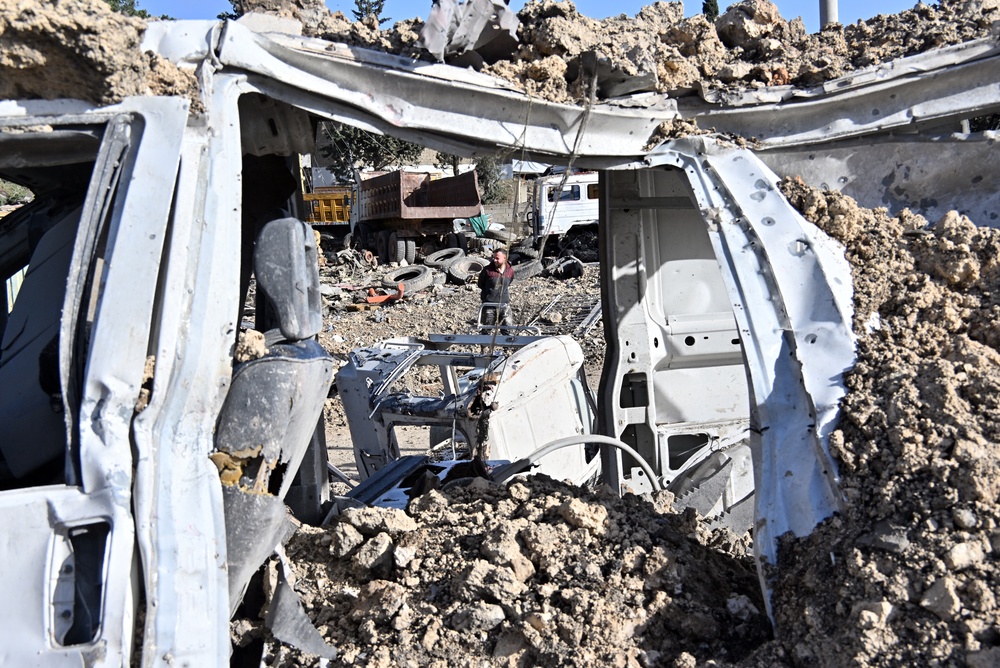
Currently, the Amana gas stations, a Hezbollah network, are being targeted by the Israeli air force, which is issuing evacuation orders day and night. The war has already claimed more than a thousand lives and left more than three times that number wounded.
The Israeli Invasion
On the ground, Israel is continuing to expand its ground offensive. Its army is advancing horizontally to disperse Hezbollah fighters and fragment the territory. For this reason, to cut off Hezbollah fighters from the rear, all bridges over the Litani River have been targeted.
The strategy of fragmenting the south is part of a broader plan: to control a vast area south of the Litani and turn it into a buffer zone off-limits to the population. This is already resulting in the systematic destruction of border villages and civilian infrastructure.
Aware that Iran considers this front to be joined to its own, Israel is talking about a protracted conflict, likely to escalate. Some Israeli ministers, such as Bezalel Smotrich, have even raised the idea of annexation.
In any case, Defence Minister Israel Katz has clearly stated that residents will not be allowed to return to the north of the Litani River before Hezbollah is dismantled and an agreement is concluded guaranteeing Israel's security, ultimately paving the way for negotiations that could lead to a peace deal.
According to some reports, the ground offensive seeks to establish lasting control over the south of the Litani before imposing conditions such as the creation of a local militia modelled on the South Lebanon Army, tasked with preventing any armed action against Israel. In this context, Israel would try to influence the nature of the military force deployed in the south, the types of weapons authorised, and even the names of the officers.
Meanwhile, several European countries are calling for the deployment of an international or multinational force to oversee Hezbollah's disarmament. Many believe that Israel will not be able to completely dismantle the party's military infrastructure or disarm it. And that in the event of an occupation, Hezbollah would continue its resistance and legitimise it to liberate the territory.
In any case, despite repeated overtures from President Joseph Aoun, actively supported by France, Israel has responded by demanding the prior disarmament of Hezbollah, which amounts to a veiled refusal.
Le Drian: “Lebanon is in mortal danger”
Very close to Lebanon, which he frequently visits, President Macron’s envoy and former foreign minister, Jean-Yves Le Drian, expressed grave concerns on Sunday regarding the deteriorating situation in the Middle East.
In an interview with La Tribune last Sunday, he warned that “Lebanon is in mortal danger.” For the former minister, Lebanon has become “the battleground between Israel and Iran,” and it is now “crucial” to engage in negotiations with Hezbollah, emphasising the importance of dialogue to defuse the crisis.
The former minister cautioned against “the possibility of a regional conflagration,” stressing the need for an Israeli response to be “targeted and proportionate” to avoid an uncontrollable escalation that could destabilise the entire region and engulf Lebanon, despite all the Vatican’s efforts to prevent such a catastrophe.

.png)
09/07/2014
24/10/2024 13:55
30/12/2020 12:40










