








Christmas in Cambodia, amid the noise of war and the desire for peace
Celebrations are held but the mood is sober to show solidarity with the soldiers at the front while help is offered to the displaced with calls for a ceasefire. Fr Franco Legnani, a PIME missionary in Battambang Prefecture, speaks about Christmas among Cambodian Christians while war with Thailand continues. “Its effects affect everyone. The elderly say: we are back to the times of the Khmer Rouge. May the Lord grant us his peace.”
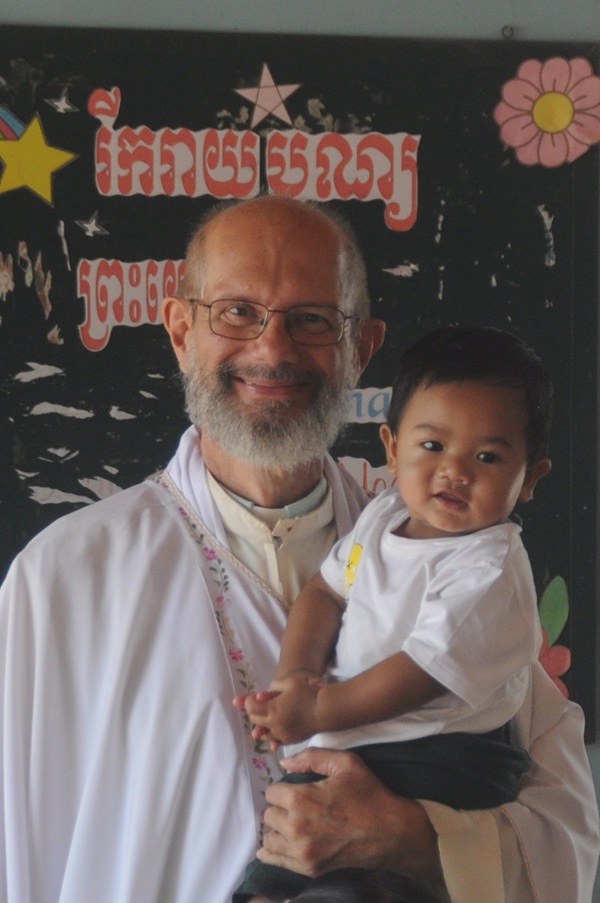
Battambang (AsiaNews) – On Christmas Eve, in many Cambodian homes, the talk is not of celebrations, decorations, or gifts, but of war. "People are afraid," said Fr Franco Legnani, a PIME missionary who has lived in Cambodia since 1994.
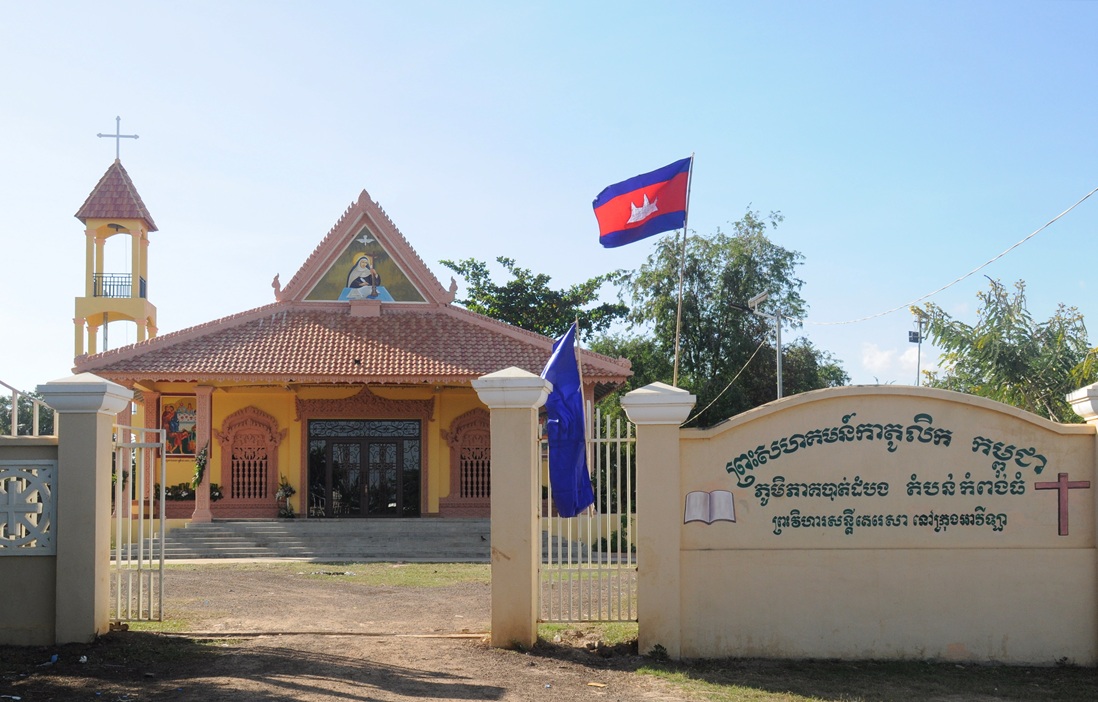
The clergyman currently serves as pastor in several parishes in Kampong Thom province, as well as in Kampong Roteh, Maniev, Preik Sboy, and Kampong Ko in the Apostolic Prefecture of Battambang.
In a region still bearing the scars of past conflicts, Thailand and Cambodia resumed fighting on 8 December over their disputed border, with scores of deaths and approximately one million people displaced on both sides.
“Just a few days ago, in a house behind the church in Kampong Roteh, they celebrated the funeral of a 40-year-old soldier I knew who died on the front. He leaves behind a wife and children. The wife of the current prime minister also attended the Buddhist ceremony,” the missionary said.
“Even though we are far from the border, the conflict is affecting the entire country. The stories reaching our parishes make everything very real, even for us, who are in central Cambodia.”
This year, no big Christmas celebrations are being held. “The government has asked us to scale back the festivities: no karaoke and no dancing, to share the suffering of those at the front," noted the 67-year-old missionary from Saronno (Italy).
“The general feeling is one of fear. Some older people say it feels like we're back in the days of the Khmer Rouge, who came down from the north.”
The reference is to the communist group led by dictator Pol Pot, who took power in Cambodia in 1975 after years of civil war and ruled until 1979, establishing one of the most violent and brutal regimes of the 20th century.
Since June, when hostilities first broke out, the plight of displaced Cambodians and workers expelled from Thailand has not ended.
“A few weeks ago, I met a woman who had about ten children at home. She told me they were her grandchildren who had fled the border because of the war, while their parents returned to the areas where fighting is going on.”
More than 900 schools and businesses have been closed. “A boy who studied at a Jesuit-run school in Svay Sisophon, for example, returned because the school was closed due to bombs falling nearby, and now he follows classes online.”
“Many families had borrowed money from relatives working in Thailand. Those [financial] flows have stopped for months, and now only debts remain."
The forced return of thousands of workers, following the political rift between Bangkok and Phnom Penh, weighs especially heavily on rural areas.
For Father Legnani, the conflict has historical roots. Since 1450, after the fall of the Angkor Empire, Cambodia has been a land of conquest for its two powerful neighbours: Vietnam and Thailand; only during the colonial period were the borders mapped.
“Recently, I reread a report written in 1903 by a French captain on the border issue between Siam, the ancient name of the Kingdom of Thailand, and Cambodia. It's shocking: it describes a rebuffed diplomatic mission, aggression, mutual accusations, and a weak Cambodia forced to submit. The protagonists change, but the pattern is the same."
Tensions have always centred around the temple of Preah Vihear, on the border between the two countries.
Even today, however, the balance of power remains profoundly unbalanced. Cambodia has no air force and is highly vulnerable in terms of energy. It depends on Laos and Vietnam for electricity. If Thailand were to attack power lines or energy infrastructure along its borders, the country would be left without electricity and Internet within a short time. This is also why Phnom Penh's official stance is marked by moderation.
"This morning too," the missionary said, "Thailand bombed a rice paddy near Battambang, sowing panic among the people. This demonstrates that Bangkok can strike deeply and spark fear."
Meanwhile, nationalism, which both countries have been exploiting since the beginning of this war, is growing.
Local radio stations are broadcasting propaganda with very direct messages: "We are the victims – the Thais are the aggressors." Patriotic slogans appear on T-shirts and in public, while Thai products, from gasoline to food, have been boycotted.
As a result, support is growing for the Cambodian government led by Prime Minister Hun Manet; in reality, his father, Hun Sen, now Speaker of Parliament, still holds the reins of power.
The conflict escalated after the release of a phone call between Hun Sen and former Thai Prime Minister Paetongtarn Shinawatra. In the audio, the former Thai prime minister complained about her own armed forces, leading to the end of her political career.
Several international observers remain uncertain as to why Hun Sen, who has always had a very close relationship with the Shinawatra family, released that phone call.
China, which offered to mediate after the failed attempts by the United States and Malaysia, remains a key player in restoring normalcy.
Cambodian banks hold Chinese capital, and bridges, roads, the port of Sihanoukville, and the naval base at Ream were financed by Beijing. It is hard to see China letting Thailand continue for much longer. It has too many business interests here.
In this context, the Cambodian Church is trying to keep open room for peace. Cambodian bishops have appealed to the government for an immediate ceasefire. Bishop Olivier Schmitthaeusler, Apostolic Vicar of Phnom Penh, met with the monk Samdech Preah Maha Areyavong Yon Seng Yeathha, Supreme Representative of the Buddhist Monks, to reflect on what to do for peace. This is a strong sign that peace is built together here.
Christmas comes at a time of suffering and uncertainty. Father Franco and his people await Christmas with hope: “May the Lord bring us the gift of His peace.”

.png)
23/10/2021 13:36
07/02/2019 17:28
30/07/2025 17:45










