








Dushanbe, the village that became the capital of Tajikistan
Capital Day provided an opportunity to celebrate the efforts that, during the years of the terrible Stalinist dictatorship, made it possible to build one of Central Asia’s most beautiful cities on a desert plateau. Today, its modern buildings project it into the future.
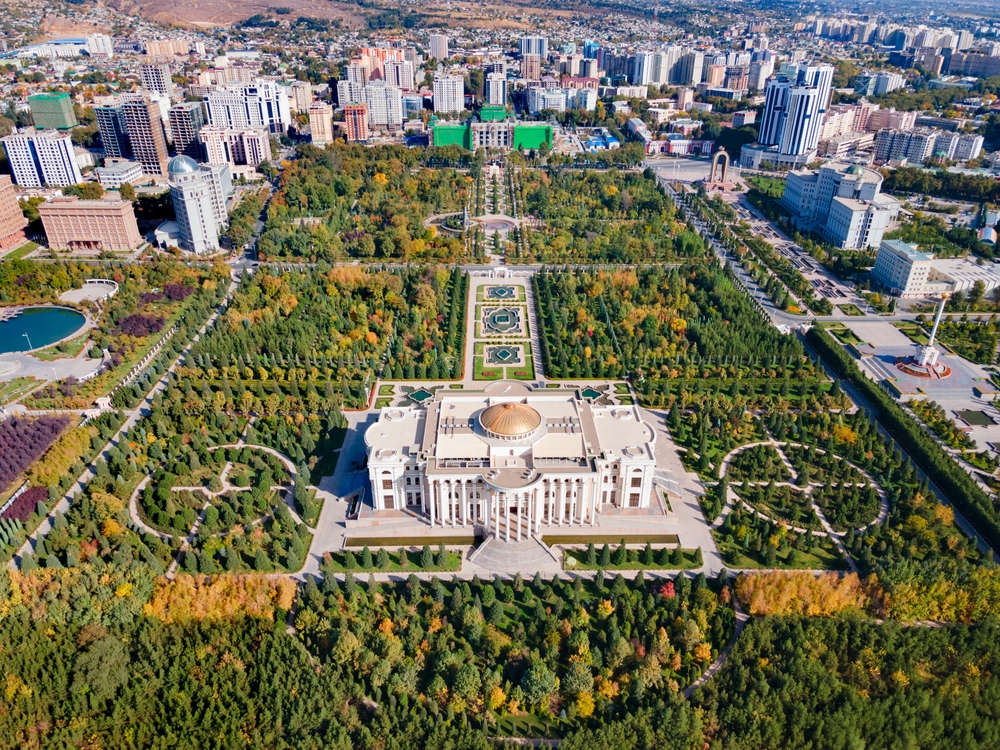
Dushanbe (AsiaNews) - Capital City Day was recently celebrated in Tajikistan. Only by understanding Dushanbe’s past can one truly appreciate the sheer amount of work, creativity and daring required of the architects, engineers and builders who worked on what was once known as Dushanbe-Stalinabad, so that during the years of the terrible Stalinist dictatorship, one of Central Asia’s most beautiful cities could rise from a desert plateau.
The central element of Dushanbe’s development is, in fact, its architecture, which underscores its status as a capital and represents one of the main reflections of the transformation of the state and society as a whole.
All these changes are evident in the buildings, monuments and memorials of the past and present. In 1930, the republic decided to establish a design agency, Tajikgosproekt, to draw up master plans for cities and workers’ settlements and to develop design documentation for new buildings, as part of the first Soviet five-year plans.
Dushanbe then grew rapidly and developed at a truly incredible pace, so rapidly that many, even specialists, failed to immediately grasp the scale of the construction work or the feasibility of the planned projects.
Thus Nikolai Fedorovsky, a participant in the expedition to Tajikistan and founder of applied mineralogy, a corresponding member of the USSR Academy of Sciences, wrote of Dushanbe in the early 1930s that “the city seems to have been designed by science-fiction architects.
The houses are built at enormous distances from one another, empty, undeveloped streets stretch for kilometres… the city was probably conceived to become the future capital of all Asia”.
According to Aleksandr Fersman, a geochemist, academician and vice-president of the USSR Academy of Sciences who had worked in Tajikistan as part of the “Tajiko-Pamir” expedition, “New Stalinabad, the city under construction on the site of the village of Dushanbe, already represents a new type of city with a well-thought-out urban plan... In recent years I have seen numerous new buildings in the Urals, Siberia, the Arctic and the central regions of the Union, but nowhere else have I perceived so clearly the specific rationale underlying the construction of a new city, a coherent rationale that takes into account climatic conditions, the abundance of sun and dust, and all the positive and negative aspects of the southern climate.”
During that period, architects who had graduated from the architecture and construction institutes of Leningrad and Moscow arrived in Dushanbe to work at the Tajikgosproekt Design and Production Institute.
Among them were architects who left an indelible mark on Dushanbe’s architectural heritage, such as Sergei Anisimov, Dmitry Bilibin, Kirill Terletsky and others. Building on the city’s ancient cultural layers, they succeeded in preserving and adapting the traditional foundations, modernising them and adapting them to the conditions of the modern era, combining the historical legacy of medieval urban planning with the finest European examples of classical architecture from the 19th and 20th centuries, and with contemporary Art Nouveau.
At the same time, the city’s architectural history, dating back to the Soviet period, also includes purely European examples that do not clash at all with Dushanbe’s overall appearance. These include the now-demolished Vakhš Hotel, the buildings of the Tajikistan Medical University, the Pedagogical University, the Academy of Sciences, the Philharmonic Hall—now also home to Safina TV—the House of Political Education (Kokhi Vakhdat) and many other urban structures.
The modern buildings of the Palace of Nations, the National Library, the Parliament of the Republic, the Ministry of Communications, the Kokhi Nawruz Palace and the Hyatt Hotel create a sense of modernity in a city looking towards the future, bearing witness to its commitment to global architectural excellence.
The Istiklol complex, a completely new architectural and artistic ensemble situated in the main Independence Square in the capital of Tajikistan, is a symbol of the republic’s freedom and independence, embodies the centuries-old history of the Tajik people and connects the country’s past, present and future.

.png)
03/10/2025 10:38
30/07/2025 09:05
16/07/2025 09:42
05/07/2024 11:06
02/06/2022 09:00










