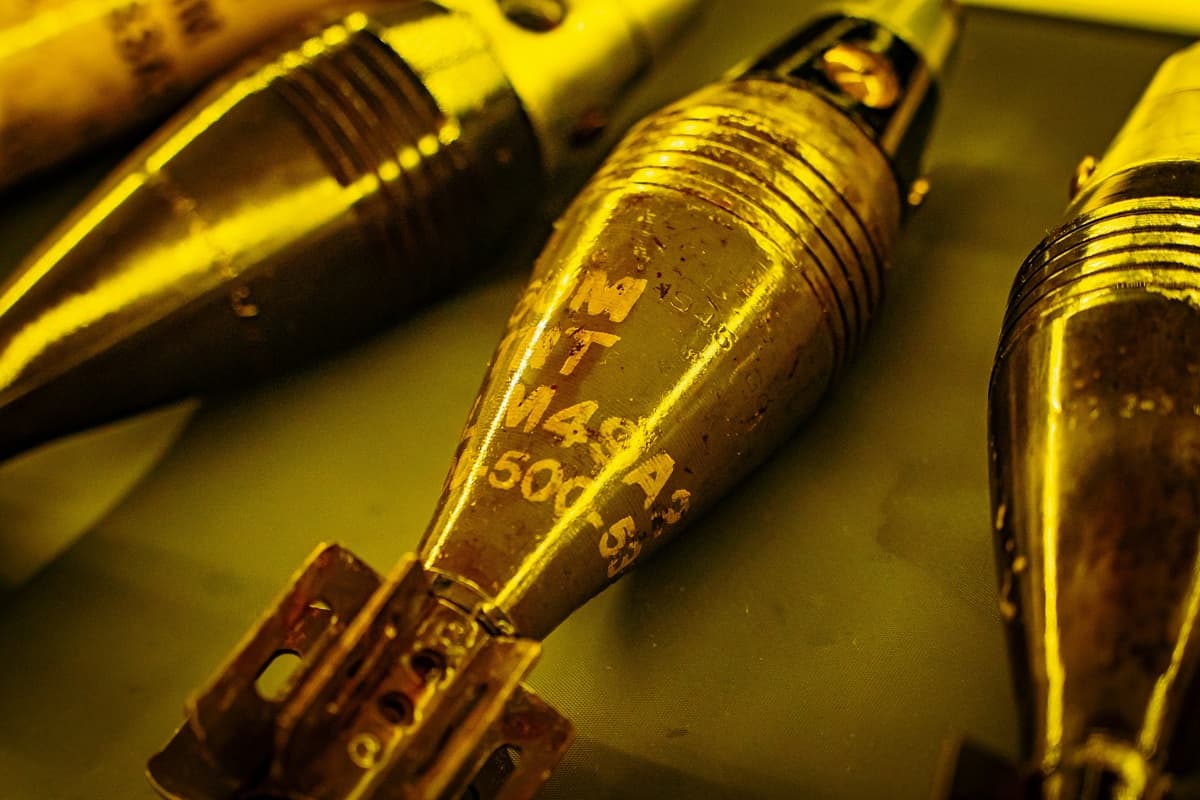
Milan (AsiaNews) – They fall in seconds, but kill for decades. Cluster bombs, banned by a 2008 international treaty, are increasingly used in contemporary conflicts, especially by countries that are not signatories to the Convention.
Besides Iran, which recently used them against Tel Aviv, killing a couple in their seventies, Israel itself is not a signatory and has used them in recent conflicts, such as in Lebanon.
The United States, Russia, Ukraine, China, India, Pakistan, Saudi Arabia, the United Arab Emirates and the other Gulf Arab monarchies, South Korea, North Korea, Egypt, and Turkey – to name just a few – are also not party to the Convention, which entered into force in 2010.
Precisely the use of such weapons by these countries bolsters the widespread belief that international law is no longer useful.
The 2008 Convention on Cluster Munitions prohibits the use, production, transfer, and stockpiling of these weapons, and provides for the clearance of remnants, assistance to victims, families of the wounded, and affected communities.
More than 40 states parties to the treaty have done away with 100 per cent of their stockpiles, destroying nearly 1.5 million cluster munitions and 179 million submunitions. Peru was the last state party to complete the destruction of its arsenals, in December 2023.
Designed to disperse dozens of explosive bomblets over large areas, cluster bombs strike multiple targets simultaneously, but their most devastating impact emerges long after the end of a war, when unexploded munitions turn roads and cities into minefields for civilians.
According to the Cluster Munition Monitor 2025, the most recent report on the subject, at least 314 people were killed or injured by these weapons in 2024 alone, although the true number is likely much higher. Some 42 per cent of the victims – both from direct attacks and unexploded ordnance – were children.
The highest number of deaths so far has been recorded in Ukraine, where cluster bombs have been employed by both Russian forces (using ordnance from North Korea) and Ukrainian forces.
In 2023 alone, at least 116 people were killed or injured, including by unexploded ordnance left in agricultural fields and residential areas. Since 2022, the year of the Russian invasion, over 1,200 civilians have been victims of cluster munitions in some way.
But Ukraine is not an isolated case. The Cluster Munition Monitor documents the recent use of these weapons in Myanmar, where the ruling military junta has deployed them against armed groups that make up the pro-democracy resistance. In Syria, they were used during the civil war that broke out in 2011 and today pose a threat to the civilian population.
The recent conflict in the Middle East is revealing how Israel and Iran are also using missiles equipped with cluster warheads capable of dispersing submunitions even in urban areas.
Thailand seemingly admitted to using cluster munitions in the border conflict with Cambodia in July 2025. Again, neither state is a party to the Convention.
Today, approximately 29 countries and territories are contaminated with explosive remnants of war. For many communities, the most lethal phase begins precisely when the weapons fall silent, because clearance operations are long, costly, and risky, often taking decades.
Laos remains the most contaminated country in the world today, more than 50 years after the Vietnam War. Dozens of cases reported in Afghanistan and Yemen confirm that civilians remain exposed to the daily risk of accidental explosions.
Even before the recent resumption of their use, civilians accounted for over 90 per cent of casualties. The reasons are structural.
Cluster bombs do not distinguish between military targets and civilian spaces. Instead, they are designed to hit a wide area, targeting homes, schools, and other infrastructure, indiscriminately impacting everyday environments.
The Cluster Munition Monitor was set up from efforts by civil society groups to hold governments accountable for their legal obligations regarding landmines and cluster munitions, but over the years, it has effectively become the body that monitors compliance with the treaty.
In 2024, the states parties cleared just over 100 km² of minefields, destroying at least 83,452 unexploded submunitions, the highest number in the last five years, despite several countries, such as Afghanistan, Iraq, Lebanon, South Sudan, Chad, and Somalia, failing to make progress due to declining funding or the outbreak of new conflicts.
The Third Review Conference of the States Parties to the Convention on Cluster Munitions, from which Lithuania withdrew in March last year, will be held in Vientiane, Laos, from 14 to 18 September 2026.
Unlike the annual meetings of the signatory states (the last of which was held in Geneva in September 2025), the upcoming summit will assess progress, violations, and future challenges in disarmament and the protection of civilians.
The current cycle of the Convention covers the period 2021–2026, so this year's conference will be a key moment to take stock and revitalise compliance with the treaty.
Photos by XT7 Core on Unsplash