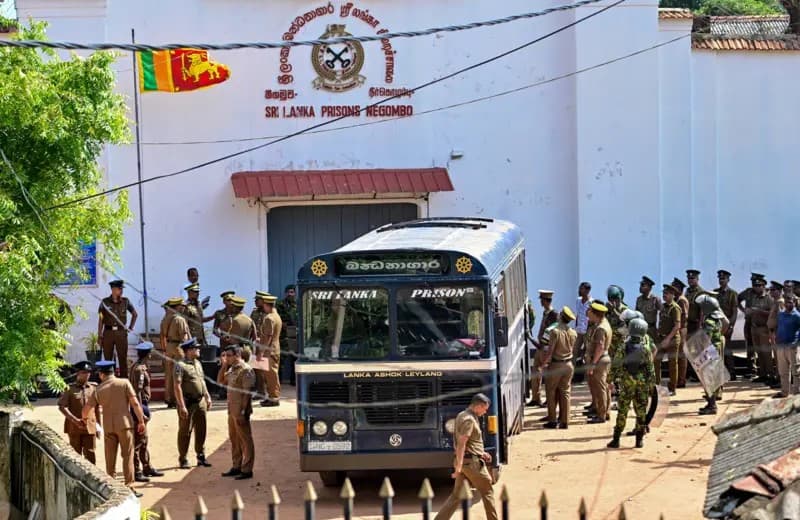
Colombo (AsiaNews) – Following the (alleged) clash between two groups of prisoners on 5 July at Negombo prison, serious unrest broke out the following day, resulting in a very heavy toll of deaths and injuries: according to the latest reports, 29 people – including prisoners and prison guards – have already died, with over a hundred injured and admitted to hospital, some of whom are in a serious condition.
Among the dead are seven officers and 20 prisoners, whilst the Prisons Department adds that the deceased law enforcement personnel also include the prison governor and six guards. Relatives and friends are currently flocking to the city’s hospitals in an attempt to recover the bodies of those killed or to offer comfort and support to the injured.
The Committee for the Protection of Prisoners’ Rights (CPRP) claims that two prisoners transferred to other prisons to contain the unrest in Negombo died yesterday following attacks, the details of which are unknown. In a statement released yesterday evening, the activist group stated that one prisoner admitted to the Welikada prison hospital and another taken to Galle prison had died after being attacked.
Furthermore, as reported by CPRP chairman Senaka Perera, prisoners transferred to Angunakolapelessa prison “were beaten, had their legs broken and suffered serious back injuries following inhumane attacks”. Moreover, prison authorities are reportedly attempting to cover up evidence of the (alleged) assaults on prisoners, starting with those that took place at Angunakolapelessa Prison.
Meanwhile, those who still do not know what has happened to their family members have gathered near the prison and the hospital in Negombo, desperately seeking information. Parents and siblings, in tears, emphasise that, although “in the eyes of the world they are criminals”, they remain “our flesh and blood”. Mothers weep with unbearable grief at the sight of their children in prison cells, pointing the finger at the police and former politicians who they claim have helped turn them into criminals.
Some parents shout emphatically that “our children have done nothing wrong, but they were arrested by the police and have suffered this fate on false charges”. The Director of the Criminal Investigation Department, Deputy Inspector General of Police Shani Abeysekara, informed the court yesterday that he had been entrusted with the investigation into the disturbances that took place at Negombo prison. He then updated the court on the progress of the investigations carried out so far.
Among the injured, at least 65 are prisoners and a further 23 are officers. Meanwhile, the specialist forensic pathologist at Negombo District Hospital stated that, following the post-mortem examinations, the handover of the bodies of the deceased has begun.
“My son is in there… he no longer has his right hand; I beg you to give him back to me,” exclaimed a mother, in tears. “Yesterday they beat my child to death, they beheaded him, they thrust sticks into his eyes, they burned him, they tortured him at length and they killed my son. ‘His body,’ the woman added, ‘is still at Negombo Hospital. Our children were not imprisoned to come out dead.’ ‘I found out my husband had died from a photo: there was a lot of blood on his face,’ another woman told the reporters present, weeping alongside her children.
The true institutional context that led to this large-scale conflict, the links between officials and drug traffickers, as well as the region’s risk of an imminent serious prison riot, was revealed by Senaka Perera, chair of the Committee for the Protection of Prisoners’ Rights. He stated that “none of the previous recommendations of the commission on the Welikada and Mahara killings have been implemented. Commissions are appointed solely to suppress public opposition. No one in the world is born a criminal. The second wave of unrest and the pressure caused by prison overcrowding,” he added, “have contributed to creating such a tragic situation in Negombo Prison”.
Although the maximum capacity of Sri Lanka’s 26 prisons is 18,800 inmates, there are currently almost 41,000 people incarcerated there. In Negombo, 2,600 people were being held in a facility with a capacity of 650.
“The sudden overcrowding,” Perera continued, “was caused by extreme heat and a lack of ventilation, forcing prisoners to sleep in shifts even in the toilets, which caused them severe psychological stress.”
He also emphasised that some police department officials “are acting unprofessionally, planting fake packets of drugs in the pockets of innocent young people and imprisoning them. The aim, he claims, is to “meet their monthly arrest targets and improve their media image”, and all this “has created unnecessary overcrowding in prisons”.
The Christian Women’s Voice Movement stresses that anyone imprisoned for any offence, regardless of their status, must be treated fairly and in accordance with the law, as they are, after all, human beings. Those who have committed an offence against society or another person must be punished and serve their sentence regardless of their status. However, they warn, “it is unjust to pay with one’s life for criminal and unjust reasons”.
“Not only should those who have been imprisoned be reintegrated into society, but Sri Lanka’s entire prison system should be completely reformed. The work of the police, too, should become a duty carried out in accordance with the law, with full legal standing. In this way,” concludes Christian Women’s Voice, “only those who are truly guilty of offences will be subject to the law. Thus, the number of prisoners will not increase excessively.”