








High Court blocks 'The Kerala Story 2' for fuelling sectarian tensions
With a reserved order, the court halted for “for 15 days” the film's premiere, today. Questions remain about the certification and classification of a work that presents an "unfiltered" reality. Of greatest concern are the repercussions at the community level, given the sensitive issues such as reconversions.
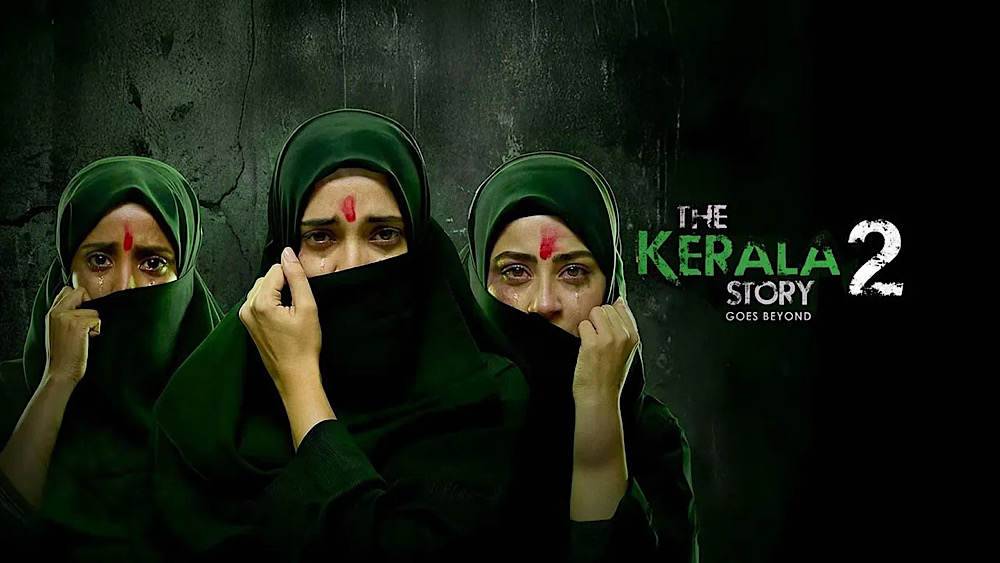
Delhi (AsiaNews) – The Kerala High Court has halted the release of The Kerala Story 2: Goes Beyond, whose countrywide premiere was scheduled today, marking a new chapter in the controversy surrounding the feature film.
The reserved order, issued yesterday at the last minute by a single-judge bench headed by Magistrate Bechu Kurian Thomas, suspends the film's release for at least 15 days. The ruling is said to be based on concerns about certification, content, its potential impact on communal harmony, and possible sectarian tensions.
Doubts about certification
In its observations, the Court raised serious doubts about the manner in which the Central Board of Film Certification (CBFC) granted clearance to the film.
The bench noted that the release ban appeared to reflect a “non-application of mind”, specifically questioning the decision to assign a U/A 16+ rating instead of an "A" certificate, which is used to indicate films for adults only.
The Board had previously ordered the producers of the controversial film to make 16 major cuts. These included reducing scenes of violence and sexual assault by 50 per cent and editing out images depicting bulldozers demolishing houses.
The CBFC had also scrutinised the filmmakers’ claim that the movie presents an "unfiltered reality”, suggesting that some scenes required contextual moderation.
Communal Harmony
Justice Bechu Kurian Thomas observed that both the film’s title and the theme could, at least theoretically, disturb sectarian and communal harmony in the state.
The court's forceful intervention comes at a time of growing political and civil society opposition, with critics arguing that the film could exacerbate ethnic and social tensions in Kerala.
Political parties across the ideological and parliamentary spectrum have expressed strong objections. Both the ruling Left Democratic Front (LDF) and the opposition United Democratic Front (UDF) have joined in their scathing criticism of the film.
Kerala Chief Minister Pinarayi Vijayan, along with opposition leaders, has described the film as "false propaganda" and a threat to the secular fabric of the state.
Propaganda and Stereotypes
Public figures and commentators have widely condemned the film as propagandistic, arguing that it relies on " malicious and stereotypical projections" of the state and its communities.
A particularly controversial scene in the trailer, showing a woman forced to eat beef, has been slammed by critics as a calculated attempt to inflame religious sentiments in a Hindu-majority country where cows are sacred and eating their flesh is forbidden.
The film reportedly opens with a stark warning that India could become an Islamic state governed by Sharia (Islamic law) within 25 years. Critics, the Times of India reported, called this claim provocative and lacking credible evidence, intended only to inflame tempers.
Amid the controversy surrounding the film, a report by The News Minute (TNM) drew attention to 2024 Gazette records on religious conversion in Kerala.
The report, analysed in February 2026, challenges the film’s central claim of widespread forced conversions to Islam. According to Gazette data, Hinduism recorded the highest number of converts in the state, followed by Islam and Christianity.
It is also significant that the TNM analysis found that a significant percentage, nearly 72 per cent at certain times, of those who converted to Hinduism were Dalit Christians who "re-embraced" the majority faith.
The report suggests that many of these reconversions are motivated more by socioeconomic considerations than purely religious ones.
According to India's reservation system, individuals who convert from Hinduism to Christianity lose their right to Scheduled Caste (SC) status and the associated affirmative action benefits. This is why reconversion to Hinduism often becomes a strategy to regain access to these lost rights.
It should also be noted that various organisations, including the Vishwa Hindu Parishad (VHP), have facilitated many of these reconversions under the banner of Ghar Wapsi (return home), with a nationwide propaganda campaign.
Legal Battle
The TNM report finally emphasises that religious conversion in Kerala is often driven by structural factors such as caste discrimination and state policy, rather than narratives of mass coercion.
These findings have intensified scrutiny of the film's claims, which critics say are unsupported by official statistics.
However, as the legal battle over the film's release continues, the debate surrounding The Kerala Story 2: Goes Beyond is likely to continue.
INDIAN MANDALA IS THE ASIANEWS NEWSLETTER DEDICATED TO INDIA. WOULD YOU LIKE TO RECEIVE IT EVERY FRIDAY? TO SUBSCRIBE, CLICK HERE.

.png)










