








Lampedusa, Europe, America, and Migrants: ‘indifference’ kills
Leo XIV issues a warning on the island in the heart of the Mediterranean, 13 years after Pope Francis’s historic visit. “Those who have lost their lives in this sea are victims both of decisions that were made and of decisions that were not made,” he said. The pontiff urged Europe to address this challenge “in a comprehensive manner” without fear, and called on the United States, on its 250th anniversary, not to forget migrants’ “hopes, sacrifices and contribution”.
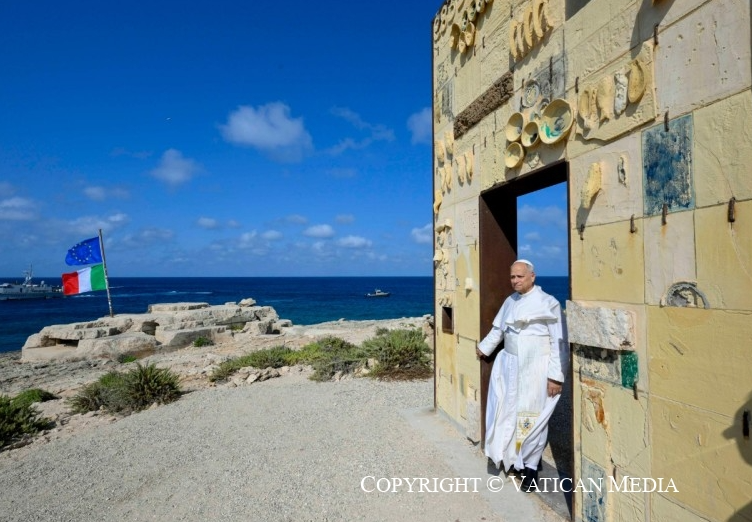
Lampedusa (AsiaNews) – Pope Leo XIV issued a message to Europe today from Lampedusa, following in the footsteps of Pope Francis’s first trip in 2013. He did the same to the United States of America, his homeland, for 4 July, the 250th anniversary of the Declaration of Independence.
In them, he noted that the road from Jerusalem to Jericho – where a man is left for dead by bandits according to the parable of the Good Samaritan in the Gospel of Luke – today runs through Lampedusa and all the world's crossroads where migrants tread. And it is up to us whether to choose “not to make a decision” and leave this humanity abandoned to itself, or to stand alongside these brothers and sisters.
Leo XIV arrived early this morning in Lampedusa, the southernmost island of Italy, which has become a symbol of migrant journeys across the Mediterranean towards Europe, a watery death trap for thousands of people. As soon as he set foot, he went to the cemetery to lay floral tributes on the graves of some of them.
Afterwards, he reached the “Porta d’Europa”, the Gateway to Europe, an art installation overlooking the sea that commemorates this feature of Lampedusa, standing alone to pray on the Favaloro Pier, the landing point renamed, as of today, after Pope Francis, who did so much during his pontificate to give a voice to migrants.
Leo also met with a group of migrants, accompanied by the Red Cross.
“I have not come to make speeches," he said, responding to the greeting from the island's mayor, Filippo Mannino, “but to celebrate the Eucharist, the supreme sign of Christ's presence among us. Jesus’s gesture of breaking bread to give Himself gives meaning and strength to our daily gestures of assistance and sharing."
In the homily, held in sports complex located at La Salina, he mentioned how the apostles of Jesus had “sailed the Mediterranean and experienced the hospitality of the inhabitants of its islands and coasts”.
“The Gospel,” he said, “resounds where peoples meet, people welcome one another, their lives intertwine and different cultures engage in dialogue. It falls silent, however, when each person makes him or herself an island, avoiding contact and cutting off exchange.”
If 13 years ago, Pope Francis repeated God's question to Cain, "Where is your brother?" (Gen 4:9), in Lampedusa, Pope Leo called for a further step, that is to reread here the words of the Good Samaritan (Lk 10:25-37).
“Here you have seen not just one, but thousands of human beings fallen into the hands of robbers who have taken everything from them, beat them brutally and walked away, leaving them half-dead. The sea has claimed the lives of others — those who did not manage to reach their hoped-for destination.
“Yet we feel their presence, which challenges us no less than that of those who have landed in need of attention and aid. Indeed, before any intellectual consideration or ideological conviction, the encounter with those who lie before us, stripped of everything, calls us to be close to them.”
Leo XIV explained that he came to thank the people of Lampedusa for the assistance they provided to migrants for many years.
“Yes, it is love that has taken shape among you. Compassion, which recognizes a brother or sister in peril at sea, is its first stirring: a profound call to do what you might never have imagined possible.”
He also greeted “the migrants who are here. They themselves have not only received solidarity but have often shown it on their journey, as the poor helping the poorest.”
But love is always a free choice, not a given. And in Lampedusa, it is not possible to ignore the fact that some choose not to be close and, like in the parable, just walk away.
“Those who have lost their lives in this sea are victims both of decisions that were made and of decisions that were not made,” Leo said.
“Indifference to the common good and corruption in their countries of origin; a global economic system that generates poverty and exclusion; fear that fuels prejudice and contempt; the belief that such problems do not concern us; the criminal calculations of those who profit from the suffering of others; the slow and difficult transition from mere emergency management to the development of comprehensive and shared policies”.
Pope Leo is well aware that the parable is also a provocation since some religious men are among those who just walk away.
“Unfortunately, in every age there are those who fear being ‘contaminated’ by contact with others, thus denying — even in the face of suffering and death — our common origin in God, the infinite dignity of every human being and the call to boundless love.
“It is time to recognize and affirm that religious affiliation must never become a reason for discrimination, as if faith had boundaries rather than being a universal call to salvation. Where there were walls of separation, Christ broke them down. There is no love of God without love of neighbor, and there is no neighbor if I do not draw near.”
It is from Lampedusa that the pontiff reiterated the challenge of giving life to the "civilization of love”, so much evoked by Paul VI, and which Leo himself placed at the centre of his encyclical Magnifica Humanitas.
“[W]e have entered a millennium in which we must give spiritual, cultural, legal, political and economic expression to the civilization of love. May the enormity of the suffering we witness help us grasp the radical nature of this call.”
“From this far-flung corner of Europe on the Mediterranean Sea, one can more clearly perceive the momentous challenge that the phenomenon of migration poses to European societies,” he noted.
He calls on Europe not to waste its “unique potential, stemming from its history and culture, and therefore bears a corresponding responsibility.
“Thanks to its geographical location and institutional framework, Europe is capable of addressing the crisis — in this region — in a comprehensive manner, integrating immediate relief efforts into a long-term strategic plan capable of receiving, protecting, supporting and integrating migrants, while at the same time assisting developing countries so that no one is forced to emigrate.
“All of this must be done with vigilance, ensuring respect for the dignity of every person. This is a task not only for public institutions but also for civil society as a whole and for the Church.”
As he did recently in Tenerife, he pointed out that Lampedusa is also an important tourist destination, which many fear could be threatened by having to cope with so many migrants.
But for Leo the perspective must be reversed. Holidays are not just distraction, lightheartedness, and carefreeness. For him, “an invisible wall” need not “be erected between the sea of shipwrecked migrants and the vacationers.” “Have the courage to think differently,” he said.
“Little by little, with a bit of creativity, you will be able to ensure that anyone who spends time on this island, even if only for rest, becomes more humane, inspired by your charity, what the sea has taught you and the encounters that have formed you.
“There is authentic rest when the meaning of life is rediscovered, and true well-being when the economy is just and fraternal. In such an economy, care for creation and social friendship come together in a synthesis that humanity is seeking today.”
Leo ended by offering the image of Our Lady of Porto Salvo, patron saint of Lampedusa.
“Let us not be overcome by fear, but rather look upon daily hardships as a time of opportunity and witness,” he told islanders, highlighting her example.
“May this venerated image speak to you once again with the same power as in days past, when those who handed down this devotion entrusted themselves to the Virgin’s intercession with radical sincerity. In God we all have a safe haven, and every Christian community is called to be a reflection of it on earth.”
On the very day of his visit to Lampedusa, Pope Leo XIV also turned his thoughts to the reception of migrants on the 250th anniversary of the founding of the United States of America, which falls today.
Citing the dignity of every human being as one of the fundamental principles that inspired the birth of the nation, the pontiff stressed the need to defend human life "from its beginning at conception until natural death” and to build a society in which "the vulnerable, the suffering, and the forgotten" are always welcomed with "compassion, solidarity, and love.”
He emphasised that protecting human dignity includes welcoming immigrants, whose "hopes, sacrifices, and contribution" have marked the history of the United States since its origins.
Those who have sought "freedom, opportunity, and a place to belong," said the first US-born pope, have helped shape the country's identity; therefore, welcoming them "with compassion and generosity" means recognising the inherent dignity of every person.
"Building a world in which everyone can flourish requires shared responsibility and courage," he concluded, warning that in the face of today's challenges, "we need one another" and are called to work "together in unity”.

.png)
23/02/2020 15:35
23/02/2020 13:44
11/08/2017 20:05










