Vatican City (AsiaNews) – Pope Leo XIV opened his second consistory stressing the values that already accompanied the first (7-8 January 2026), convened last year, at the end of the Jubilee of Hope, namely responsibility, listening, a shared journey, but also communion, availability, and trust.
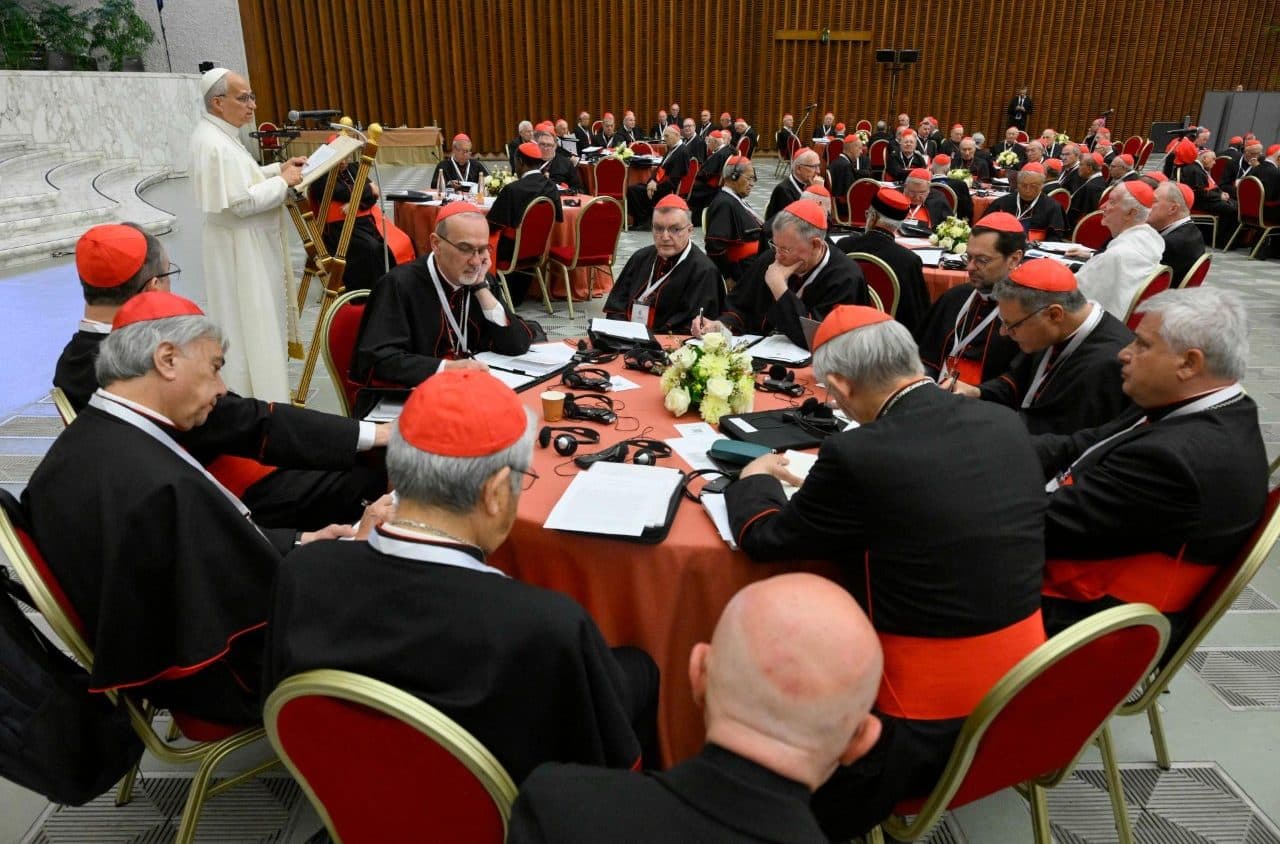
The extraordinary consistory brought 178 members of the College of Cardinals who travelled to Rome from around the world for the meeting. Organised in four sessions over two days in the Paul VI Hall, the prelates sat at round tables, symbolising dialogue and the synodal method.
As in the previous extraordinary consistory, they split into two groupings: one of eight groups of ordinary cardinal electors and another of ten groups of cardinal electors of the Roman Curia and non-electors.
The proceedings are divided into three phases: each participant has three minutes to speak about the established questions, plus another two minutes to speak on key points, after which the secretary prepares the final report. The presentation of the proceedings in the Hall will follow.
The first session included a biblical meditation by Polish Cardinal Grzegorz Ryś, Metropolitan of Kraków. The pope spoke standing, immediately after the introduction by Cardinal Dean Giovanni Battista Re, 92. After thanking those present “most sincerely” for once again accepting his "invitation”, Leo said that their presence shows "concern for the whole Church”.
Meeting with the cardinals who elected him in May 2025, the pope noted the desire he expressed during the consistory six months ago “to work together," and continue a “dialogue" that would help him in his service.
“We too, like the whole Church, learn as we walk forward,” he said. “Communion is never a result that is achieved once and for all”.
The pontiff, whose motto is In Illo Uno Unum centred on the value of unity, has spoken a lot about communion in recent months. “[W]e are called to be builders of Christ’s communion, a communion that takes shape in a synodal Church,” he said.
He referred to the address he gave to the Roman Curia on 22 December 2025, in which he stressed that the communion “is built not so much through words and documents as through concrete gestures and attitudes”. Such calling is the “leaven of universal fraternity”.
Leo said that the four themes of the meeting are “deeply interconnected”.
First, “we are invited to contemplate the world in which the Church is called to proclaim the Gospel.” In fact, “Before asking ourselves what to do, we must pause to consider reality, looking at it through the eyes of faith and allowing ourselves to be challenged by listening to our brothers and sisters,” he said.
The second is “to reflect together on the culture of power and the civilization of love.” To this end, the pontiff noted that some cardinals, in all five continents, operate in “lands marked by war, violence, and social or religious polarization.”
Since “none of us are immune to the many forms of conflict, oppression, and division that afflict our societies today,” the “discernment” undertaken during the meeting “concerns us all and challenges the Church’s mission in every context.”
In particular, Leo XIV expressed interest in the reception, i.e. the "questions," "perspectives," and "steps” that the encyclical Magnifica Humanitas raises in the various Churches.
The third theme, in the third session, touches Leo XIV's first encyclical letter, “on safeguarding the human person in the time of artificial intelligence”.
For him, “We live in an age in which the temptation towards fragmentation is growing and particular interests all too easily prevail. The Church’s social teaching reminds us that the common good does not arise spontaneously, but requires shared responsibility.” This is why the Church’s “synodal style” is important.
Finally, one session will be dedicated to “the process of implementing the Synod.” For Leo, “synodality points to a way forward: listening, discerning, and taking responsibility together for the choices that the Lord entrusts to us.”
He noted that synodality is not “a set of procedures,” but “a willingness to understand.” In fact, “These four sessions find their unity in the missionary perspective, which we shared at the last Consistory,” he said.
Finally, the pope asked the cardinals for their help. “I am counting on you,” he said. The ministry of Peter’s successor “cannot be carried out alone.” Indeed, “It requires your experience, your pastoral wisdom, and your knowledge of the Churches and of the peoples entrusted to you.”
“I need your support,” he added, “strong, explicit, and public. I need to feel sustained by you, as by brothers.” Likewise, “Help me to listen to what is emerging in the Churches, to recognize the signs of hope that often grow in silence, but also to not ignore the struggles, misunderstandings, and resistance [. . .]. I need your freedom, your frankness, and your loyalty. Sincere advice is always an act of communion,” Leo added.
Before the pope, Cardinal Giovanni Battista Re expressed the cardinals' "deepest gratitude and profound appreciation" for the invitation, citing the "present difficult moment for humanity," marked by profound challenges such as the emergence of artificial intelligence, "human poverty," and a "collapse of ethical and moral values," all of this, nevertheless, accompanied by "reasons for hope."
Card Re also thanked Pope Leo for Magnifica Humanitas, signed on 15 May 2026. “It is a light and a guide for us,” he said. "Thank you for the call to awaken consciences; thank you for pointing the way to build the civilization of love, brotherhood, civility, and peace”.
Earlier in the morning, at 7:30 am, Leo XIV led the opening Mass of the consistory at the Altar of the Chair in St Peter's Basilica. In his homily, he spoke to the cardinals who had arrived in Rome.
At the beginning, he emphasised the global nature of the consistory. “Let us offer to God our lives,” he said, as well as “the communities and peoples we hold dear, as well as our pastoral projects and experiences with all their joys and sorrows.”
He noted as “significant” the fact that the consistory began on the eve of the solemnity of the Holy Apostles Peter and Paul. “Let us pause, then, to commemorate these two pillars of the Roman Catholic Church,” Leo said.
In his homily, Leo also spoke about the "gift of peace in unity” at a time when “international tensions and conflicts seriously wound the human family”.
“[W]ar is never worthy of humanity, and it is never blessed by God, because, even if we are equipped with high-tech weapons, the Creator has endowed us with intelligence and free will to resolve conflicts as human beings and not as beasts,” he said.
“Indeed, this is how Christian witness becomes prophecy, evangelization and service for a new world, as well as a cultural and social project that promotes integral human development.”
Today's sessions focused on the growing polarisation within societies and communities, which leads to political tensions and violence.
Several groups highlighted how in many parts of the world, people suffer from the lack of respect for religious and ethnic minorities, which undermines religious freedom and leads to hostility, particularly against the Church.
At the heart of many interventions were the awareness of a general sense of distrust, fatalism, and impotence towards institutions and democracy, trends also linked to the declining birth rate, the growth of criminal groups, and drug trafficking.
As the Holy See Press Office announced, the need to address the issue of migration in a humane and Christian manner was also discussed, along with the urgent need for effective integration policies, as new forms of exclusion emerge.
Faced with these dire scenarios, all groups emphasised the need for the Church to show herself as a mother, a welcoming place, including through the restructuring of parishes, as well as capable of acknowledging her own mistakes.