








Bishop under investigation for opposing a mine in the Luzon region
At the heart of the dispute is a plan by a local company covering almost 4,500 hectares of the ancestral lands of the Bugkalot/Ilongot indigenous people. The Bishop of Bayombong, Monsignor Elmer Mangalinao, celebrated Mass at a barricade erected by local committees opposing the project. The bishop said: “Caring for the land means caring for the poor”.
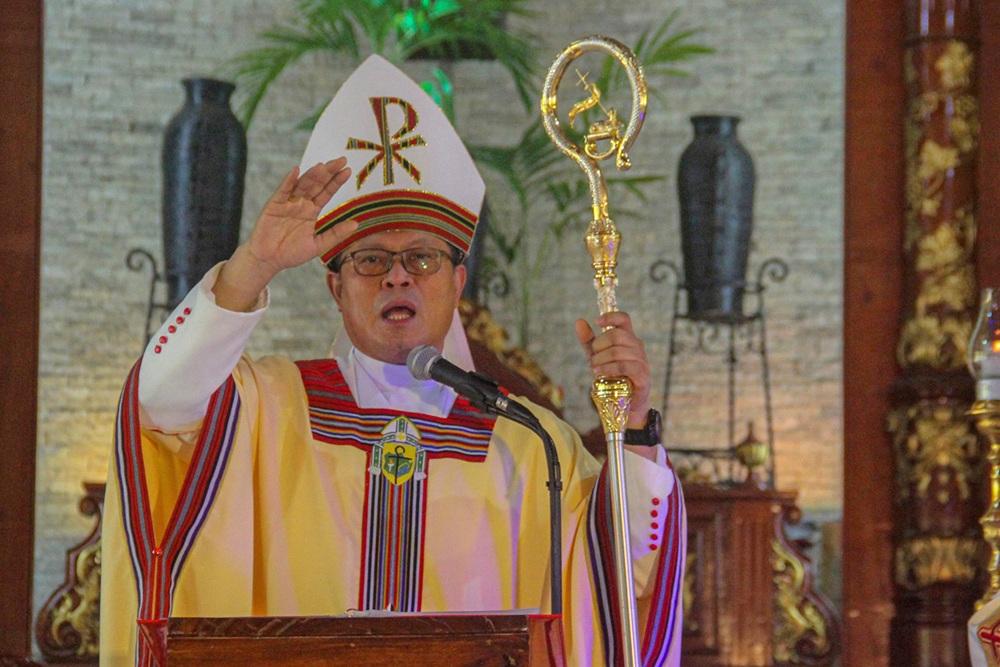
Manila (AsiaNews) – Bishop Jose Elmer Mangalinao of the Diocese of Bayombong, in the Luzon region of the Philippines, is among those under investigation in a legal dispute linked to his opposition to a mining exploration project in the province of Nueva Vizcaya.
Along with other environmental activists, priests and community leaders, the bishop has been drawn into a civil case linked to protests against the activities of the North Luzon Minerals Resources Corporation (NLMRC) in the municipality of Kasibu.
The case concerns a mining exploration plan covering approximately 4,456 hectares of land spread across several villages in the area. Among those accused are also Fr Christian
Dumangeng, former director of social ministry for the diocese, anti-mining activist Florentino Daynos and others who, according to the charges, were allegedly involved in maintaining a barricade within the ancestral territory of the Bugkalot/Ilongot indigenous people to prevent the exploration activities from proceeding.
The case was brought by Rosario Camma, a representative of the Bugkalot/Ilongot indigenous community. However, the court rejected the application for a temporary restraining order, ruling that there were insufficient grounds to adopt such a measure immediately. Proceedings regarding the application for a preliminary injunction, however, remain open.
Lawyer Fidel Santos, who is representing the defendants, argues that the proceedings could be seen as a tactic used to intimidate or discourage citizens and organisations committed to defending the environment and the public interest.
In response to the allegations, Bishop Mangalinao issued a lengthy pastoral letter in which he reiterated that his involvement stems exclusively from the Church’s mission to accompany the most vulnerable and to promote the care of creation.
“I write to you as your bishop, a shepherd whose first and enduring duty is the care of souls and the protection of creation entrusted to us by God,” he stated. “As Bishop of this diocese, I bear the responsibility to stand by the poor, defend the vulnerable and be a voice for those whose voices are often not heard.”
The bishop rejected any political interpretation of his commitment, making it clear that the defence of the environment is a pastoral duty rooted in the Church’s social teaching and in Pope Francis’s encyclical Laudato Si’.
“It is not a political duty, but a pastoral one,” he explained. “We believe, as the Church has always taught, that the earth is not our property to be depleted, but to be cared for. The earth, the rivers and the forests that sustain us are not simply resources to be measured by their yield; they are part of God’s creation, entrusted to us for the good of generations yet to be born.”
According to the bishop, environmental protection is closely linked to the defence of the poor and indigenous communities who depend directly on natural resources for their survival. “Caring for the earth means caring for the poor, because they are the ones who depend most directly on it and who suffer first and most severely when it is damaged,” he said.
Bishop Mangalinao also recalled visiting the residents who are guarding the area affected by the mining project, emphasising that his presence was for religious and pastoral purposes only. “ “When I visited our brothers and sisters who were keeping vigil in defence of their land, I went as their bishop to celebrate Holy Mass, pray with them and remind them that their concern for the land, water and the future of their children is a concern that the Church shares and blesses,” he said.
The bishop also rejected accusations that he had played an active role in organising the protests: “I went to accompany, not to lead. I went to comfort, not to command,” he clarified, adding that any support provided by the diocese was motivated solely by Christian charity and pastoral concern.
The Commission for Justice, Peace and Integrity of Creation of the Conference of Major Superiors of the Philippines (CMSP) also expressed its full solidarity with the bishop. In an official statement, the ecclesiastical body expressed concern that the case might have an intimidating effect on those who raise environmental and social issues of public interest.
The CMSP emphasised that environmental protection is not an obstacle to economic development, but rather a necessary condition for authentic and sustainable growth. Development that compromises ecosystems, indigenous communities and natural resources cannot be considered true progress.
Concluding his message, Bishop Mangalinao called on the faithful to pray and to share responsibility for the care of creation. “The cry of the earth and the cry of the poor are one and the same,” he said. “The Church will continue, as it always has, to listen to it.”

.png)
07/02/2019 17:28
11/08/2017 20:05










