








Leo XIV: an encyclical born from listening says AI should be a building block for a 'new horizon of communion’
“Magnifica Humanitas” is presented at the Vatican. Christopher Olah, cofounder of Anthropic, spoke at the event. “Pressures" in the sector distract from doing the "right thing”. For Leo, disarming AI is not enough; “repairing bonds, restoring trust” is needed. Cardinal Czerny cites the "ecological question”. Prof Lushombo calls on the global South not to lose the value of relationships. Some concepts from Asian cultures, like "emotional connectedness to ‘we’” and "mutual support”, are highlighted.
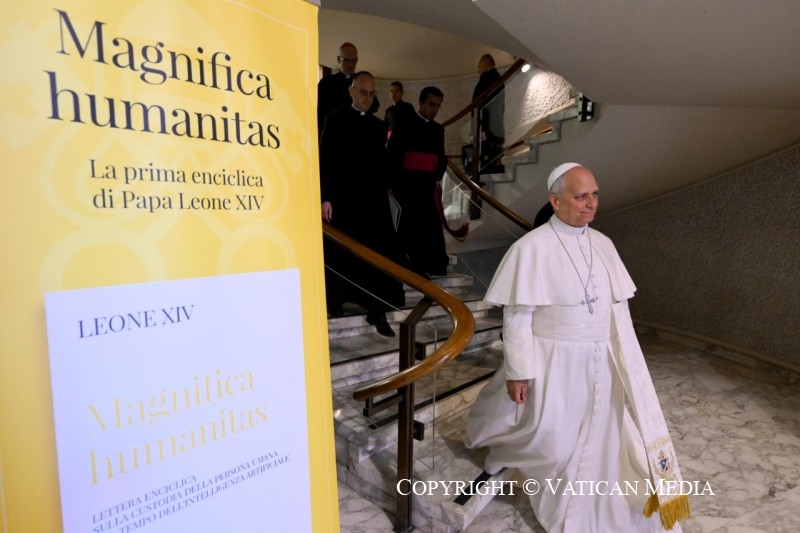
Vatican City (AsiaNews) – “I have listened,” said Pope Leo XIV in presenting Magnifica Humanitas, his first encyclical letter, which was released at a press conference yesterday in the New Synod Hall in the Vatican.
Thanks to this listening, the pontiff acquired the conviction that Artificial Intelligence (AI) "needs to be disarmed”, a “strong word” that was “deliberately chosen because this moment needs words capable of attracting attention, awakening consciences and indicating paths forward for humanity,” Leo said.
This is the first time that a pope takes part in person in the release of such an important papal document, a social encyclical which, as previously announced, follows in the footsteps of Leo XIII's Rerum Novarum, released in 1891, exactly 135 years ago, in an age of rapid industrial change.
For Leo XIV, humanity today faces a transformation "of similar magnitude”, which is "threatening human dignity”. Like his predecessor Leo XIII, Leo XIV stressed the "responsibility" that falls upon him to observe the new changes with “eyes of faith, with lucidity of reason, with openness to mystery, and with cries of the poor”.
Along with the pontiff, the podium was shared by Secretary of State of the Holy See Card Pietro Parolin, who moderated the event, along with Card Víctor Manuel Fernández, Prefect of the Dicastery for the Doctrine of the Faith, and Card Michael Czerny, Prefect of the Dicastery for Promoting Integral Human Development.
The prelates were joined by other speakers like Anna Rowlands, a theologian and professor at Durham University in the United Kingdom; Leocadie Lushombo i.t., professor of political theology and Catholic social thought at the Jesuit School of Theology-Santa Clara University in California; and Christopher Olah, cofounder of Anthropic (United States).
“I have listened”
Leo XIV, speaking last, said that he listened to scientists, engineers, political leaders, parents, and teachers, echoing their "enthusiasm” but also their concern, arising from their relationship with technology.
Technologies are capable of going “beyond human reach," even giving rise to "autonomous weapons systems”, as well as "block access to healthcare” and “employment," based on the "prejudices and injustice" inherent in algorithms.
Nevertheless, a future “not for a privileged few, but for the entire human family” is possible only if it is built “together” by “those who design systems and those affected by them, richer countries and poorer ones, institutions and individuals, power centres and peripheries,” Leo XIV said.
Christopher Olah, cofounder of Anthropic (US)
From this point of view, the presence of Christopher Olah among the speakers at yesterday’s release is noteworthy. The 34-year-old Canadian and self-described atheist is an expert in AI interpretability. After working at OpenAI, in 2021 he cofounded of Anthropic, a company based in San Francisco, known for the development of the chatbot Claude.
At the start of his address, Leo XIV thanked him. “What a great sign of hope that, with our differences, we can listen to one another. This interchange clearly bespeaks the gravity of the moment,” he said.
For his part, Olah noted that today "is only the beginning" of a shared journey, acknowledging the pope's ability “to take this seriously, to look closely, and to push events in a better direction.”
In his address, Christopher Olah spoke of the "constraints" and "pressures" affecting the AI sector, from economics, research, politics, ambition, and pride, which distract from doing “the right thing”.
Therefore, it is important that some people are "willing to say hard things," unconstrained by pressures, for the questions raised by artificial intelligence go beyond "computer science”.
AI models are based "on a structure modeled after the brain, on an enormous inheritance of human thought and speech," he explained. “They are not the cold, calculating robots” that some might imagine; instead, “They are made from us, from our words”.
They have aspects that are "mysterious” even to their trainers. Hence, it is good to ask: how do we behave toward them? Questions like this belong to "society at large”, he said.
Olah then acknowledged three contributions the Church can make.
First, support is needed for workers replaced by AI; helping them "will be a moral imperative of historic proportions," he said.
Second, humanity's "need for moral imagination and ambition” must be safeguarded, since the use of AI can undermine human dignity.
Finally, Olah calls for "discernment" into the structure of AI models. “[W]e keep finding things that are mysterious, even unsettling. We find structures that mirror results from human neuroscience. We find evidence of introspection. We find internal states that functionally mirror joy, satisfaction, fear”.
Magnifica humanitas helps those on the inside, often blind, to see all this.
Disarm and build
“[A]rtificial intelligence now demands to be ‘disarmed’, freed from logics that turn it into an instrument of domination, exclusion and death,” said Leo XIV.
Stressing the importance of "building," since "disarmament" alone is not enough, Leo mentioned the 2017 floods in Peru, where he served as a missionary.
“I learned that rebuilding does not mean simply replacing what has been destroyed. It means repairing bonds, restoring trust, and reawakening hope in the future,” the pope explained.
“Artificial intelligence can be a construction site of history from within a horizon of communion, in which technical progress learns to serve human life.”
As a Church, “We do not possess technical answers, nor do we seek to displace those with expertise. But we bring a wisdom concerning the human that our present time desperately needs
Digital transition, ecology, and safeguarding relationships
During the presentation, Card Víctor Manuel Fernández addressed the document's theological significance. He noted that paragraphs 118 to 130 contain theological pronouncements.
Looking at the title, he said that “despite everything [. . .] the Holy Father is not ashamed to call it ‘magnificent’”, referring to a humanity that has within itself “a terrible capacity for evil”, like “wars”, and actions “contrary to international law”.
Cardinal Fernández also noted that certain organisations and individuals are mentioned in Magnifica Humanitas, whose example makes us "proud" to be human, namely the Red Cross, the United Nations, Martin Luther King, Nelson Mandela, and Saint Teresa of Calcutta.
For his part, Cardinal Michael Czerny structured his address around three notions: ingenuity, conscience, and care, noting that technology can become “dominion over humanity and over Creation," as Pope Francis had lamented.
The new encyclical in fact follows in the footsteps of the late pontiff’s own documents like Laudato si' and Laudate Deum on the care of Creation.
Card Czerny notes that, “The digital construction site and the construction site of our common home converge on the same question: what kind of world are we building, and what place does the human person have in it?”
Since, at a “material level", AI’s infrastructure is huge, "The digital transition is also an ecological issue,” he explained, adding that "the technological evolution does not follow a predetermined path, but can be guided by personal and collective responsibility."
In her address, Prof Anna Rowlands points out that Pope Leo XIV's Magnifica Humanitas calls upon us to “urgently safeguard the human " in his or her freedom and dignity, emphasising that the Church speaks out in an era marked by AI because "her mission is to reveal the face of God to history."
Rowlands spoke about the "positive story about technologies”, which can “be viewed as an extension of the freedom that God gives us in Genesis”. In fact, they belong “within the terms of the covenant between God and humanity.”
She notes that these technologies are not "mere tools," but "bear moral architectures" in the hands of "a few wealthy individuals," which raises questions about how to resist "distorted concentrations of power."
Finally, Prof Leocadie Lushombo touched upon four AI-related concerns in her address to all those present, journalists, men and women religious, and cardinals.
The first one is about "safeguarding the capacity of the mind to attain the truth." For her, machines “ought not to replace our responsibility".
The second is about "preserving inner freedom." To this end, we must "be aware of digital platforms," and adopt a "healthy attitude" that includes "silence" and "study”.
The third is the awareness that "truth is deeply relational”, as is knowledge, “for it is built through bonds of trust”. To highlight this point, she mentioned some Asian concepts that evoke “mutual support” and “emotional connectedness that values the ‘we’”, namely jeong in Korea, bayanihan in the Philippines, and gotong royong in Indonesia and Malaysia.
Overall, Magnifica Humanitas urges “the global South not to lose these values”, warning of the “danger" of eroding relationships. This, she added, citing Leo XIV, is also caused by a new form of "colonialism" that turns lives into "data”.

.png)
24/10/2019 17:56
14/06/2024 20:40
12/05/2025 20:14










