








Orthodox Jews, military service and women: the breaking point for Israel’s religious community
Military service reflects the divisions within society and serves as a political battleground. Women make up over 21% of combat troops, but religious leaders fear that gender integration could drive observant Jews away from combat units. “Intermediate” solutions are being considered to avoid promiscuity. The unresolved issue of the Haredim and Naftali Bennett’s “repositioning”.
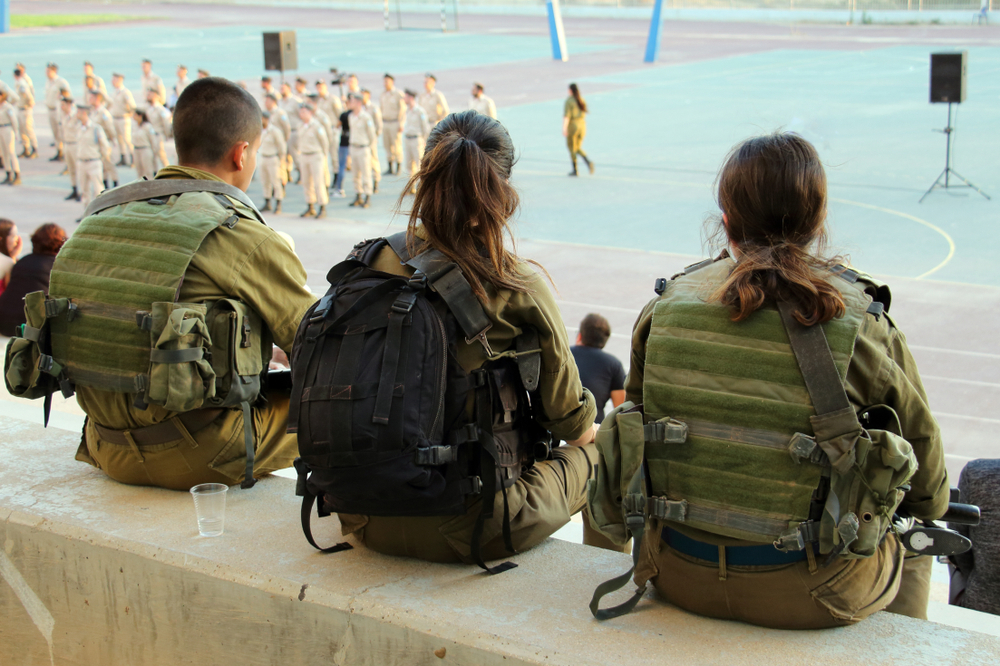
Milan (AsiaNews) - “Simply forbidden, like eating non-kosher food”. The phrase used by Rabbi Shmuel HaBar to describe military service in mixed units (i.e. composed of men and women) aptly captures the rift currently dividing a significant section of the Israeli religious world.
The prospect of permanently integrating women into combat units – in recent days the heated debate has centred in particular on the inclusion of women in the tank corps – is perceived by many rabbis not as an organisational adjustment, but as a non-negotiable halachic violation (i.e. relating to Jewish law).
The rules of halakhah constitute the regulatory framework guiding the lives of observant Jews, based on the Torah and the Talmud. In the context of Israeli military service, these norms take on particular significance and help explain the current tensions.
One of the most significant principles is that of modesty (tzniut), which prescribes the separation of men and women, especially in contexts of close cohabitation. For this reason, many rabbis consider service in mixed combat units problematic, where soldiers share confined spaces (such as inside an armoured vehicle or a tank) and intense operational conditions. Added to this are restrictions on physical contact and shared daily life, which are difficult to reconcile with the reality of a modern army.
The issue came to a head in early 2025, following a Supreme Court ruling that had required the Israel Defence Forces (IDF) to further open up combat roles to women, including armoured units.
The Israeli army’s decision in recent months to accelerate the integration process, following the ruling, prompted an extraordinary meeting, lasting over four hours, at a symbolic site of religious Zionism: the home of Rabbi Haim Druckman, a leading figure in religious Zionism who passed away in 2022.
A compromise position emerged from that meeting: not opposition to women’s service per se, but a clear rejection of ‘mixed operational contexts’. Rabbi Yaakov Medan, a veteran of the 1973 war, had been explicit: ‘We will not serve in a field unit where there is mixing’.
Yehuda Gilad took a similar line, speaking of “extreme halachic problems”. The crux of the matter, however, is not merely theological: several religious leaders fear that gender integration could drive observant young people away from combat units, reducing the contribution of religious Zionism (which today operates on a voluntary basis) precisely in the units most exposed and engaged on the various war fronts.
Yet, a more complex dynamic is developing within the religious world itself. Since 7 October 2023, there has also been a significant increase in the number of religious women choosing to enlist, breaking a taboo that for decades had confined many of them to alternative civilian service. In 2025, according to official figures, around 3,500 observant young women enlisted, and a growing proportion (around 10%) opted for combat roles. Overall, women now account for over 21% of the Israeli Defence Forces’ combat troops, representing a 240% increase over a decade.
This transformation has prompted the army and the religious establishment to seek solutions that might be described as ‘intermediate’. Among these is the creation of all-female units designed for religious female soldiers, with dedicated halachic support and conditions that prevent promiscuity. The aim is to reconcile participation with observance, but the model remains limited and does not resolve the central issue: integration into the main operational units, where gender segregation is impractical, especially in wartime.
The ongoing war (from the Gaza Strip to Lebanon) has in fact highlighted these contradictions. Chief of Staff Eyal Zamir has made it clear that the army cannot afford exclusions: “Women are an integral part of the operational force.” The need for combatants at the front is such that every social group, including the ultra-Orthodox, whether men or women, becomes strategic.
The issue, at this point, is intertwined with another major theme: the compulsory conscription of the haredim. In June 2024, the Supreme Court ruled that, without a specific law, the state cannot continue to exempt yeshiva students from compulsory military service.
In February 2026, before the High Court, the government indicated its capacity to enlist several thousand ultra-Orthodox men per year, though these figures fall far short of the approximately 80,000 young men of conscription age.
The issue is highly contentious within Israeli society. On the one hand, pressure is mounting from secular sectors and army reservists (who are heavily involved in ongoing conflicts, to the detriment of businesses and entire productive sectors of the country) calling for a fairer distribution of military service. On the other, the ultra-Orthodox parties, central to the stability of the current government, defend the exemptions as a pillar of their identity. The army, caught between operational needs and political constraints, openly states that the conscription of the haredim is now “a clear security requirement”.
Further complicating the picture is the radicalisation of a section of the religious right. Certain politicians, such as Itamar Ben-Gvir and Bezalel Smotrich, represent a faction that staunchly defends the autonomy of the religious world. This context contributes to further polarising the internal debate: on the one hand, the security imperative; on the other, the risk of a drift towards identity-based conflict.
In this scenario, military service essentially becomes a mirror of the fractures within Israeli society: between secular and religious groups, between inclusion and separation, between operational needs and ideological constraints. The issue of gender is intertwined with that of compulsory military service, creating a tension that runs through both the barracks and the political system.
Meanwhile, Israel is heading towards possible early elections within six months. Prime Minister Benjamin Netanyahu, bolstered by his alliance with religious and nationalist parties, could play this card in an attempt to stay in power once again, in a context where Israel is at war with Hamas, Hezbollah, Iran and the associated network of pro-Tehran militias.
In view of this possibility, which observers consider far from remote, the opposition is attempting to reorganise itself: former Prime Minister Naftali Bennett (who has founded his own movement) has initiated a rapprochement with the centrist and liberal leader Yair Lapid, in an attempt to rebuild a front capable of challenging the right for power.
Bennett, an exponent of religious Zionism but with a modern and pragmatic profile, now finds himself having to balance two pressures: on the one hand, the increasingly strong demand to broaden the military service base to include the ultra-Orthodox; on the other, the need not to alienate an electorate sensitive to rabbinical demands, including opposition to mixed-gender units. His repositioning reflects a changed reality: the war has brought security back to the forefront, but also the sustainability of the ‘people’s army’ model.
Ultimately, the issue of conscription (who serves, under what conditions and with what limits) is now more than ever one of the main ‘battlegrounds’ of Israeli politics. It no longer concerns only the organisation of the Israel Defence Forces, but the very definition of the social contract. It will inevitably be one of the decisive issues in the upcoming election campaign, in a country where war, religion and politics appear today to be more intertwined than ever.

.png)
24/10/2019 17:56
11/08/2017 20:05










