








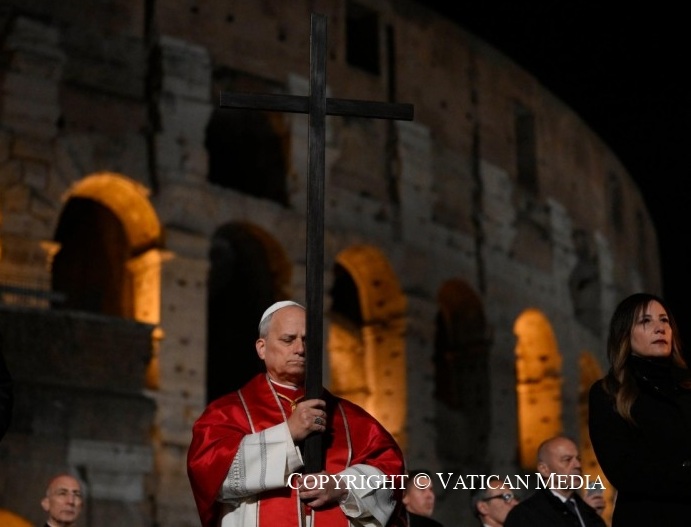
Pope Leo XIV with the cross at the Colosseum: “Let us follow in the footsteps of Jesus”
The Pope presided over the traditional Good Friday service, personally carrying the crucifix through all 14 stations. At the end, he recited only the words of a prayer by St Francis, the 800th anniversary of whose death falls this year. The former Custos of the Holy Land, Father Patton, recalled in his meditations that “even those who start a war will have to answer for it before God”.
Rome (AsiaNews) - “Grant us, wretched as we are, to do, for your love’s sake, what we know you wish, and to always desire what pleases you, so that, purified within, enlightened within and set ablaze by the fire of the Holy Spirit, we may follow in the footsteps of your beloved Son, our Lord Jesus Christ, and by your grace alone, come to you, O Most High”.
It was with the very words of this prayer of St Francis – which “invites us to live our lives as a journey of progressive involvement in the relationship of love that unites the Father, the Son and the Holy Spirit” – that Pope Leo XIV concluded this evening’s traditional Good Friday Way of the Cross at the Colosseum, the first of his pontificate.
Before some 30,000 faithful gathered in the heart of Rome, Pope Prevost renewed the event reintroduced by Paul VI in 1964, reviving an ancient Roman tradition. In a significant gesture – as John Paul II also did in the early years of his pontificate – it was Pope Leo XIV himself who carried the cross throughout all 14 stations of the Way of the Cross along the route that climbs from the ancient amphitheatre up to the Palatine Hill.
“I think it is an important sign of what the Pope represents, a spiritual leader in the world today, and to say that Christ still suffers,” Pope Leo XIV had said a few evenings ago, responding to a question from journalists at Castel Gandolfo on the significance of this gesture. “I carry all these sufferings in my prayers,” he added. “And I would like to invite all people of good will, people of faith, all Christians, to walk together, to walk with Christ who suffered for us, to give us salvation, and to strive ourselves to be bearers of peace.”
In this year in which the Church celebrates the 800th anniversary of his death, the words of St Francis have marked all the meditations of the Way of the Cross, prepared by Father Francesco Patton, a Franciscan friar who until last year was Custos of the Holy Land and who now carries out his ministry in Jordan at the shrine on Mount Nebo, where Moses’ gaze upon the Promised Land is commemorated. By bringing together the Passion narratives of the Gospels and some of St Francis’s writings, Father Patton’s meditations led the faithful to view today’s tragedies through the eyes of faith. Facing Jesus condemned to death by Pilate, he recalled that “every authority will have to answer to God for the way in which it exercises the power received: the power to judge, but also the power to start a war or to end it, the power to educate for violence or for peace, the power to fuel the desire for vengeance or that for reconciliation, the power to use the economy to oppress peoples or to free them from misery, the power to trample on human dignity or to protect it, the power to promote and defend life or to reject and stifle it”.
In Jesus’ encounter with his Mother, he invited us to look upon the “too many mothers who even today see their children arrested, tortured, condemned, killed”, but also to those “woken in the middle of the night by heart-rending news and those who keep vigil in hospital over a child who is dying”. With Veronica, to recognise Jesus even in the “disfigured beauty” of the “poor person deprived of their dignity” or “of women victims of trafficking reduced to slavery”. Or to weep like the women of Jerusalem “over massacres and genocides”.
In Jesus stripped of his garments, the Franciscan who served as Custos of the Holy Land called on us to recognise attempts to strip away dignity in every situation of life: from prisoners left half-naked in their cells, to victims of rape and abuse; from the exploitation of nudity in the entertainment industry to the pillories of the media world. Before Jesus taken down from the cross, he urged us to remember that even the body of a criminal cannot be reviled, concealed or destroyed: “Grant that our age, which has lost respect for the living, may at least retain that for the dead,” he asked God in prayer.
Until the final station of the Way of the Cross, the tomb where Jesus is buried in a garden like that of Eden, from which it all began. “A place where the old, fragile and mortal creation is transformed into a new creation, which shares in the very life of God”, “a sure foundation for our hope of eternal life”.

.png)










