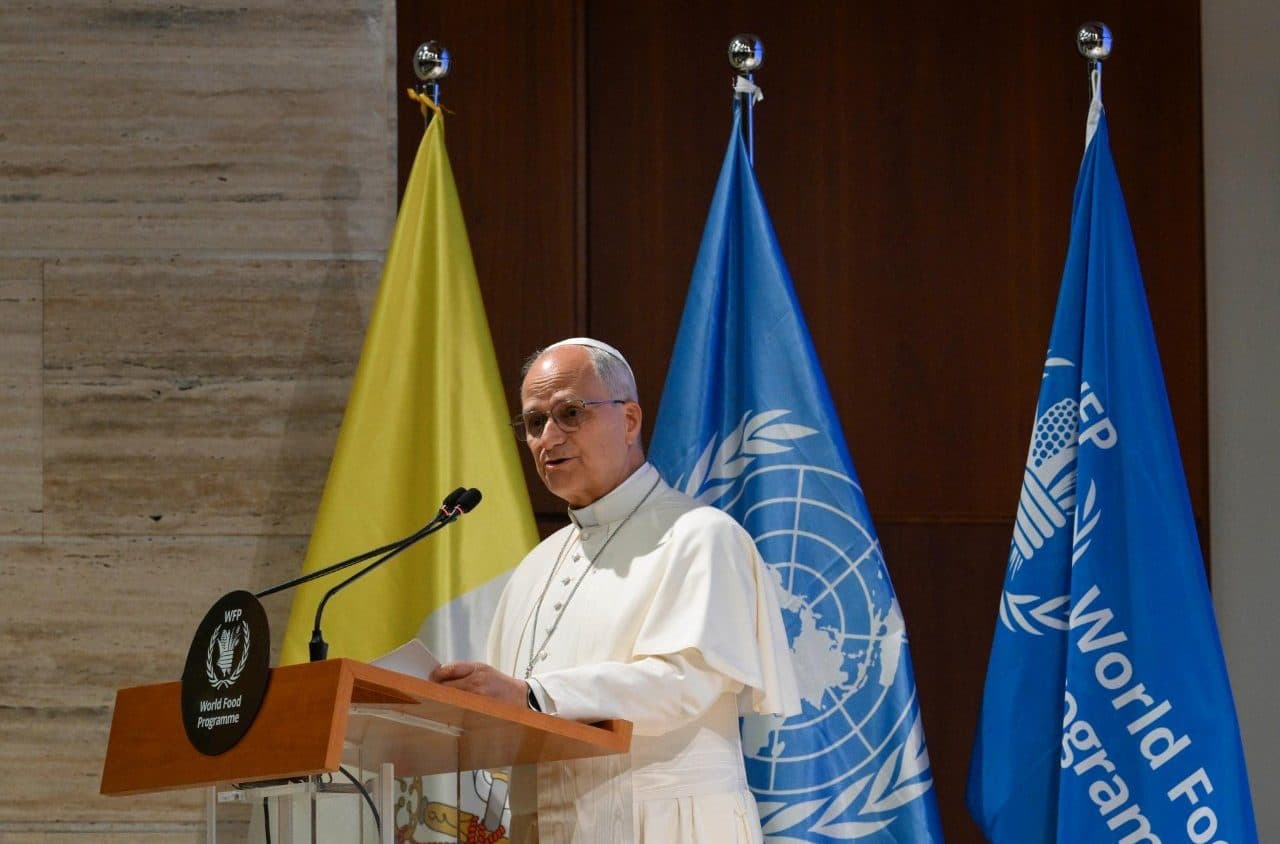
Rome (AsiaNews) – Pope Leo XIV this morning visited the Rome headquarters of the World Food Programme (WFP), an international organisation within the United Nations dedicated to food assistance in times of conflict and natural disasters.
In his address, the pontiff called for the simplification of “what has become overly complex” and a return to what is “essential”, getting rid of an “unnecessary bureaucracy” that hinders the delivery of aid.
“Access to adequate food is a fundamental human right grounded in the dignity of every person,” the pope said. In order to address the need to alleviate the suffering of millions of people around the world, action is required against the “underlying causes of geopolitical instability,” he added.
During his visit, Leo XIV met the staff of the UN body together with their families and the participants of the annual meeting of the agency’s executive board. He travelled to the headquarters by car, leaving the Vatican at 10:30 am.
Leo stressed that the WFP’s mission is to save “lives in emergency situations”. This “commitment resonates profoundly with the Catholic Church’s mission to uphold human dignity and to foster fraternity, rooted in the Gospel’s call to love our neighbor”.
The pontiff added that the “structural causes” that fuel hunger and malnutrition must not be neglected.
WFP was founded in 1961, and was the recipient of the 2020 Nobel Peace Prize. Present in more than 120 countries and territories, its work is impressive. In 2025 it brought assistance to about 120 million people worldwide, delivering more than 15 billion daily food rations.
The organisation reports that 2026 saw “unrelenting food needs” caused by “weather-related and economic shocks.” Every day it had up to 5,000 lorries, 80 aircraft and 20 ships on the go to deliver aid.
For Leo, to effectively address “the urgent task of confronting hunger and malnutrition,” it is well to examine the “challenges” that await with solutions, causes and trajectories.
Painting a world of war and disorder, the pope listed these challenges, namely “prolonged conflicts, chronic food insecurity, economic volatility and growing climate vulnerabilities”, whose main causes are the “crisis of the multilateral system,” the “absence of a shared ethical horizon" and greater allocation of resources to "national security".
From this, a “striking paradox” emerges, namely that an “unprecedented global productive capacity exists alongside expanding zones of extreme vulnerability”, exclusion and marginalisation fuelled by the “same forces” that “drive economic growth.”
Unfortunately, “humanitarian concerns increasingly risk being relegated to a secondary place among international priorities,” Leo warned, leading to a “serious ethical challenge”, in which “the human person is no longer consistently placed at the center of international action”.
The pope also slammed the “progressive bureaucratization of solidarity alongside the quiet commodification of human life”, lamenting that conflicts are "fuelled" more easily than doing something for starving people.
Generally, “hunger erodes social cohesion, heightens the risk of conflict and fuels forced migration. Moreover, it undermines the capacity of States and societies to build resilient institutions”.
From such a perspective, “humanitarian action is not extraneous to the international order.” It reflects in fact the "responsibility" of the global community in terms of solidarity, opposition to exclusion, and recognition of the dignity of every person.
In describing the WFP, Leo said that it was “more than a political, economic or technical actor; it is a concrete expression of international solidarity,” intervening “where national institutions recede and community networks disintegrate”.
Thus, in an increasingly “fragmented and multipolar world”, the pontiff calls for “a renewed commitment to multilateral cooperation” that can contribute to a “Lasting peace and integral, sustainable human development [. . .] through the participation of all”.
“Such an approach requires a firm political will capable of transcending short-term perspectives and investing in global public goods,” Leo said.
Finally, the pontiff appealed directly to the governments and peoples of the world “to increase the resources dedicated to combating hunger and its root causes, and to remove the obstacles that prevent aid from reaching those in need.”
For Leo, “such support should strengthen engagement with the Church and civil society.” Indeed, “Reinforcing the capacities of all these actors together will multiply our collective effectiveness in the fight against hunger.”