








Russia’s interests in Hungary
For the first time, in the upcoming elections on 12 April, Viktor Orbán appears at risk of defeat by his opponent, Peter Magyar. This is drawing particular attention from Moscow, which has so far regarded him as its main ally amongst the countries of the European Union. And Putin has tasked his most trusted adviser with closely monitoring this election.
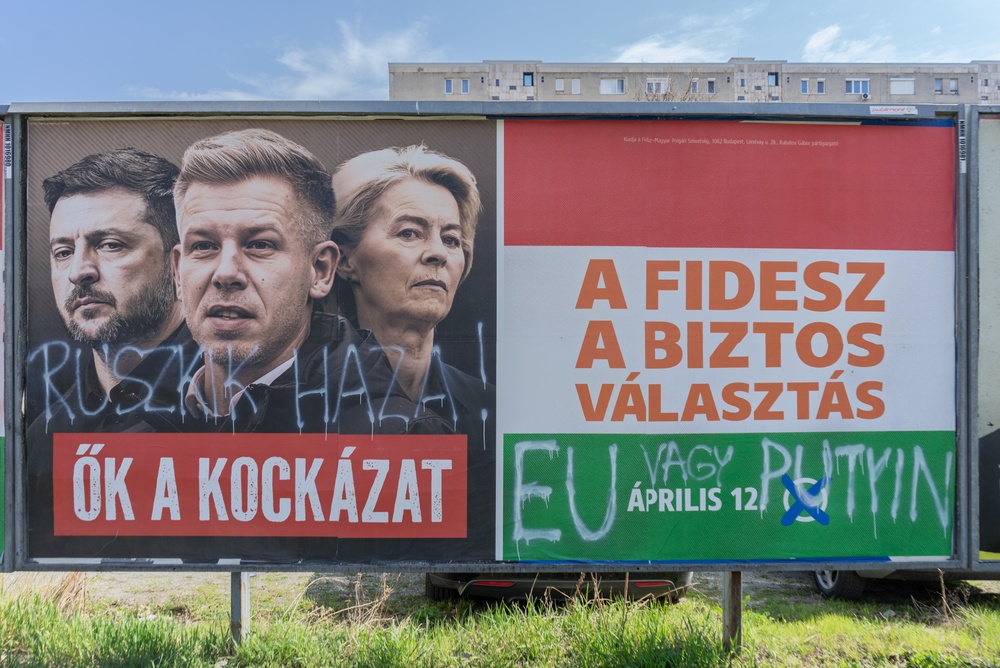
Moscow (AsiaNews) - On the eve of the parliamentary elections in Hungary, scheduled for 12 April, Viktor Orbán’s long-standing government appears at risk of being defeated by his opponent Peter Magyar, a shift that would radically alter the outgoing prime minister’s anti-European and anti-Ukrainian stance.
This is drawing particular attention from Russia, which has so far found in Orbán its main ally among the countries of the European Union, given that Hungarians consider themselves “the most Asian of European peoples” due to their descent from the Huns, who originated in Central Asia.
The Russian journalist and writer Andrei Sharyi has co-authored the book *Austro-Hungary: The Fate of an Empire* with the Belarusian historian Yaroslav Shimov, a work dedicated to the period of the Habsburg Monarchy, which links Hungarians more closely to Europeans than to their ancient Eastern ancestors.
In his view, “Hungary has a unique historical trajectory, particularly due to the way politicians exploit the historical traumas of the past”, something Orbán has managed rather well so far. The nomadic Hungarian tribes arrived in the territory of Pannonia in the 10th century, distinguishing themselves from all neighbouring peoples both by their ethnic roots and by their ‘Finno-Ugric’ language.
This gave rise to the concept of Hungary’s ‘historical isolation’, which is reflected in a vast body of local literature that developed in the second half of the 19th century alongside the formation of modern European nations.
Today, this theory underpins Hungarian nationalism, which, following the medieval dynasties, has always been subject to the rule of other kingdoms—from the Habsburg Empire to the Soviet Union—and seeks to assert its superiority over the seven neighbouring states where Hungarian minorities reside: Slovakia, Serbia, Croatia, Romania, Austria and, above all, Ukraine, where, according to official statistics, at least 150,000 Hungarians live.
Hungarians living in other countries have the right to obtain Hungarian citizenship and to vote in elections, and since 2010 Orbán has actively supported social and cultural projects beyond his country’s borders, fostering the idea of a ‘Hungarian world’ analogous to the ‘Russian world’, drawing in many peoples through the presence of their compatriots.
This is therefore a deep-seated reason for the harmony between Orbán and Putin, who support one another in a Eurasian vision to challenge ‘Western hegemony’ and propose a ‘multipolar’ world, in which Moscow and Budapest play roles of aggregation and ‘unification’.
Compared to Russia and Central Asia, the level of freedom and democracy in Hungary appears to be higher, and various parties can indeed participate in elections, even though until now the opposition has been easily controlled by Orbán, using systems similar to Vladimir Putin’s regime. Orbán had radically changed his initially anti-Russian stance when he was invited in 2009 to the congress of Putin’s United Russia party in St Petersburg, securing Hungarian involvement in major energy projects – a matter which today constitutes one of the main points of friction with Ukraine and the whole of Europe.
As has emerged in recent days, Putin has entrusted his most trusted adviser, Sergei Kirienko, with the task of closely monitoring the Hungarian election campaign. Current polls suggest it is unlikely that Orbán will win these elections; yet he is certainly prepared to try by any means necessary, inspired by his close friends in the Kremlin.

.png)










