








Saigon: Crosses return to the cathedral’s spire, a visible sign of faith
The decade-long restoration of Notre Dame has been completed. The installation coincides with the feast of St. Joseph. For Bishop Zalewski, they are “a sign of faith placed in the heart of the city.” Last year, over 200 churches, ecclesiastical buildings, and other structures related to pastoral work were constructed nationwide.
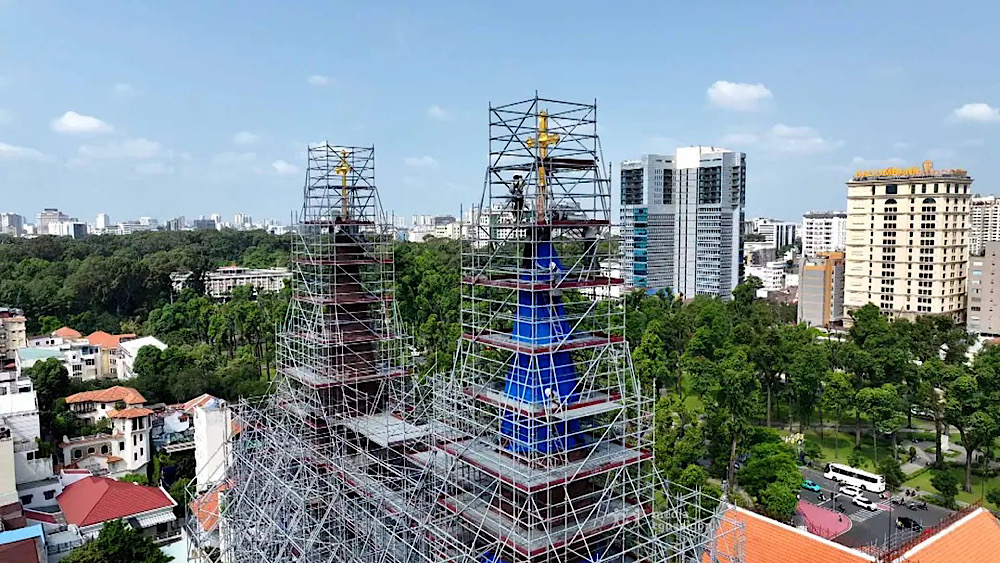
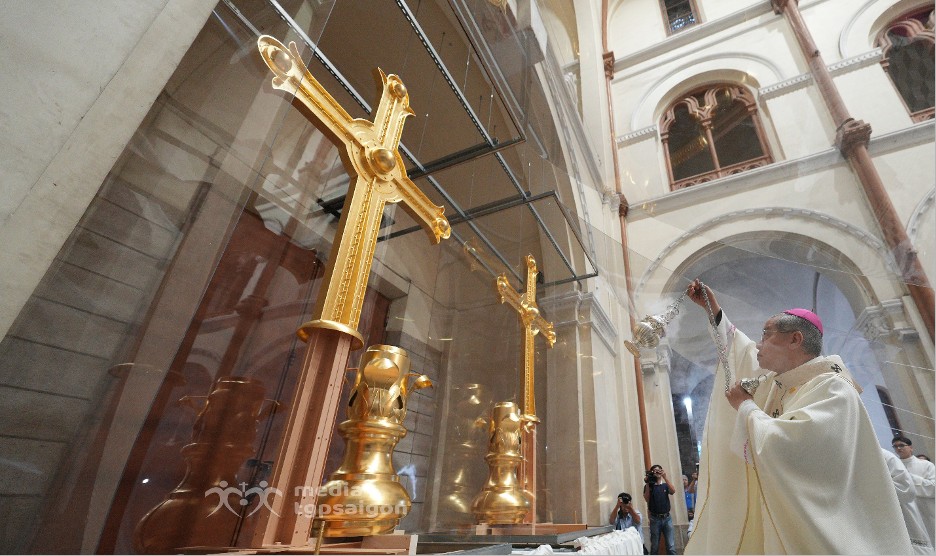
Ho Chi Minh City (AsiaNews) - After years of restoration work, Notre Dame Cathedral in Saigon [now Ho Chi Minh City] can once again display its golden crosses atop its twin towers, which since yesterday have returned as a visible sign of faith and the Christian presence in the skyline of the southern Vietnamese metropolis.
The installation took place on the Solemnity of St. Joseph and marks a significant moment in the modernization of this historic place of worship, restoring new splendor to a religious symbol long associated with the city’s spiritual life.
Leaders of the Vietnamese Church and the restoration teams witnessed the installation of the two crosses, as cranes lifted them to a height of 57 meters and secured them to the zinc-clad towers.
Bishop Marek Zalewski, the Vatican’s non-resident representative in Vietnam, stated that the return of the crosses holds “spiritual significance,” after they had been removed in 2023 for restoration, explains LiCAS.news.
For the prelate, this is “a sign of faith placed in the heart of the city, which guides people toward the mystery of the Cross of Christ” and of a Church formed by “living stones,” to which every believer can contribute through works of faith and charity.
Archbishop Zalewski continued by noting that the cross refers “both to the sacrifice and to the resurrection.” Yesterday’s ceremony coincided with the feast of St. Joseph, patron of the universal Church.
Hence the archbishop’s exhortation to protect the faith, the family, and community life through “humility and fidelity.” The process of installing the crosses was supervised by engineers and specialists from abroad and Vietnam.
Each of the two crosses is over 3.7 meters tall and weighs approximately 400 kilograms. They are made of steel and covered in gold leaf, a material suitable for tropical conditions. The crosses were manufactured in Belgium based on the original design.
The work is the result of several years of technical studies, including structural assessments, 3D scans, and material analyses. The original crosses, which had stood for nearly 130 years, were removed in March 2023 after severe deterioration was detected. Built between 1877 and 1880, the cathedral remains one of the city’s most famous landmarks, with restoration work having been carried out on the roof, the supporting structure, and the bell towers.
The restoration of the crosses at Saigon Cathedral is another visible sign of the growth of the Church in Vietnam, which, as Ucan notes, “in 2025 alone saw over 200 churches, rectories, ecclesiastical buildings, and other clergy-related structures built nationwide.
Nearly 150 were in the northern dioceses, where many church properties—the analysis continues—had long been neglected since many Catholics migrated south in 1954 following the communist government’s rise to power in the north.” Furthermore, new churches are also appearing in expanding urban areas as migrants move to cities and establish new parishes.
Some of these projects may seem enormous in terms of size and cost, taking up to a decade to complete at a cost of millions of dollars. A striking example is the Lang Van Church in the northern province of Ninh Binh, inaugurated last December after 10 years of construction at a cost of .2 million—“the largest in Southeast Asia” according to local media—and funded by a wealthy local Catholic businessman.
The Gothic-style building can accommodate about 5,000 people, with a basement hall for another 800. Its bell tower rises 110 meters. The new building replaced an older church that could no longer accommodate the nearly 4,000 members of the 140-year-old parish.
The scale of these projects has sparked debates—sometimes heated—within the Catholic community, as some question whether the resources would be better invested in programs dedicated to education, charity, or aid for the poor.
Experts and sociologists distinguish between two forms of religious capital: material capital—buildings and assets—and social or spiritual capital, which includes community bonds, service, and living faith.
If the former grows faster than the latter, they warn, a church can become rich in property but poor in community life. Today’s construction boom in Vietnam reflects both the historic revival and the desire for a visible presence. However, the deeper challenge facing the Catholic Church may not be one of the number of buildings, the experts conclude, but rather whether the buildings help nurture vibrant communities of faith capable of serving society and living the Gospel.
(Photo credit: Son Nu SPC, Minh Phong, Paul Pham / Vietnamese Bishops’ Conference)

.png)
07/02/2019 17:28
11/08/2017 20:05










