








Secret bases and future government: the impact of the US-Iran war on Iraq
Iran accuses Prime Minister-designate al-Zaidi of being too close to US positions. Iraqi officials say Tehran is trying to exercise a veto and pressure Iraqi Shias. A visit by US officials is expected to oversee the formation of the new Iraqi cabinet. Israel is rumoured to have set up a secret base in the west of the country.
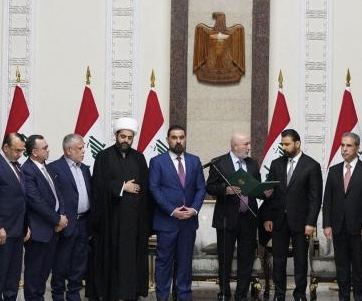
Baghdad (AsiaNews) – Iraq is once again a battleground between Israel and Iran, local and regional media report, as the country’s various political forces struggle to set up a new (and long-awaited) government, after Ali al-Zaidi was named prime minister-designate.
Despite presenting himself as a mediator among Shias, the 41-year-old businessman-turned-politician lacks a strong support base. In fact, his appointment is one of the sources of tensions since Iran accuses him of being too aligned with US positions.
He reportedly received strong support from the White House with US President Donald Trump inviting him to visit Washington. The US leader is quoted as saying that the United States “is with him all the way", provided he excludes pro-Iranian militias and limits its neighbour's influence, a position certainly not appreciated by Tehran.
Speaking about the formation of the next cabinet, two senior Iraqi officials yesterday noted that an Iranian veto would hinder, if not freeze, ongoing efforts.
Iran’s reaction was triggered by Iraq’s new leaders, under US pressure, to exclude pro-Iranian armed factions from the cabinet. Interviewed by Asharq Al-Awsat, the two officials confirmed Iran’s request to the Shia Coordination Framework to refrain from voting in favour of a cabinet that “harms the influence of its allies."
The request comes amid the surprise visit by Esmail Qaani, commander of the Iranian al-Quds Force, the foreign arm of the Revolutionary Guard Corps (IRGC), to the Iraqi capital.
This latest tug-of-war in Iraq between Tehran and Washington comes as peace talks to end the Gulf War triggered by the US-Israeli attack on Iran are stalled.
In the past few days, both sides rejected the other's proposals, and effective mediation for an agreement appears difficult. According to Iraqi officials, Iran wants to prevent Iraq from having a "purely American government”, amid US pressure on Baghdad to curb the activities of pro-Iranian armed factions.
Under the Iraqi Constitution, a prime minister-designate has only 30 days to present a cabinet to parliament for a vote of confidence. Thus, time is of the essence. However, with several lawmakers in Saudi Arabia for the Hajj, the major pilgrimage to Makkah, Iraq’s Council of Representatives (parliament) lacks a quorum for a vote.
Meanwhile, US officials are expected in the Iraqi capital in the coming days to ensure that no "alternate arrangements" are made for the cabinet, a step believed to have triggered the Iranian veto.
One of the Iraqi officials quoted a senior member of the Shia Coordination Framework as describing the US involvement in the cabinet formation as "unprecedented.” He warned that the differences could escalate into an “open conflict” between Washington and Tehran, concerns heightened by Qaani's arrival in Baghdad before US officials.
The issue is not limited to the government alone, but include restrictions on the economic and political links between Iraqi groups and Iran, particularly regarding water resources, oil, and independent political decision-making.
Another internal conflict in Iraq is linked to revelations last weekend by the Wall Street Journal, according to which Israel set up a clandestine outpost in Iraq's western desert before attacking Iran.
The newspaper's information is believed to be linked to classified information received from US officials (and other sources) who are said to have intimate knowledge of the matter.
The newspaper reported that the site on Iraqi soil served as a logistics hub for Israeli fighter jet operations, as well as hosting special forces and search and rescue teams.
Furthermore, it noted that Israeli forces launched airstrikes to prevent Iraqi troops from reaching it after it was identified, which appears to be in the western area of Al-Thubanah, Najaf province.
The use of Iraqi territory in regional conflicts, particularly in the US-Iran war, is not new, as evidenced by past events that primarily touched the Kurdistan region.
The presence of an Israeli base, however, has become a further source of tensions, beyond the (already known) issue of the country’s permeability to foreign interference.
Yesterday, an advisor to outgoing Prime Minister Iraqi Mohammed Shia al-Sudani denied that the Jewish state could have operated a secret military base inside Iraq.
He cited a deadly incident in the Najaf desert region in March, noting that it was linked to an attempt to recover an object that “fell from the sky" during the regional conflict.
Hussein Allawi, speaking on Al Hadath television, explained that the incident, which occurred on 5 March, involved an unidentified force that entered the desert to recover an equally unspecified object.
Iraqi security forces moved towards the location after a shepherd reported unusual activity. The operation resulted in the death of one Iraqi soldier and the wounding of two others.
This adds fuel to the fire in a country that has struggled to find stability and autonomy vis-à-vis regional and global powers since the 2003 US invasion and the overthrow of Saddam Hussein.

.png)










