








Settler attacks cause ‘uncertainty, fear’, leaving people ‘defenceless’ in Taybeh, says pastor
The latest settler attacks in Palestinian areas include uprooted olive groves, torched cars, insults sprayed on the walls of houses, and attacks on students. “Attention only comes when there is a serious attack or a tragic event!” Father Bashar laments. However, “the situation is difficult for us every day.” Lebanon accuses Israel of spraying toxic substances on fields and farmland in its southern villages.
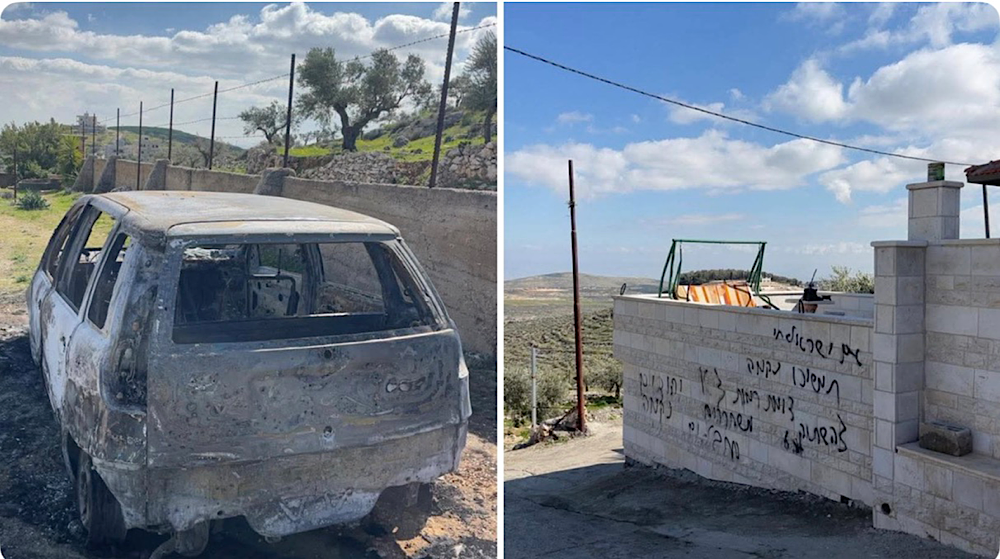
Milan (AsiaNews) – Jewish settlers continue their attacks against Christians (and Muslims) in the West Bank in a constantly escalating situation with worrying pattern of abuses and violations largely ignored by the Israeli government and international media.
Olive groves are being uprooted, cars torched, students slapped, spat upon, their religion verbally insulted, private property violated – this is forcing people to live with the constant threat and fear of further violence.
The latest incident on Wednesday involved once again the village of Taybeh. The following day, a group of Palestinian students from the Ibn Khaldun School in Sakhnin, while they were on a school trip to the Beisan (Beit She'an) area.
This situation is a source of "great stress, constant uncertainty, fear, and pressure,” said Father Bashar Fawadleh, parish priest in Taybeh, speaking to AsiaNews.
Yesterday, under Israeli army protection, groups of settlers launched coordinated attacks in various parts of the West Bank, uprooting hundreds of olive trees, attacking Palestinian civilians and shepherds, and attacking villages.
North of the Governorate of Ramallah and al-Bireh, settlers uprooted around 300 olive trees, damaging farmland and the home of a family that had already been the victim of raids.
Northeast of Ramallah, settlers raided the village of al-Mughayyir and attacked residents as they grazed their cattle. Further south, in the Nablus Governorate, they pepper-sprayed Palestinians and attacked three young men as they worked.
On Wednesday, a group of Israeli students attacked Palestinian teachers and students, both Christian and Muslim, at the Ibn Khaldoun School in Sakhnin, requiring hospital treatment for more than a dozen of them.
The attackers used pepper spray, insulting and hitting the young victims who were on a school trip in the HaMa'ayanot Park area.
Israeli police arrested three minors suspected of involvement, along with an adult, while the school's principal, Kamal Abu Younis, described the incident as a "racist attack”.
That same day, CCTV captured the moment Jewish settlers attacked Taybeh, invading private property, setting vehicles on fire, and spraying graffiti with racially hateful slogans on homes and walls.
Located in the West Bank, the village of about 1,500 residents and three churches, 30 kilometres north of Jerusalem and east of Ramallah, is known as the last Palestinian place inhabited entirely by Christians. The residents include more than 600 Latin Catholics, plus Greek Orthodox and Greek Melkite Catholics.
In recent months, the village has become the scene of repeated attacks by Jewish settlers, prompting the Latin Patriarch of Jerusalem, Cardinal Pierbattista Pizzaballa, and the Greek Orthodox Primate, Theophilos III, to visit it in a show of solidarity.
According to official Palestinian statistics, over the past few weeks, Jewish settlers have committed 349 acts of vandalism and theft, affecting large swathes of farmland across the West Bank.
The raids, carried out with the support of the Israeli army, resulted in the uprooting, or poisoning of 1,245 olive trees in several governorates, including 750 trees in Hebron, 245 in Ramallah, and 250 in Nablus.
Father Bashar Fawadleh confirms the community's fears.
“We live in a very stressful environment. Our lives are characterised by constant uncertainty, fear, and pressure. Even on days when nothing serious happens, we live with the expectation that something could happen at any moment,” he told AsiaNews.
“We worry about our homes, our cars, our families, and our future. Most of the time, our reality is invisible to the mainstream media. Attention only comes when there is a serious attack or a tragic event!” he added.
However, “the situation is difficult for us every day. Harassment, threats, property damage, and the feeling of being defenceless have become part of our normal life. Nothing has really changed. We continue to live in the same conditions, with the same risks and lack of security,” he explained.
“This constant pressure affects our mental health, our sense of stability, and our ability to live a normal life. We don't ask to be seen only in times of tragedy. We want the world to understand our daily reality," he insisted.
Meanwhile, Lebanon recently accused Israel of spraying herbicides and toxic substances on the fields and agricultural land of villages in its southern districts, near the border, an area that has been the scene of Israel’s toughest operations against Hezbollah in the past.
Lebanese authorities say these substances sprayed are hazardous to human health, and cause of concern for food safety and the environment.
Lebanon’s agriculture and environment ministries reported that laboratory tests confirm the presence of glyphosate, a chemical used to destroy vegetation, with concentrations in some samples “between 20 and 30 times the levels usually accepted.”
Lebanese President Joseph Aoun also addressed the issue, calling it a violation of Lebanese sovereignty and a crime against the environment and health, while the Israel Defence Forces (IDF) has made no official comment.
The issue has also reached the United Nations, which is monitoring with attention and concern the latest developments in the areas near the Blue Line, where a fragile truce exists, often violated by the Israeli military.

.png)










