








Tamils displaced by Cyclone Ditwah and abandoned by government launch protest
More than 100 days after the environmental disaster, over 60,000 people in Sri Lanka are living in makeshift accommodation. ‘The relief centres don't even have drinking water,’ they complain. The effects of the disaster compound the historical discrimination suffered by the tea plantation workers’ community. A petition with 15 demands have been submitted to the president and the government.
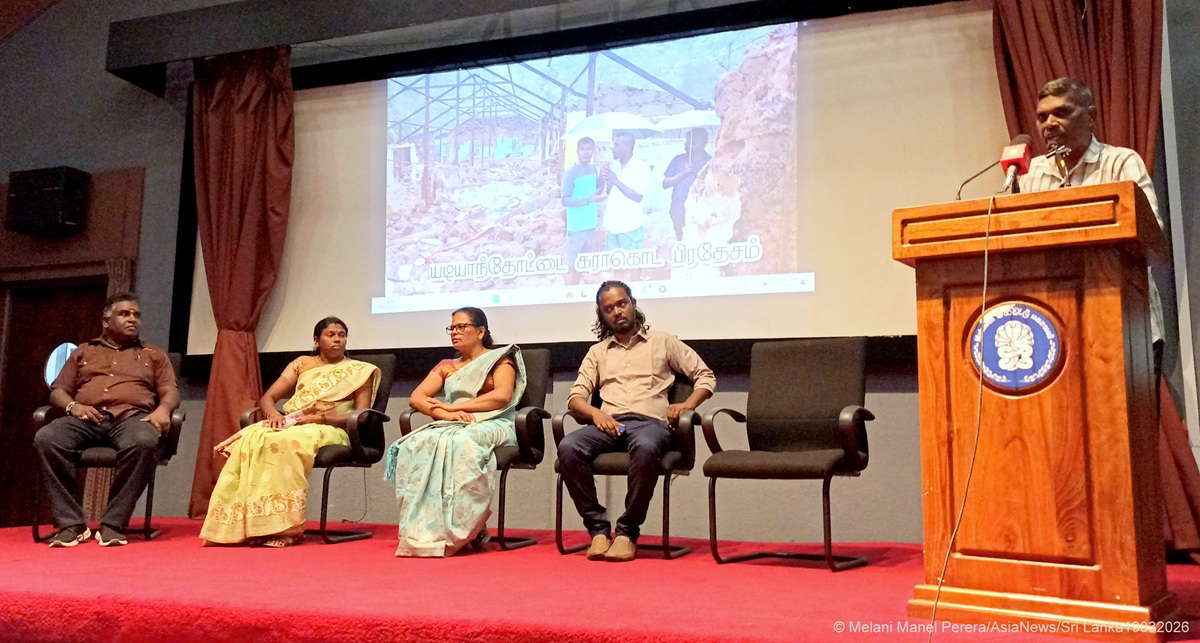
Colombo (AsiaNews) - Sri Lanka’s Malaiyaha Tamil community continues to live in conditions of extreme precariousness months after the devastating passage of Cyclone Ditwah on 28 November last year.
During a meeting held in Colombo on 19 March, the Civil Society Collective for Malaiyaha Reconstruction (CCMR) denounced the slow pace of relief and reconstruction efforts in the affected areas, highlighting how plantation families have been left behind compared to other regions of the island.
The testimonies gathered during the meeting paint a dramatic picture. Many displaced people are still living in temporary camps lacking essential services, such as drinking water and adequate sanitation. In some cases, around 50 families have to share just six latrines. Others find shelter in schools converted into refuges: during the day they leave the buildings to allow lessons to take place and return in the evening to sleep.
The situation is particularly critical for former residents of the so-called ‘line houses’, communal dwellings that were already in a state of disrepair before the disaster. According to several witnesses, these structures were so dilapidated that further rainfall could have led to tragedy. Despite this, the authorities reportedly urged the displaced people to return there, causing fear and outrage among the residents.
The Malaiyaha community, largely made up of tea plantation workers, highlights a long history of marginalisation. Many emphasise the economic contribution they make to the country and demand to be recognised as full citizens, with access to fundamental rights such as decent housing.
More than 100 days after the cyclone, over 60,000 people remain displaced in the regions of Nuwara Eliya, Badulla and Kegalle. Despite some relief efforts, the government’s promises of reconstruction and resettlement have yet to materialise into lasting solutions.
During the meeting, a petition with 15 demands addressed to the government and the president was presented, with the aim of urging urgent action. Among the main demands are the immediate provision of adequate temporary accommodation and a concrete plan for the construction of permanent housing.
“Our community remains in a state of extreme helplessness due to the government’s broken promises. Relief centres in most areas where our community lives lack even drinking water. Even the forms to be filled in to receive aid were not in Tamil. This shows just how unfair and discriminatory the situation is,” said Jeevarathnam Suresh, director of the Institute for People Engagement and Networking.
“We are asking the president to provide us with adequate temporary accommodation so that we can live in peace until the government keeps its promise to give us permanent homes,” said two women, Malar Willi from Badulla and Ambiga from Nuwara Eliya, speaking about their situation.
“Because of the government’s discrimination against us, we had to celebrate Pongal on the street in January because we had no home. Similarly, will we perhaps have to celebrate the Sinhalese and Tamil New Year, which falls in April, in front of the Presidential Secretariat too?” asks the Malaiyaha community bitterly.

.png)
07/02/2019 17:28
11/08/2017 20:05










