








Tashkent opens a magnificent new Centre for Islamic Civilisation
Commissioned by President Mirziyoyev, with 42,000 square metres of exhibition space, it is one of the world’s largest facilities dedicated to the study and promotion of Muslim history, culture and civilisation. Also on display is the Mushaf of ʿUthmān ibn ʿAffān, the oldest manuscript of the Qur’an.
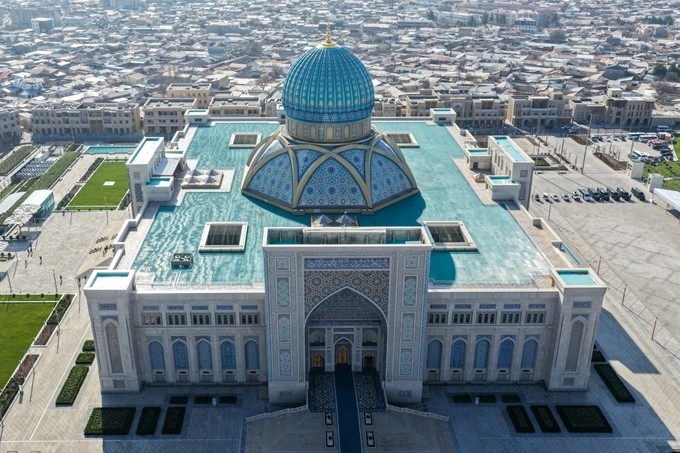
Tashkent (AsiaNews) - To mark the end of Ramadan and the Nowruz festival celebrating the spring new year, Uzbek President Shavkat Mirziyoyev has inaugurated the new Centre for Islamic Civilisation in Tashkent, which has been under construction for eight years.
The large complex will be open to everyone, featuring a magnificent museum, a Quran hall housing manuscripts unique in the world, and a library; the Religious Administration of Muslims of Uzbekistan has also moved here.
As stated in the official announcement of its opening, the centre represents one of the world’s largest facilities for the study and dissemination of Islamic history, culture and civilisation, so much so that it has been included in the Guinness Book of Records.
The building stands on the grounds of the Khazrati Imam complex, covering an area of 10 hectares, and comprises three storeys, measuring 161 metres in length and 118 metres in width. The dome stands 65 metres high, and the total area open to visitors exceeds 42,000 square metres.
The design of the palace was developed based on architectural ideas proposed by Mirziyoyev himself, as highlighted by the President’s press office. Entry is via four entrances with large portals, which, together with the external arches, are decorated with āyāt (verses from the Qur’an) and ḥadīth, anecdotes from the life of Muhammad that express ideals of “enlightenment, humanism and respect for one’s elders”. The basement houses a special area for children, a restoration and digital processing laboratory, storage facilities for museum artefacts and rare manuscripts, as well as spacious vestibules.
On the first floor is the museum, featuring a large exhibition hall spanning 8,350 square metres and a 550-seat conference hall. The second floor houses the Muslim Administration, another library with a collection of manuscripts and lithographic sources, printed and digital literature, reading rooms, and spaces for international organisations and scientific institutions.
The ‘spiritual centre’ of the entire complex is the Hall of the Quran, featuring unique displays centred around a projection mapping hologram beneath the dome, where a starry sky based on an astronomical chart first appears – a view of the night sky over Tashkent. Ninety Swarovski crystals were used to represent the stars, illuminated by 650 light bulbs.
This hall houses the Muskhaf of ʿUthmān ibn ʿAffān, the oldest manuscript of the Qur’an, included in UNESCO’s “Memory of the World” register, and a collection of 114 rare manuscripts owned by Uzbekistan, created during the reigns of the most important dynasties.
Among them are highly valuable examples from the Samanid, Karakhanid, Ghaznavid, Timurid, Shaybanid and other periods. There are over two thousand ancient sources, and more than 60 Qur’an manuscripts, both of local origin and acquired at international auctions.
The Centre has already received several accolades from authoritative international organisations and publishing houses, including the French Avicenna award, which ranks it among the top 10 museums in the world; its opening in 2026 is being awaited with growing interest.
The Centre’s facilities meet the most advanced sustainability criteria, in accordance with the requirements of UNESCO and ICOM, the International Council of Museums. The works on display are explained via QR codes in various formats, with video and audio in three languages, and there are plans to expand this to eight languages.
The large building is designed as a space for social integration, based on the slogan ‘A museum open to all’, and a special audio guide for the visually impaired will also be installed, offering various options for independent movement using electronic solutions available via Bluetooth.
Robot guides and other cutting-edge solutions are also being considered, as is already the case in the world’s leading museums, to offer everyone a rich heritage of spirituality, whilst feeling welcomed into a future where technology serves humanity.

.png)










