








Trump opposes Chagos Islands agreement: Diego Garcia base at the centre of tensions
The US president has questioned the deal between the United Kingdom and Mauritius, which provides for the transfer of sovereignty over the archipelago and the maintenance of the US-UK military base under a 99-year lease. London wants to ensure the continuity of the UK-US military presence. Excluded from the talks, Chagossians fear that they will not obtain the right of return.
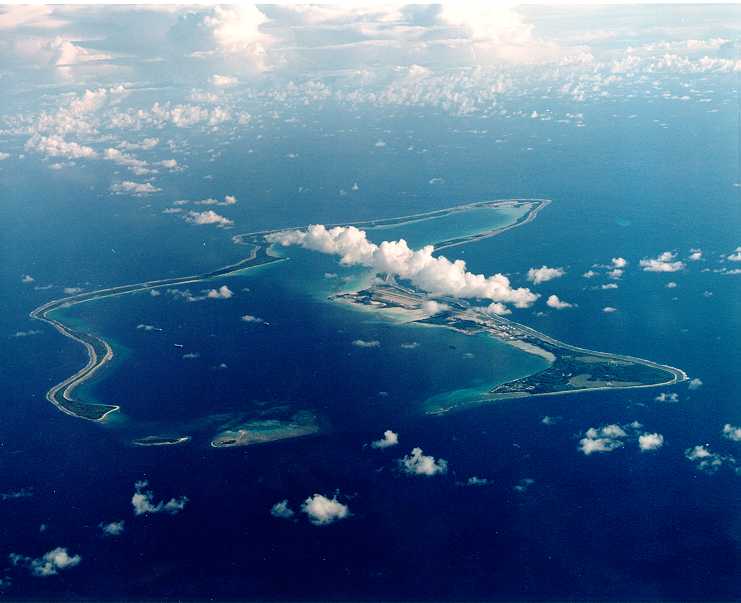
London (AsiaNews) – Tensions have flared up again over the fate of the Chagos Islands after US President Donald Trump yesterday questioned the agreement signed by the United Kingdom and Mauritius that provides for the transfer of sovereignty over the archipelago from the former colonial power, while the military base on the island of Diego Garcia would continue to host British and US troops under a 99-year lease.
After abandoning (for now) territorial claims on Greenland, an autonomous Danish territory, in a post on the Truth Social platform, Trump urged British Prime Minister Keir Starmer not to "give away Diego Garcia,” the archipelago's largest island, arguing that it “should not be taken away from the UK” and that doing so would be "a blight on our Great Ally”.
The US president went on to argue that “Leases are no good when it comes to Countries," referring to the planned military base agreement, which the local Chagossians have long opposed.
Yet, just a few days ago, the US State Department officially expressed its support for the agreement, stating that it backed the “decision of the United Kingdom to proceed with its agreement with Mauritius”.
This was another U-turn for Trump, who first called the agreement "an act of great stupidity,” then describing Starmer's deal as the "best he could make".
Strategically located in the Indian Ocean, between East Africa, the Middle East, and South Asia, the island of Diego Garcia is important for US military operations in the Indo-Pacific (against Chinese ambitions) and the Persian Gulf, particularly in anticipation of a likely US attack on Iran.
“Should Iran decide not to make a Deal, it may be necessary for the United States to use Diego Garcia," Trump reiterated, linking the issue to tensions over Iran's nuclear programme.
The White House press secretary Karoline Leavitt later clarified that the president's post "should be taken as the policy of the Trump administration,” confirming the political nature of the president’s post.
In 1965, the United Kingdom established a separate administration for the Chagos Islands, granting the status of a British Indian Ocean Territory.
Although Mauritius, which gained independence in 1968, has always maintained that the Chagos Islands were part of its territory, London maintained control over the archipelago and expelled at least 2,000 inhabitants to build, in cooperation with the United States, the Diego Garcia military base.
In 2019, the International Court of Justice in The Hague, at the request of the United Nations General Assembly, ruled (in an advisory manner) that British administration over the Chagos Islands was illegal and that the decolonisation process of Mauritius could not be considered complete until the islands were returned.
In October 2024, London and Port Louis announced an agreement, which was signed in May 2025, providing not only for the transfer of sovereignty over the former British Territory, but also commitments to cooperate on security and environmental protection, and the establishment of a trust fund for the benefit of the Chagossians.
According to estimates by the British government, which has defended the lease agreement as essential to ensuring the military base's operational continuity, London will need to pay Mauritius £3.4 billion (US$ 4.5 billion) over the next century.
Starmer has repeatedly argued for the need to transfer sovereignty to avoid new legal challenges that would risk ending the US-UK military presence altogether.
The issue remains pending in the United Kingdom, which is also grappling with a political crisis following the release of the Epstein files and the arrest of the former prince Andrew Mountbatten-Windsor, brother of King Charles.
The bill that would implement the agreement in British law has been postponed, and a date for final discussion in the House of Lords has not yet been set. A meeting between the United States and Mauritius is scheduled for the coming days.
In the United Kingdom, opposition parties have harshly criticised the agreement, but parts of the Chagossian community have also opposed it. In recent days, four native inhabitants of the islands landed on Ile du Coin atoll, also part of the Chagos Islands, in protest.
More people are expected to arrive in the coming days, getting the support of British far-right politician Nigel Farage.
The group's leader, Misley Mandarin, stated that "there’s no reason” for this agreement, “because Mauritius never owned the Chagos Islands in the first place" and called on the British government to "cancel that deal and let the Chagossians come back to their homeland as British”.
Other Chagossians distrust the Mauritian government and fear they will not be granted the right of return once the agreement goes through.
Those who were forced to move to Mauritius or the United Kingdom in the 1960s and 1970s have complained that they were not involved in the talks that led to the agreement and have called for a referendum.
United Nations experts have also stressed that the agreement reached between London and Port Louis risks perpetuating human rights violations if it does not guarantee a genuine right of return.

.png)










