








UNRWA warns of ‘fragile and worrying’ humanitarian situation in forgotten Gaza
The conflict with Iran, the Gulf crisis and devastating attacks in Lebanon are overshadowing the tragedy in the Strip. Over 21,000 children have been killed, nearly 45,000 injured, and at least 58,000 have lost one or both parents. There is a shortage of drinking water and medicines, and infectious diseases are spreading. The aid system is paralysed. Restrictions imposed by Israel are taking their toll, whilst Hamas is weakened but not disarmed.
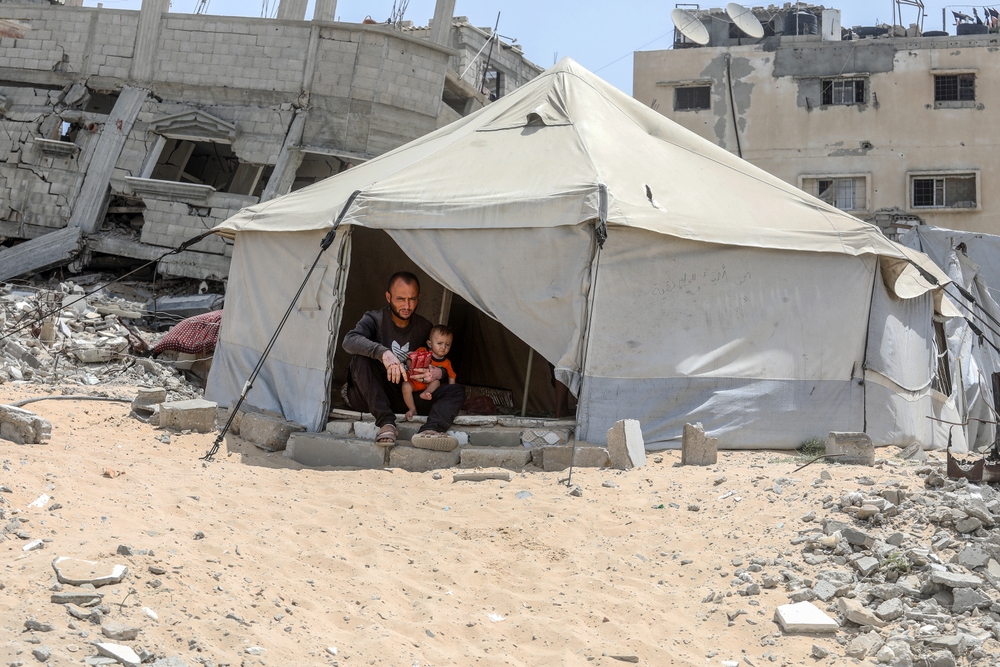
Milan (AsiaNews) - A picture, if possible, even bleaker than the humanitarian crisis in the Gaza Strip. This is what emerges from the 216th report by UNRWA (the UN agency for Palestinian refugees), updated on 8 April. Whilst the international public’s attention shifts towards other terrible war zones in the Middle East, fighting in the Strip (bar a few brief lulls) has not ceased: air strikes, shelling and gunfire continue to hit densely populated areas, particularly in the eastern part of Gaza City, but also near Khan Younis and Al Mawasi. The human toll, already dire, continues to worsen steadily, partly because Hamas, though severely weakened, appears rather reluctant to disarm following the new plan presented on 19 March by the Bulgarian diplomat Nikolaï Mladenov (High Representative for Gaza within the Board of Peace established by Donald Trump). All the more so now that everything east of the ‘yellow line’ is effectively occupied by the Israeli army.
According to data from the UNRWA report, between 7 October 2023 and early April 2026, over 72,000 Palestinians were killed and more than 172,000 wounded. The Palestinian Central Bureau of Statistics, in figures updated to 6 April 2026, states that since the day Israel launched its military offensive on Gaza, 21,283 children have been killed (including 450 newborns, 1,029 infants under one year of age, and 5,031 under the age of five). This accounts for 30% of all fatalities and 26% of the injured recorded in the Strip. The physical consequences for those who have survived are devastating: 44,486 children have been injured, 10,500 have suffered permanent disabilitiesandmore than a thousand have lost one or more limbs. 58,000 children have lost one or both parents. The figures regarding humanitarian staff are also striking: nearly 400 UNRWA workers have lost their lives since the start of hostilities, a sign of the pervasiveness of military operations even in contexts, such as humanitarian agencies, that are theoretically protected by international law.
In terms of public health, the situation is becoming increasingly fragile and worrying. Overcrowding, a shortage of drinking water and the deterioration of sewage systems are creating an ideal environment for the spread of infectious diseases. There are increasing numbers of cases of scabies, skin infections, dermatitis and infestations with lice and fleas, whilst the presence of rodents is facilitating the transmission of further diseases.
There is also a rise in cases of acute diarrhoea, dehydration, hepatitis A and gastrointestinal infections linked to the consumption of unsafe or contaminated water. Among children, there are growing signs of acute malnutrition and a weakened immune system. Access to soap, disinfectants and hygiene products remains extremely limited, making any form of prevention difficult.
Added to all this is an increasingly evident structural problem: the progressive operational paralysis of the humanitarian system. The lack of batteries, fuel, lubricants and spare parts is compromising the functioning of generators, logistics vehicles and healthcare facilities. The containment measures adopted (notably the drastic reduction in electricity supply) are merely delaying a potential collapse of the infrastructure, making it increasingly difficult to guarantee even minimal essential services.
The issue of displacement remains central. Around 67,000 people are currently living in 83 collective centres managed by the UN agency, whilst many facilities are now located within militarised areas or areas subject to access restrictions. This further limits the ability to provide regular and safe assistance, increasing instability and the vulnerability of the civilian population.
At the same time, the restrictions imposed on international staff are having a decisive impact on the effectiveness of interventions. For over a year, entry into the Occupied Palestinian Territories has effectively been blocked for foreign aid workers. UNRWA continues to operate thanks to around 11,000 Palestinian staff in Gaza and over 4,000 in the West Bank, but the absence of international staff significantly reduces coordination, supervision and fundraising capabilities.
Even more significant is the direct blockade of aid. Since March 2025, the agency has been unable to independently bring humanitarian goods into the Strip, despite having substantial stocks in neighbouring areas. The result is an increasingly evident operational paradox: resources are available but impossible to distribute. In this context, the opening of alternative corridors is also proceeding extremely slowly and with great difficulty.
In recent days, a number of initiatives promoted by UN agencies have sought to circumvent these restrictions, at least in part. A first shipment of over 100 tonnes of life-saving nutritional supplies was transported by sea via an internationally coordinated humanitarian corridor, arriving at the Israeli port of Ashdod and subsequently prepared for distribution in Gaza. This is a significant operational step, aimed at diversifying the routes for aid access and reducing logistical ‘bottlenecks’. Deliveries by land also continue via the Kerem Shalom crossing, currently the only one operational for goods, with the recent entry of hundreds of thousands of litres of fuel essential for keeping essential services running. Humanitarian agencies are also seeking to support a minimal resumption of local activities. Some programmes promoted by the FAO (the United Nations Food and Agriculture Organisation) have enabled groups of farmers to return to cultivation, with the aim of producing mainly vegetables to partially alleviate food insecurity. But this is a drop in the ocean of need.
This scenario also includes the controversial and now defunct experience of the Gaza Humanitarian Foundation (GHF). Established in February 2025 with the support of the Israeli and US governments, the organisation aimed to distribute humanitarian aid by bypassing the UN system. From the outset, however, its operational model proved to be seriously flawed. The concentration of aid in a few distribution centres, located in militarised areas, exposed the civilian population to extremely high risks. Numerous incidents of violence occurred precisely in the vicinity of these distribution points, with hundreds of civilians killed whilst seeking food. Several humanitarian organisations denounced the management of aid as incompatible with the principles of neutrality and safety, openly describing the GHF as a political tool in Israel’s hands to redefine control over aid and the civilian population. The organisation’s operations were suspended following the ceasefire in October 2025 and ceased definitively in November of the same year, without, however, UN agencies on the ground being granted freedom of action or the ability to carry out humanitarian interventions.
In this ‘circle of hell’ that Gaza has now become, the debate over UNRWA’s future takes on a significance that goes far beyond the humanitarian dimension. The political and legislative pressure to limit or eliminate its activities is part of a broader dynamic of the conflict. Dismantling the agency would, in fact, mean removing one of the main pillars of survival for the Palestinian population: healthcare, education, food distribution and social support.
Depriving Gaza of the infrastructure managed by UNRWA and making humanitarian aid impossible effectively amounts today to making daily life even more precarious and unsustainable, with the stated aim of encouraging the exodus of Palestinians. In short, the reduction or elimination of UNRWA and the curtailment of UN humanitarian agencies’ operations is by no means a marginal issue, but a strategic component of the conflict: restricting the humanitarian space to the point of rendering it incapable of operating appears, on closer inspection, to be a genuine act of war.

.png)
11/08/2017 20:05










