








Russia threatens Yerevan
At the recent European summit in Armenia, attended by Zelenskyy and marked by a clear desire to strengthen relations with the European Union, Putin responded by warning Armenia not to follow in Ukraine’s footsteps. These are weighty words in a country preparing to go to the polls on 7 June for extremely sensitive parliamentary elections.
Yerevan (AsiaNews) - Following the European summit in Yerevan on 4 May, attended by Ukrainian President Volodymyr Zelenskyy, relations between Russia and Armenia have entered a new critical phase.
Armenian Prime Minister Nikol Pashinyan expressed his intention to strengthen Armenia’s relations with the European Union, stating that “we would be happy to be welcomed as a member state”. Kremlin spokesperson Dmitry Peskov reacted by stating that the Russians would like an explanation, considering it “abnormal” that Zelenskyy was given a “platform for statements that are entirely anti-Russian”.
Russian Foreign Ministry spokeswoman Maria Zakharova also accused Armenia of “actions against Russia”, threatening “very serious complications” in relations with Yerevan.
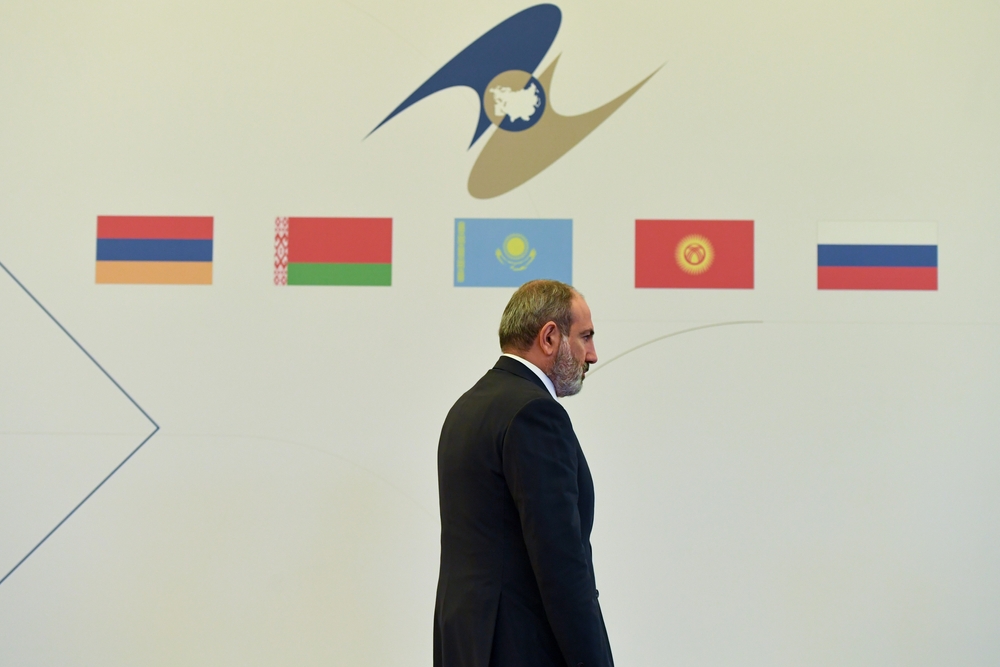
Following these statements, Pashinyan refused to travel to Astana in Kazakhstan for the summit of the Eurasian Economic Union (EAEU), a Moscow-led organisation comprising Belarus, Kazakhstan and Kyrgyzstan.
The Armenian Prime Minister stated that he was too busy with the election campaign for the renewal of the Yerevan parliament scheduled for 7 June, sending Deputy Prime Minister Mher Grigoryan instead. A few days later, Vladimir Putin himself spoke in harsh terms at the press conference following the 9 May parade, stating that Armenia’s accession to the EU and its withdrawal from the EAEU “must be decided by a popular referendum of the Armenian people”, to be organised “as soon as possible”.
He also urged Armenia “not to take the situation to extremes” and not to follow Ukraine’s path, recalling that Moscow’s conflict with Kyiv had begun in 2014 precisely because of the Ukrainians’ desire to integrate with the European Union.
In typical “Putin the Terrible” style, the Russian president noted that “all this led to the overthrow of the established order”, referring to the Maidan uprising, “and subsequently to the events in Crimea, the conflicts in south-eastern Ukraine and military actions; this is a very serious matter, and Armenia must take the possible consequences into account”.
Pashinyan replied in turn that “we will hold the referendum when there is an objective need to do so”, and that bilateral relations with another state, including Russia, “should not be confused with marriage”.
Political scientist Ruben Megrabyan, vice-president of the “Military Republic of Armenia” party, told Currentime that in his view “Putin’s words are a professional attempt at operational action typical of a former KGB member—or rather, a member who is still active, because there is no such thing as a former KGB member”. The Kremlin leader is seeking to appear accommodating and to assert Russia’s “constructive spirit”, in order to “amicably” convey his warnings to Armenia regarding the “objective difficulties”. According to Megrabyan, Putin’s words serve the ongoing electoral process, to make Moscow’s position on Armenia’s future clear to everyone, a sort of “instruction to the many pro-Russian forces within the country”.
Pashinyan is trying in his own way to avoid a direct confrontation with Putin, fully understanding the dangers that could ensue. He realises that “being an enemy of Russia is dangerous, but being a friend is even worse”, comments the political scientist, as the Russians are accustomed to fuelling internal divisions in other countries.
The decisive moment will therefore come at next June’s elections, where, according to forecasts, the majority of Armenian citizens will seek to assert the country’s independence and are therefore expected to support the pro-European choice, which is based on guarantees of independence and sovereignty, alongside partnership with the United States and peace with neighbouring countries, particularly Azerbaijan and Turkey.
Putin has also sought to emphasise economic issues, stating that “Armenia’s GDP is guaranteed by trade with Russia”, but Megrabyan points out that “for Russia, trade is not trade, it is politics”, and the Armenians will have to choose the most appropriate way to ease these pressures as well. Russia is extremely unnerved – “to the point of hysteria” – by Armenia’s attempt to strike a fair balance between East and West, and much of the future of any possible peace hinges precisely on the most sensitive part of the Caucasus.

.png)










