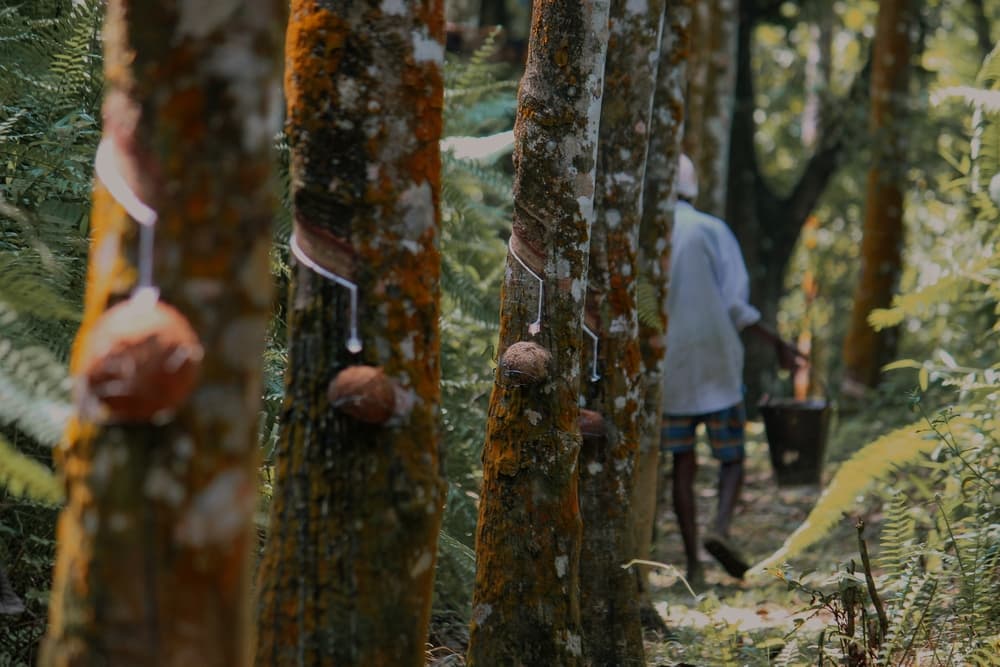
Colombo (AsiaNews) - This year marks the 150th anniversary of rubber cultivation in Sri Lanka, introduced in 1876 in what was then Ceylon. But the country’s rubber industry is now on the brink of collapse due to a range of factors, from a lack of attention from the authorities in recent decades to rising prices; costs are also affected by the ageing of the trees and the “stepchild treatment” meted out to a plantation crop that, more than 70 years ago, was considered as valuable as gold in terms of yield and productivity.
According to Professor Asoka Nugawela, former director of the Sri Lanka Rubber Research Institute, “in the country’s major rubber plantation companies, productivity levels have fallen by around 50% by 2025”. Harin de Silva, president of the Colombo Rubber Traders Association, also recently spoke on the matter, explaining at a press conference: “When I entered the sector in 2002, production stood at 130,000 metric tonnes. Today it has fallen to 70,000 tonnes”.
Damitha Perera, director of Forbes & Walker, adds: “Whilst Sri Lanka exports high-quality crepe rubber latex – the world’s sole producer of this material used in the manufacture of niche products – the country imports cheaper raw materials to meet tyre production needs.” This is a deeply critical situation, which risks overshadowing the celebrations planned throughout the year to mark a century and a half of activity in the sector and the life of a product that has helped the nation “earn valuable foreign currency”. Today, in reality, experts say “the [local] rubber industry is on the brink of collapse”.
Sarangi Dissanayaka and Damith Tennakoon, university lecturers specialising in agricultural matters, explain to AsiaNews that “in 1960 the country exported 107,000 tonnes (107 million kg), meaning that Sri Lanka boasted considerable local production. However, production has now fallen to 69,200 tonnes (69 million kg) from the 98,600 tonnes (98 million kg) recorded between 2014 and 2024”. At present, they continue, most of the raw rubber “is imported” from other foreign producers, and this would not have happened “if the country had increased its own production and cultivable land”. Conversely, the island remains the world’s leading producer and exporter of high-quality crepe rubber latex. It also holds the record as “the world’s largest exporter of solid industrial tyres and the fifth-largest exporter of latex gloves.”
Meanwhile, the researchers continue, “between 2014 and 2024, the area allocated to the rubber industry has also fallen dramatically”, dropping from 133,000 to 84,000 hectares (207,568 acres), whereas in 1960 the area under production stood at 668,213 acres. Natural rubber production and the area under cultivation have recorded negative growth of 2.98% and 3.68% per year respectively over this decade. If this trend continues, the rubber industry, which generated over a billion dollars a year in foreign exchange, supporting thousands of families and preserving our natural environment, “could eventually disappear”, conclude Sarangi and Damith.
According to industry operators Waruna Samarawickrama and Shirantha Alwis, “the drastic decline in land productivity is part of a broader picture of rising costs, particularly in workers’ wages and agrochemicals, without a corresponding increase in selling prices”. The current situation in the rubber plantation sector will significantly reduce revenue generated, whilst increasing expenditure and leading to negative cash flows, including low investment in the sector, even though 2026 marks a century and a half since the first rubber seedlings were introduced to the country. “It was from Sri Lanka that natural rubber cultivation spread to become the current giants of the sector in the Asian region. From the outset, the country’s natural rubber industry – they conclude – has played a key role in economic development, including job creation and the mitigation of the impacts of climate change.”