Milan (AsiaNews) – Violence broke out in recent days in some parts of Syria, which prompted Church leaders in Damascus to celebrate Palm Sunday yesterday in a quiet and low-key manner.
"Now the situation is calm, but it is not yet resolved” because "tempers have not yet calmed,” said Archbishop Jacques Mourad, Syriac Catholic Archbishop of Homs, Hama, and Dabek, speaking AsiaNews.
A climate of "awful" tensions persist, with "attacks and verbal violence," rooted, especially "in the Homs area," in a desire for "revenge,” the prelate lamented. Attacks and abuses against Christians “are taking place in various parts of the country" and are "the result of an injustice" linked to the decision taken by the new leaders to "take away the weapons" of minority groups, entrusting them "to Sunnis”, who are now responsible for security.
This, he warns, is fuelling tensions and encouraging a “desire for revenge" in other groups.
Sectarian tensions, attacks against minorities (from the massacre of Alawites in March last year to violence against Christians, including the suicide attack on the Mar Elias Church in Damascus), and widespread violence have marked the hard rebirth of the "new" Syria.
For more than a year, power has been in the hands of Ahmed al-Sharaa and the Hayat Tahrir al-Sham[*] group (HTS), who overthrew the decades-long regime of Bashar al-Assad in late November and December 2024.
The former dictator fled into exile to Moscow, while the Arab country began a slow and arduous return to the international political, diplomatic, and economic scene.
However, the lifting of Western sanctions and the welcome given by Donald Trump to the current caretaker president (who has never renounced radical Islamism) at the White House have not been enough to guarantee stability and security in the country.
Whether involving Alawites, Kurds, Christians or Druze, conflicts are multiplying with no solution in sight, while gangs linked to the ruling group commit abuses and crimes, often with complete impunity.
The latest incident occurred last week in Suqaylabiyah, a town in the Orontes Valley, Hama governorate, in a district with some 250,000 people, mostly Sunni Muslims, except for the town where the violence took place, which is inhabited mainly by Greek Orthodox Christians.
The clash was sparked by a dispute at a Christian-run liquor store. The sale of alcoholic beverages was recently banned in the capital (except in a few areas).
Moreover, the issue of alcoholic beverages, prohibited by Islam, is not only a point of contention, but also a sign of the extent to which radical Muslims intend to impose their law.
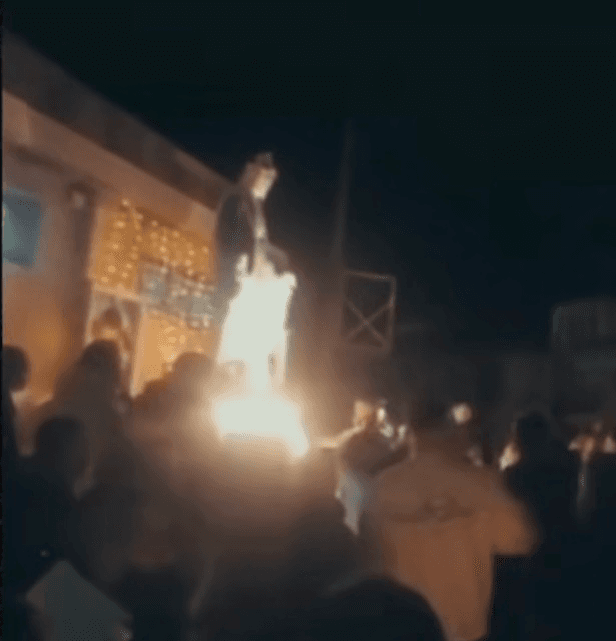
The dispute at the liquor store attracted groups of radicalised youths from other villages in the area, who went on a rampage, destroying a statue of the Virgin Mary in a square (pictured).
Some of the attackers, from the nearby town of Qalaat al-Madiq, also attempted to attack a group of Christian girls, threatening the residents with further and even worse attacks.
The following morning, 28 March, young Christians took to the streets to protest the raids and call for justice.
This incident confirms what Christian activists and experts have repeatedly denounced, namely that Syria is still far from guaranteeing equality and justice for all its communities and that President al-Sharaa does not have full control over certain militias.
The justice system, explained Archbishop Mourad, "doesn't work at all" because there is no clear division of powers, and those who commit crimes are rarely held accountable.
What is more, sectarian tensions have never subsided. They may not be fuelled by the new leadership, but the latter has proved incapable of translating the promises of equality and rights into action.
“This is not the first time," the prelate said, “that young Muslims [in Suqaylabiyah] have attacked or used offensive words towards girls walking freely in the street, triggering a reaction from their Christian peers, sometimes even violent.”
This time, the attackers "showed up in large numbers, armed and on motorcycles, and began breaking up businesses and shops, firing shots into the air, and creating a climate of fear and terror.”
"Security officials didn't arrive immediately.” In fact, “the attackers included members of the security forces and police, who actively participated in this act of persecution. Now the situation is calm, but it's not yet resolved.”
"In Homs, killings occur almost every day," especially of Alawites, but “no one says anything, no one hears the cries of suffering of the mothers or does anything to stop this cycle of revenge; few have the courage to report it. This is an injustice.”
In response to the recent tensions, churches in Damascus that follow Western liturgies decided for security reasons to hold "limited" services without solemn rites or outdoor events over the weekend, which marked the beginning of Holy Week.
“Given the current discouraging circumstances, we have decided, in coordination and agreement with all the churches, that Easter celebrations this year will be limited to prayers only inside the churches," the Greek Catholic Patriarchate in Antioch and the East said in a statement on Saturday.
The measure is further confirmation of the tense climate in the capital, where discontent has been mounting for days among minority Christians over controversial and discriminatory measures taken by the authorities, not least the alcohol ban in the name of Islam.
A Catholic source close to the local Church spoke to AsiaNews about the situation on condition of anonymity.
“When a person believes, silently or openly, that they are the sole guardian of the truth, that they have the right to judge others, classify them, exclude them, or even impose on them a lifestyle they deem right, the issue of faith shifts from being an element of light to a question of power."
"From spiritual source”, religion becomes an “instrument of control," something that "we see clearly around us at present, under the pretext of 'organising society,' but which, in reality, conceals an attempt to impose a single image of God on all."
This, he warns, applies to alcohol but also “when the decision to wear the niqab is seen as ‘retrograde’. In both cases, there are those who believe they possess the truth, and others must follow. Yet, despite all the different images we have of God, the truth remains simple and profound: God created us different. Do not claim ownership of God and do not speak in his name.”
[*] Organisation for the Liberation of the Levant.