








Al-Sharaa’s summits and attacks in Damascus
The bombings in the Syrian capital, coinciding precisely with Macron’s visit and his meeting with Trump in Turkey, have reignited doubts about the extent to which the former jihadist-turned-president truly controls the country. The army is ‘absorbing’ more than sixty militias but without dismantling the local power bases, while international players pursue different objectives regarding the ‘new Syria’.
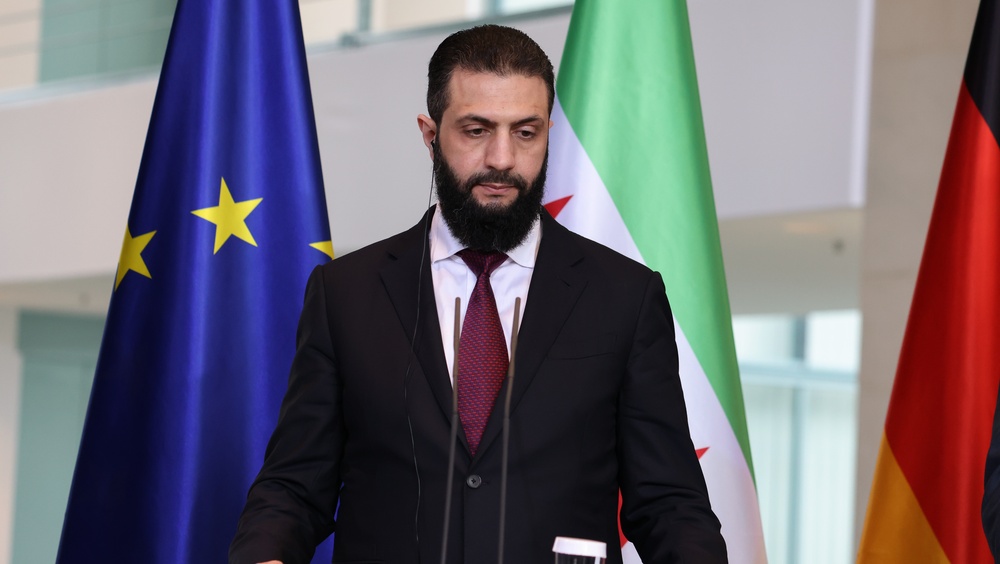
Milan (AsiaNews) – The two explosions that rocked the centre of the Syrian capital, Damascus, on the morning of 7 July, just a few hundred metres from the Four Seasons Hotel where Emmanuel Macron was staying – the first European Union head of state to visit the country since the fall of Bashar al-Assad – were much more than a simple attack.
Rather, they served as a stark reminder – arriving at the most politically sensitive moment – that whilst Syria has emerged from the war, it has not yet emerged from its state of instability. The French president was in the capital to mark Syria’s return to the international stage, discuss reconstruction and sign economic agreements.
The bombs (two powerful but rudimentary devices, which injured 18 people) served as a dramatic reminder that reconstruction, even before economic considerations, remains a matter of security.
The French President chose not to alter his schedule, turning the visit into a political statement: Europe is backing Syria’s new course led by Ahmed al-Sharaa. Behind this decision lies a less obvious but decidedly complex political calculation.
In Paris, they are convinced that the ‘window of opportunity’ to bring Syria back into the Western orbit is narrower than ever, and that leaving it entirely in the hands of Ankara, the Gulf monarchies or a Russia still present in the region would mean relinquishing any capacity to influence the future of the Levant.
This is why Macron decided to put himself on the line. The message is clear: for European capitals today, Syria’s stability carries more weight than the background of whoever governs Damascus.
The most significant strategic move took place a few hours later in Ankara, where the Syrian president arrived under the protective wing of his main regional sponsor, Recep Tayyip Erdogan, to meet Donald Trump on the sidelines of the NATO summit on 7–8 July.
Until a few years ago, Al-Sharaa was known primarily by his nom de guerre, Abu Mohammed al-Jolani, leader of Hayat Tahrir al-Sham and a figure linked to Syrian jihadism.
In Ankara, he met the US President thanks to the mediation of the Turkish leader, who for years has been backing the overthrow of Bashar al-Assad and the network of Sunni armed opposition groups.
It is no coincidence that this face-to-face meeting with Trump, too, came about under Erdogan’s direction (the third such meeting, following the one on 14 May 2025 in Riyadh, Saudi Arabia, and the visit on 10 November last year to Washington, where he was received with full honours in the Oval Office).
Diplomatic sources have for weeks been describing intensive Turkish efforts to establish al-Sharaa as an increasingly reliable interlocutor in the eyes of the US administration and NATO allies.
The Turkish president is now aiming to reap the strategic dividends of his ‘Syrian strategy’: from border security to the reopening of trade corridors to the Arab world.
Trump, as is often the case, summed up the shift in a few colourful remarks. “He’s a tough guy,” he said, speaking of the new Syrian president. He then added: “He’s done an extraordinary job in a year and a half; he’s united the whole country.”
These words capture the most surprising geopolitical turnaround on the international stage: a former jihadist commander transformed, at least in the eyes of the White House and its unpredictable occupant, into the man tasked with rebuilding a state.
Behind those words, however, lies a clear choice of realpolitik. In Washington, the prevailing view is now that the priority is no longer to judge al-Sharaa’s past, but to assess whether he is capable of preventing Syria from descending back into chaos.
The former terrorist is viewed less for what he was and more for his ability to ensure order, contain the threat posed by Islamic State and, above all, prevent Iran and Russia from filling the vacuum left by Assad’s fall.
But behind the diplomacy and expressions of confidence, a fundamental question remains: does al-Sharaa really have a country to govern? The problem is not merely about rebuilding destroyed cities or finding the billions needed to revive the economy.
The real test lies in building a state capable of exercising a monopoly on the use of force. In other words: creating a national army. The old Assad-era armed forces were a rigidly centralised instrument.
Every division was answerable to Damascus, whilst the security services constantly monitored commanders and officers, preventing the emergence of autonomous powers. That model collapsed along with the regime.
The new army appears to be taking shape according to an opposite logic. The more than sixty factions that fought against Assad are gradually being integrated into the Ministry of Defence without actually being disbanded.
They retain their commanders, networks of loyalty and, above all, their roots in the territories from which they hail. This is what some observers are already calling the army of the ‘sons of the people’.
Not a force built from the top down, but a (heterogeneous) collection of armed communities returning to their own towns alongside displaced civilians and seeking to transform themselves into state institutions.
The idea stems from a practical necessity. Damascus has neither the resources nor the coercive apparatus to dismantle all the militias and rebuild the armed forces from scratch.
Al-Sharaa has therefore opted for a pragmatic solution: to incorporate the factions rather than fight them.
This is also why, as Western diplomats monitoring the Syrian situation explain, no one in Damascus is talking any more about rapidly demobilising the militias. That would be the quickest way to provoke a new civil war.
The watchword is rather ‘absorb’, even at the cost of accepting an imperfect army, made up of parallel chains of command and local loyalties.
Within the Syrian ministries, there is an awareness that the process will likely require an entire generation of new officers trained in state academies before military identity prevails over that of the faction from which they originate. The price of this risky strategy could, however, be extremely high.
Each division continues, in fact, to reflect local power balances. The Damascus area is home to the fighters of Jaysh al-Islam, key players in the war in Eastern Ghouta.
To the east, former formations of the Turkish-backed Syrian National Army are operating. In the north-east, the situation remains fluid with the Kurdish-led Syrian Democratic Forces (backed by the US), who are negotiating a gradual integration whilst retaining significant autonomy over the territory.
In the south, in the Druze areas of Suwayda, other local powerbrokers are dealing directly with Damascus from a position of strength, supported by regional balances of power that are far from settled.
In short, rather than a national army, a federation of local armies could emerge, formally answerable to the Ministry of Defence but essentially loyal to their own commanders and respective communities.
This fragility also weighs heavily on international diplomacy. Erdogan sees the new Syria as an opportunity to consolidate his influence and, above all, to limit the political and military clout of the Kurds along Turkey’s southern border.
Trump, on the other hand, is primarily focused on stabilising the country, convinced that a sufficiently strong government can prevent a new phase of civil war and reduce the scope for the return of Islamic State.
But their interests converge only to a certain extent. For Ankara, the Kurdish issue remains a priority.
For Washington, however, it is essential to prevent excessive pressure on the Kurds from creating new tensions or pushing the north-eastern regions towards renewed instability. Caught in the middle is al-Sharaa, called upon to reconcile often incompatible demands.
This is another reason why the attacks in Damascus take on a significance that goes beyond the death toll.
The bombings serve as a reminder that there are still groups capable of striking at the heart of the capital, just as the French president seeks to revive Western investment and the Syrian leader is welcomed to the tables of high-level diplomacy.
This is the crux of the matter that neither the diplomatic consensus reached in Ankara nor Trump’s words of encouragement can resolve.
For Syria’s future will depend not so much on international recognition of its new president as on his ability to convince men who have fought under different banners for fourteen years to accept a single one.

.png)
22/09/2025 18:50
01/02/2008










